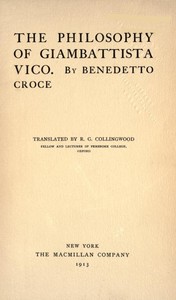
length
102,815 words
a few pages a day
~8 min
finished in
55 days
full read
7h 8m
At Folio's default of ten pages a day, you finish The Philosophy of Giambattista Vico in about 55 days — roughly 8 minutes of reading each morning.
The opening
the first pages of The Philosophy of Giambattista Vico, free
My reasons for believing that a new exposition of Vico's philosophy is required may easily be inferred from the observations on the effects of his work and the biographical notes which form respectively the second and fourth appendices to this volume.
Here I merely wish to state that my exposition is not meant for a summary of Vico's writings work by work and part by part. It rather presupposes an acquaintance with these writings, and, where that is lacking, is intended to induce the reader to procure them in order to follow better and to check the interpretation and estimate of them here offered.
On this supposition, though I have made free use of my author's actual words, especially in the chapters dealing with history, I have not thought it desirable to mark them as quotations except where it was important to emphasise the precise phrase of the original. I have in general combined such passages from fragments scattered over a wide field, sometimes abbreviating, sometimes amplifying, and always freely adding words and phrases of my own by way of commentary: and the continual use of quotation marks would merely have shown up in a manner more wearisome than valuable the reverse side of my embroidery, which any reader who so desires can study by the help of the references given at the end of the book.
In my anxiety to show in every detail of my work, so far as I could, the veneration due to the great name of Vico, I have endeavoured to be brief with the brevity at which he himself aimed as the hall-mark of sterling scientific thought. With this in view I have refrained even from controversy with his various interpreters, and have either contented myself with mere remarks, or more often left my details to be justified by the coherence of my view as a whole. Some of the interpretations supported by me I believe to be the mature fruit of the investigations and controversies which form the greater part of the literature on Vico: all the rest, for which I am personally responsible, and the general idea of my book, I will defend against alternative and contradictory views when occasion arises, should it ever do so, in the detailed and direct manner which I have not thought it necessary to adopt in the course of my exposition. I hope, in fact, that the present work will rekindle rather than quench the discussion of Vico's philosophy: since in him we have, as Goethe calls him, the Altvater whom a nation is happy to possess, and to him we must hark back for a time in order to imbue our modern philosophy with an Italian feeling, however cosmopolitan it may be in thought.
The dedication of my book, besides being a token of respect to one of the greatest modern teachers of the history of philosophy, is intended to express the expectation and hope that the gap in this history to which I have called attention more than once, especially on page 277 of the present volume, may soon be filled.
B. C.
RAIANO (AQUILA),
September 1910.
TRANSLATOR'S NOTE
This volume represents the author's La Filosofia di Giambattista Vico (Bari, 1911) forming vol. ii. of his Saggi filosofici; and also contains a paper read before the Accademia Pontaniana in March 1912 entitled "Le Fonti della gnoseologia vichiana," which figures here as Appendix III. The whole of the translation has been revised by the Author.
R. G. C.
OXFORD, 1913.
CONTENTS
I. VICO'S THEORY OF KNOWLEDGE: FIRST PHASE II. VICO'S THEORY OF KNOWLEDGE: SECOND PHASE III. INTERNAL STRUCTURE OF THE NEW SCIENCE IV. THE IMAGINATIVE FORM OF KNOWLEDGE (POETRY AND LANGUAGE) V. THE SEMI-IMAGINATIVE FORM OF KNOWLEDGE (MYTH AND RELIGION) VI. THE MORAL CONSCIOUSNESS VII. MORALITY AND RELIGION VIII. MORALITY AND LAW IX. THE HISTORICAL ASPECT OF LAW X. PROVIDENCE XI. THE LAW OF REFLUX XII. METAPHYSICS XIII. TRANSITION TO HISTORY: GENERAL CHARACTER OF VICO'S TREATMENT OF HISTORY XIV. NEW PRINCIPLES FOR THE HISTORY OF OBSCURE AND LEGENDARY PERIODS XV. HEROIC SOCIETY XVI. HOMER AND PRIMITIVE POETRY XVII. THE HISTORY OF ROME AND THE RISE OF DEMOCRACY XVIII. THE RETURN OF BARBARISM: THE MIDDLE AGES XIX. VICO AND THE TENDENCIES OF CONTEMPORARY CULTURE XX. CONCLUSION: VICO AND LATER THOUGHT, PHILOSOPHICAL AND HISTORICAL
Keep going from exactly here — Folio remembers your place and serves the next portion tomorrow.
continue reading The Philosophy of Giambattista VicoAbout this free edition
The Philosophy of Giambattista Vico by Benedetto Croce (1866-1952) is free to read in full. Folio serves it in daily portions you can actually finish, tracks your streak and reading position across devices, and reads every page aloud with a built-in narrator. The text comes from Project Gutenberg.
More like The Philosophy of Giambattista Vico
Aesthetic as Science of Expression
Folio
Aesthetic as Science of Expression
Benedetto Croce
Historical Materialism and the Economics of Karl Marx
Folio
Historical Materialism and the Economics of Karl Marx
Benedetto Croce
Ariosto, Shakespeare and Corneille
Benedetto Croce
Theory & History of Historiography
Benedetto Croce
Meditations
Folio
Meditations
Marcus Aurelius
The Enchiridion
Epictetus
Thus Spake Zarathustra
Friedrich Nietzsche
Beyond Good and Evil
Folio
Beyond Good and Evil
Friedrich Nietzsche