Historical Materialism and the Economics of Karl Marx
Folio
Historical Materialism and the Economics of Karl Marx
by Benedetto Croce (1866-1952)
first published 1914 · free to read
length
52,980 words
a few pages a day
~8 min
finished in
28 days
full read
3h 41m
At Folio's default of ten pages a day, you finish Historical Materialism and the Economics of Karl Marx in about 28 days — roughly 8 minutes of reading each morning.
The opening
the first pages of Historical Materialism and the Economics of Karl Marx, free
1. Scope of essay: Labriola's book implies that historical materialism is not a philosophy of history: Distinction between a philosophy of history and philosophising about history: Reason why two have been confused: Materialistic theory of History as stated by Labriola not an attempt to establish a law of history: This contrasted with theories of monists, and teleologists: Engels' statement that it is a new method erroneous: New content not new method 2
2. Historical materialism a mass of new data of which historian becomes conscious: Does not state that history is nothing more than economic history, nor does it provide a theory of history: Is simply investigation of influence economic needs have exercised in history: This view does not detract from its importance 12
3. Questions as to relations between historical materialism and socialism; Only possible connection lies in special historical application: Bearing of historical materialism upon intellectual and moral truth: Throws light on influence of material conditions on their development, but does not demonstrate their relativity: Absolute morality a necessary postulate of socialism 21
CHAPTER II
CONCERNING HISTORICAL MATERIALISM VIEWED AS A SCIENCE OF SOCIAL ECONOMICS
1. Relation between Professor Stammler's book on historical materialism and Marxism: Distinction between pure economics and general historical economics: Socialism not dependent on abstract sociological theory: Stammler's classification of the social sciences: His definition of society: Of social economics: Of social teleology: Nature of Stammler's social science does not provide abstract sociology: Social economics must be either pure economics applied to society or a form of history 25
CHAPTER III
CONCERNING THE INTERPRETATION AND CRITICISM OF SOME CONCEPTS OF MARXISM
I. OF THE SCIENTIFIC PROBLEM IN MARX'S 'DAS KAPITAL'
Das Kapital an abstract investigation: His society is not this or that society: Treats only of capitalist society: Assumption of equivalence between value and labour: Varying views about meaning of this law: Is a postulate or standard of comparison: Question as to value of this standard: Is not a moral ideal: Treats of economic society in so far as is a working society: Shows special way in which problem is solved in capitalist society: Marx's deductions from it 48
II. MARX'S PROBLEM AND PURE ECONOMICS (GENERAL ECONOMIC SCIENCE)
Marxian economics not general economic science and labour-value not a general concept of value: Engels' rejection of general economic law: abstract concepts used by Marx are concepts of pure economics: relation of economic psychology to pure economics: pure economics does not destroy history or progress 66
III. CONCERNING THE LIMITATION OF THE MATERIALISTIC THEORY OF HISTORY
Historical materialism a canon of historical interpretation: Canon does not imply anticipation of results: Question as to how Marx and Engels understood it: Difficulty of ascertaining correctly and method of doing so: How Marxians understand it: Their metaphysical tendency: Instances of confusion of concepts in their writings: Historical materialism has not a special philosophy immanent within it 77
IV. OF SCIENTIFIC KNOWLEDGE IN FACE OF SOCIAL PROBLEMS
Socialism and free trade not scientific deductions: Obsolete metaphysics of old theory of free trade: Basis of modern free trade theories not strictly scientific though only possible one: The desirable is not science nor the practicable: Scientific law only applicable under certain conditions: Element of daring in all action 93
Keep going from exactly here — Folio remembers your place and serves the next portion tomorrow.
continue reading Historical Materialism and the Economics of Karl MarxAbout this free edition
Historical Materialism and the Economics of Karl Marx by Benedetto Croce (1866-1952) is free to read in full. Folio serves it in daily portions you can actually finish, tracks your streak and reading position across devices, and reads every page aloud with a built-in narrator. The text comes from Project Gutenberg.
More like Historical Materialism and the Economics of Karl Marx
Aesthetic as Science of Expression
Folio
Aesthetic as Science of Expression
Benedetto Croce
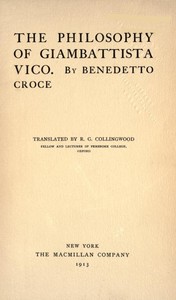
The Philosophy of Giambattista Vico
Benedetto Croce
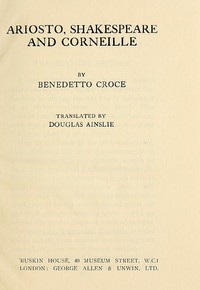
Ariosto, Shakespeare and Corneille
Benedetto Croce
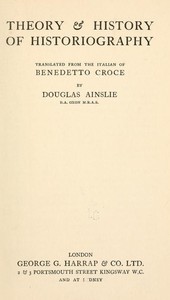
Theory & History of Historiography
Benedetto Croce
Meditations
Folio
Meditations
Marcus Aurelius
The Enchiridion
Epictetus

Thus Spake Zarathustra
Friedrich Nietzsche
Beyond Good and Evil
Folio
Beyond Good and Evil
Friedrich Nietzsche