length
85,966 words
a few pages a day
~8 min
finished in
46 days
full read
5h 58m
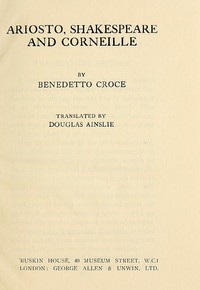
At Folio's default of ten pages a day, you finish Ariosto, Shakespeare and Corneille in about 46 days — roughly 8 minutes of reading each morning.
The opening
the first pages of Ariosto, Shakespeare and Corneille, free
Evviva L'Italia! Italy, Britain's ancient friend and loyal ally, has been an important factor both in winning the war and in bringing it to an earlier conclusion. The War! That greatest practical effort that the world has ever made is now over and we must all work to make it a better place for all to live in.
Now at the hands of her philosopher-critic, Italy offers us a first effort at reconstruction of our world-view with this masterly treatise on the greatest poet of the English-speaking world, so original and so profound that it will serve as guide to generations yet unborn. And it will not be only the critics of Shakespeare who should benefit by this treatise, but all critics and lovers of poetry--including prose--who go beyond the passive stage of mere admiration. The essays on Ariosto and Corneille are also unique and the three together should inaugurate everywhere a new era in literary criticism.
These are the first of Benedetto Croce's literary criticisms to see the light in English.
They are profound and suggestive, because based upon theory, the Theory of Aesthetic, with which some readers will be acquainted in the original, others in the version by the present translator. These will not need to be told that Croce's theory of the independence and autonomy of the aesthetic fact, which is intuition-expression, and of the essentially lyrical character of all art, is the only one that completely and satisfactorily explains the problem of poetry and the fine arts.
But this is not the place for philosophical discussion, although it is important to stress the point, that all criticism is based upon philosophy, and that therefore if the philosophy upon which it is based is unsound, the criticism suffers accordingly. Croce has elsewhere shown that the shortcomings of such critics as Sainte-Beuve, Taine, Lemaître and Brunetière are due to incorrect or insufficient philosophical knowledge and a similar criterion can be applied at home with equal truth.
The translator will be satisfied if the present version receives equal praise from the author with that accorded to the four translations of the Philosophy into English, which Croce has often declared to come more near to his spirit than those in any other language--and he has been translated into all the great European languages--the Aesthetic even into Japanese. The object adhered to in this translation has been as close a cleaving as possible to the original, while preserving a completely idiomatic style and remaining free from all pedantry.
A translation should not in any case be taken as a pouring from the golden into the silver vessel, as used to be erroneously supposed, for Croce has proved that in so far as the translator rethinks the original he is himself a creator. This explains why so many writers have been addicted to translation--in English we have Pope, Fitzgerald, Rossetti, to name but three of many--and the author of the Philosophy of the Spirit, Croce himself, has published a splendid Italian version of Hegel's Encyclopaedia of the Philosophic Sciences.
DOUGLAS AINSLIE.
The Athenaeum, Pall Mall, London, October, 1920.
CONTENTS
PART I
LUDOVICO ARIOSTO
I A CRITICAL PROBLEM II THE LIFE OF THE AFFECTIONS IN ARIOSTO, AND THE HEART OF HIS HEART III THE HIGHEST LOVE: HARMONY IV THE MATERIAL FOR THE HARMONY V THE REALISATION OF HARMONY VI HISTORICAL DISASSOCIATIONS
PART II
WILLIAM SHAKESPEARE
VII THE PRACTICAL PERSONALITY AND THE POETICAL PERSONALITY VIII SHAKESPEAREAN SENTIMENT IX MOTIVES AND DEVELOPMENT OF SHAKESPEARE'S POETRY X THE ART OF SHAKESPEARE XI SHAKESPEAREAN CRITICISM XII SHAKESPEARE AND OURSELVES
PART III
PIERRE CORNEILLE
Keep going from exactly here — Folio remembers your place and serves the next portion tomorrow.
continue reading Ariosto, Shakespeare and CorneilleAbout this free edition
Ariosto, Shakespeare and Corneille by Benedetto Croce (1866-1952) is free to read in full. Folio serves it in daily portions you can actually finish, tracks your streak and reading position across devices, and reads every page aloud with a built-in narrator. The text comes from Project Gutenberg.
More like Ariosto, Shakespeare and Corneille
Aesthetic as Science of Expression
Folio
Aesthetic as Science of Expression
Benedetto Croce
Historical Materialism and the Economics of Karl Marx
Folio
Historical Materialism and the Economics of Karl Marx
Benedetto Croce
The Philosophy of Giambattista Vico
Benedetto Croce
Theory & History of Historiography
Benedetto Croce
Meditations
Folio
Meditations
Marcus Aurelius
The Enchiridion
Epictetus
Thus Spake Zarathustra
Friedrich Nietzsche
Beyond Good and Evil
Folio
Beyond Good and Evil
Friedrich Nietzsche