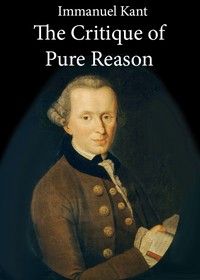
The Critique of Pure Reason
first published 1781 · free to read
length
208,676 words
a few pages a day
~8 min
finished in
110 days
full read
14h 29m
At Folio's default of ten pages a day, you finish The Critique of Pure Reason in about 110 days — roughly 8 minutes of reading each morning.
The opening
the first pages of The Critique of Pure Reason, free
The Principle of the Synthetical Unity of Apperception is the highest Principle of all exercise of the Understanding. § 13
What Objective Unity of Self-consciousness is. § 14
The Logical Form of all Judgements consists in the Objective Unity of Apperception of the Conceptions contained therein. § 15
All Sensuous Intuitions are subject to the Categories, as Conditions under which alone the manifold Content of them can be united in one Consciousness. § 16
Observation. § 17
In Cognition, its Application to Objects of Experience is the only legitimate use of the Category. § 18
Of the Application of the Categories to Objects of the Senses in general. § 20
Transcendental Deduction of the universally possible employment in experience of the Pure Conceptions of the Understanding. § 22
Result of this Deduction of the Conceptions of the Understanding. § 23
BOOK II. Analytic of Principles
INTRODUCTION. Of the Transcendental Faculty of judgement in General.
TRANSCENDENTAL DOCTRINE OF THE FACULTY OF JUDGEMENT OR, ANALYTIC OF PRINCIPLES.
Chapter I. Of the Schematism at of the Pure Conceptions of the Understanding.
Chapter II. System of all Principles of the Pure Understanding.
Section I. Of the Supreme Principle of all Analytical Judgements.
Section II. Of the Supreme Principle of all Synthetical Judgements.
Section III. Systematic Representation of all Synthetical Principles of the Pure Understanding.
Chapter III Of the Ground of the Division of all Objects into Phenomena and Noumena.
APPENDIX.
SECOND DIVISION—TRANSCENDENTAL LOGIC
TRANSCENDENTAL DIALECTIC. INTRODUCTION.
I. Of Transcendental Illusory Appearance.
II. Of Pure Reason as the Seat of Transcendental Illusory Appearance.
TRANSCENDENTAL DIALECTIC—BOOK I—OF THE CONCEPTIONS OF PURE REASON.
Section I—Of Ideas in General.
Section II. Of Transcendental Ideas.
Section III. System of Transcendental Ideas.
TRANSCENDENTAL DIALECTIC—BOOK II—OF THE DIALECTICAL PROCEDURE OF PURE REASON.
Chapter I. Of the Paralogisms of Pure Reason.
Chapter II. The Antinomy of Pure Reason.
Section I. System of Cosmological Ideas.
Section II. Antithetic of Pure Reason.
Section III. Of the Interest of Reason in these Self-contradictions.
Section IV. Of the necessity imposed upon Pure Reason of presenting a Solution of its Transcendental Problems.
Section V. Sceptical Exposition of the Cosmological Problems presented in the four Transcendental Ideas.
Section VI. Transcendental Idealism as the Key to the Solution of Pure Cosmological Dialectic.
Section VII. Critical Solution of the Cosmological Problem.
Section VIII. Regulative Principle of Pure Reason in relation to the Cosmological Ideas.
Section IX. Of the Empirical Use of the Regulative Principle of Reason with regard to the Cosmological Ideas.
I. Solution of the Cosmological Idea of the Totality of the Composition of Phenomena in the Universe.
II. Solution of the Cosmological Idea of the Totality of the Division of a Whole given in Intuition.
III. Solution of the Cosmological Idea of the Totality of the Deduction of Cosmical Events from their Causes.
IV. Solution of the Cosmological Idea of the Totality of the Dependence of Phenomenal Existences.
Chapter III. The Ideal of Pure Reason.
Section I. Of the Ideal in General.
Section II. Of the Transcendental Ideal (Prototypon Trancendentale).
Section III. Of the Arguments employed by Speculative Reason in Proof of the Existence of a Supreme Being.
Keep going from exactly here — Folio remembers your place and serves the next portion tomorrow.
continue reading The Critique of Pure ReasonAbout this free edition
The Critique of Pure Reason by Immanuel Kant (1724-1804) is free to read in full. Folio serves it in daily portions you can actually finish, tracks your streak and reading position across devices, and reads every page aloud with a built-in narrator. The text comes from Project Gutenberg.
More like The Critique of Pure Reason
The Metaphysical Elements of Ethics
Folio
The Metaphysical Elements of Ethics
Immanuel Kant
Perpetual Peace: A Philosophical Essay
Immanuel Kant
The Critique of Practical Reason
Folio
The Critique of Practical Reason
Immanuel Kant
Fundamental Principles of the Metaphysic of Morals
Folio
Fundamental Principles of the Metaphysic of Morals
Immanuel Kant
Kant's Critique of Judgement
Folio
Kant's Critique of Judgement
Immanuel Kant
Meditations
Folio
Meditations
Marcus Aurelius
The Enchiridion
Epictetus
Thus Spake Zarathustra
Friedrich Nietzsche