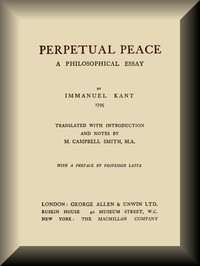
Perpetual Peace: A Philosophical Essay
first published 1795 · free to read
length
54,124 words
a few pages a day
~8 min
finished in
29 days
full read
3h 46m
At Folio's default of ten pages a day, you finish Perpetual Peace: A Philosophical Essay in about 29 days — roughly 8 minutes of reading each morning.
The opening
the first pages of Perpetual Peace: A Philosophical Essay, free
* Italics are denoted by underscores as in italics. * Bold text is denoted by equals as in =bold=. * Small caps are represented in upper case as in SMALL CAPS. * Original spelling was kept, but variant spellings were made consistent when a predominant usage was found. * Obvious printer errors have been silently corrected.
PERPETUAL PEACE
[Illustration]
“For I dipt into the future, far as human eye could see, Saw the Vision of the world, and all the wonder that would be; Saw the heavens fill with commerce, argosies of magic sails, Pilots of the purple twilight, dropping down with costly bales; Heard the heavens fill with shouting, and there rain’d a ghastly dew From the nations’ airy navies grappling in the central blue; Far along the world-wide whisper of the south-wind rushing warm, With the standards of the peoples plunging thro’ the thunder-storm; Till the war-drum throbb’d no longer, and the battle-flags were furl’d In the Parliament of man, the Federation of the world. There the common sense of most shall hold a fretful realm in awe, And the kindly earth shall slumber, lapt in universal law.”
TENNYSON: Locksley Hall.
PERPETUAL PEACE A PHILOSOPHICAL ESSAY
BY IMMANUEL KANT
1795
TRANSLATED WITH INTRODUCTION AND NOTES BY M. CAMPBELL SMITH, M.A.
WITH A PREFACE BY PROFESSOR LATTA
LONDON: GEORGE ALLEN & UNWIN LTD. RUSKIN HOUSE 40 MUSEUM STREET, W.C. NEW YORK: THE MACMILLAN COMPANY
First Edition, 1903 Second Impression, February 1915 Third ” February 1917
PREFACE
This translation of Kant’s essay on Perpetual Peace was undertaken by Miss Mary Campbell Smith at the suggestion of the late Professor Ritchie of St. Andrews, who had promised to write for it a preface, indicating the value of Kant’s work in relation to recent discussions regarding the possibility of “making wars to cease.” In view of the general interest which these discussions have aroused and of the vague thinking and aspiration which have too often characterised them, it seemed to Professor Ritchie that a translation of this wise and sagacious essay would be both opportune and valuable.[1] His untimely death has prevented the fulfilment of his promise, and I have been asked, in his stead, to introduce the translator’s work.
[1] Cf. his Studies in Political and Social Ethics, pp. 169, 170.
This is, I think, the only complete translation into English of Kant’s essay, including all the notes as well as the text, and the translator has added a full historical Introduction, along with numerous notes of her own, so as (in Professor Ritchie’s words) “to meet the needs (1) of the student of Political Science who wishes to understand the relation of Kant’s theories to those of Grotius, Hobbes, Locke, Rousseau etc., and (2) of the general reader who wishes to understand the significance of Kant’s proposals in connection with the ideals of Peace Congresses, and with the development of International Law from the end of the Middle Ages to the Hague Conference.”
Keep going from exactly here — Folio remembers your place and serves the next portion tomorrow.
continue reading Perpetual Peace: A Philosophical EssayAbout this free edition
Perpetual Peace: A Philosophical Essay by Immanuel Kant (1724-1804) is free to read in full. Folio serves it in daily portions you can actually finish, tracks your streak and reading position across devices, and reads every page aloud with a built-in narrator. The text comes from Project Gutenberg.
More like Perpetual Peace: A Philosophical Essay
The Critique of Pure Reason
Immanuel Kant
The Metaphysical Elements of Ethics
Folio
The Metaphysical Elements of Ethics
Immanuel Kant
The Critique of Practical Reason
Folio
The Critique of Practical Reason
Immanuel Kant
Fundamental Principles of the Metaphysic of Morals
Folio
Fundamental Principles of the Metaphysic of Morals
Immanuel Kant
Kant's Critique of Judgement
Folio
Kant's Critique of Judgement
Immanuel Kant
Meditations
Folio
Meditations
Marcus Aurelius

The Enchiridion
Epictetus

Thus Spake Zarathustra
Friedrich Nietzsche