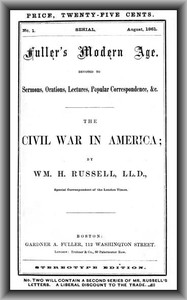
length
81,229 words
a few pages a day
~8 min
finished in
43 days
full read
5h 38m
At Folio's default of ten pages a day, you finish The Civil War in America in about 43 days — roughly 8 minutes of reading each morning.
The opening
the first pages of The Civil War in America, free
In presenting the first number of the Modern Age to the public, I have selected the letters of Mr. Russell, deeming them the most appropriate topic for the times, and worthy of an extensive circulation.
That these letters are written by the most interesting correspondent of the largest, ablest, and most influential paper in the world, is sufficient proof of their merits, and that they come to us “well recommended and properly vouched for.”
The universal “desire for more light” in regard to affairs in the South, will find abundant satisfaction in this brilliant and talented correspondence of a writer, whose chirographical experience in the Crimean war, has so eminently fitted him “to render a fair and impartial account” of the Civil War in America.
Number two of the Modern Age will contain another serial of Mr. Russell’s letters, at the close of which I shall introduce popular Orations and occasional Sermons from our most eminent Divines. The principal design of this work is to preserve in the most convenient form the best thoughts, fresh from the lips of our most gifted men: its peculiar character will prevent a regular monthly publication; yet I hope to be able from the many reports, to elect twelve in the course of a year. No pains will be spared in my endeavors to make it the best and most attractive work of its kind in the country, and I trust it will meet with much favor at the hands of a generous public.
G. A. FULLER.
THE CIVIL WAR IN AMERICA.
LETTER I.
WASHINGTON, March 29, 1861.
IF the intelligent foreigner, who is supposed to make so many interesting and novel observations on the aspect of the countries he visits, and on the manners of the people among whom he travels, were to visit the United States at this juncture, he would fail to detect any marked indication of the extraordinary crisis which agitates the members of the Great Republic, either at the principal emporium of its commerce, or at the city which claims to be the sole seat of its Government. Accustomed to the manifestation of violent animosity and great excitement among the nations of Europe during political convulsions, he would be struck with astonishment, if not moved to doubt, when, casting his eyes on the columns of the multitudinous journals which swarm from every printing-press in the land, he read that the United States were in such throes of mortal agony, that those who knew the constitution of the patient best, were scarce able to prophesy any result except final dissolution. It would require such special acquaintance as only those well versed in the various signs and forms of the dangerous influences which are at work can possess, to appreciate from anything to be seen at New York or Washington, the fact that the vast body politic which sprang forth with the thews and sinews of a giant from the womb of rebellion and revolution; which claimed half the New World as its heritage, and reserved the other as the certain reward of future victory; which extended its commerce over every sea, and affronted the antiquity of international law by bold innovations and defiant enumerations of new principles; which seemed to revel in success of doctrines that the experience of the Old World had proved to be untenable, or had rejected as unsuited to the government of mankind; which had developed all the resources of the physical agencies in manufactures, machinery, electricity, and steam, that could give strength, and wealth, and vigor to its frame;--that this mighty Confederation should suddenly be smitten with a desire to tear its limbs asunder, and was only restrained by the palsy that had smitten some of its members. Certainly no notion of the kind could be formed from actual observation of the words and deeds of men in the cities I have visited, or from any source of information, except the casual conversations of fellow travellers, or the startling headings in the newspapers, which have, however, reduced “sensation” paragraphs and lines to such every-day routine, that the American is no more affected by them than the workman in the proof-house is moved by the constant explosion of cannon. We are accustomed to think the Americans a very excitable people; their personal conflicts, their rapid transitions of feeling, the accounts of their public demonstrations, their energetic expressions, their love of popular assemblies, and the cultivation of the arts, which excite their passions, are favorable to that notion. But New York seems full of divine calm and human phlegm. A panic in Wall Street would, doubtless, create greater external disturbance than seemed to me to exist in its streets and pleasant mansions. No doubt there is, and must be, very great agitation of feeling, and much apprehension; but to the stranger they are not very patent or visible. An elegant refinement, which almost assumes the airs of pococuranteism, reigns in society, only broken by the vehement voices of female patriotism, or the denunciations addressed against the provisions of a tariff, which New York seems unanimous in regarding with hostility and dismay. If Rome be burning, there are hundreds of noble Romans fiddling away in the Fifth Avenue, and in its dependencies, quite satisfied that they cannot join any of the fire companies, and that they are not responsible for the deeds of the “Nero” or “anti-Nero” who applied the torch. They marry, and are given in marriage; they attend their favorite theatres, dramatic or devotional, as the case may be, in the very best coats or bonnets; they eat the largest oysters, drink the best wines, and enjoy the many goods the gods provide them, unmoved by the daily announcement that Fort Sumter is evacuated, that the South is arming, and the Morrill tariff is ruining the trade of the country. And, as they say, “What can we do?” “We are,” they insinuate, “powerless to avert the march of events. We think everybody is wrong. Things were going on very pleasantly when these Abolitionists disturbed the course of trade, and commerce, and speculation with their furious fantasies; and now the South, availing themselves of the opportunity which the blindness of their enemies has afforded them to do what they have wished in their hearts for many a year, start in business for themselves, and will not be readily brought back by the lure of any concession till they find they are unable to get money to pay their way, and resort to measures which may be ruinous to capital, or lead to reconstruction of the Confederation on both sides.”
Keep going from exactly here — Folio remembers your place and serves the next portion tomorrow.
continue reading The Civil War in AmericaAbout this free edition
The Civil War in America by William Howard Russell (1820-1907) is free to read in full. Folio serves it in daily portions you can actually finish, tracks your streak and reading position across devices, and reads every page aloud with a built-in narrator. The text comes from Project Gutenberg.
More like The Civil War in America
The Atlantic Telegraph (1865)
William Howard Russell

The Autobiography of Benjamin Franklin
Benjamin Franklin
Narrative of the Life of Frederick Douglass
Folio
Narrative of the Life of Frederick Douglass
Frederick Douglass
My Bondage and My Freedom
Folio
My Bondage and My Freedom
Frederick Douglass
The Story of My Life
Folio
The Story of My Life
Helen Keller

Up from Slavery
Booker T. Washington
Incidents in the Life of a Slave Girl
Folio
Incidents in the Life of a Slave Girl
Harriet Jacobs
Twelve Years a Slave
Solomon Northup