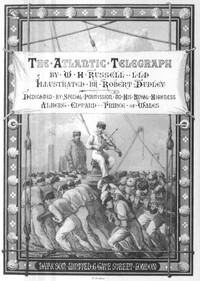
length
58,088 words
a few pages a day
~8 min
finished in
31 days
full read
4h 2m
At Folio's default of ten pages a day, you finish The Atlantic Telegraph (1865) in about 31 days — roughly 8 minutes of reading each morning.
The opening
the first pages of The Atlantic Telegraph (1865), free
Coiling the cable in the after-tank on board the Great Eastern at Sheerness: Visit of H.R.H. The Prince of Wales on May 24 41
Foilhummerum Bay, Valentia, looking seawards from the point at which the cable reaches the shore 44
The cliffs, Foilhummerum Bay: Point of the landing of the shore end of cable, July 22 45
Foilhummerum Bay, Valentia, from Cromwell Fort: The Caroline and boats laying the earth-wire, July 21 48
The Great Eastern under weigh, July 23: Escort and other ships introduced being the Terrible, the Sphinx, the Hawk, and the Caroline 49
Chart, showing the track of the steamship Great Eastern on her voyage from Valentia to Newfoundland 56
Splicing the cable (after the first accident) on board the Great Eastern, July 25 57
View (looking aft) from the port paddle-box of Great Eastern: Showing the trough for cable, etc. 62
The forge on deck; Night of August 9: Preparing the iron plating for capstan 63
Searching for fault after recovery of the cable from the bed of the Atlantic, July 31 72
In the bows, August 2: The cable broken and lost: Preparing to grapple 73
Getting out one of the large buoys for launching, August 2 80
General view of Port Magee, &c., from the heights below Cora Beg: The Caroline laying the shore end of the cable, July 22 81
Interior of one of the tanks on board the Great Eastern: Cable passing out 86
Launching buoy on August 8, in lat. 51° 25´ 30´´; long. 30° 56´ (marking spot where cable had been grappled) 87
Forward deck cleared for the final attempt at grappling, August 11 92
THE
ATLANTIC TELEGRAPH.
I shall not detain the readers of this brief narrative with any sketch of the progress of electrical science. There are text-books, cyclopædias, and treatises full of information concerning the men who worked in early days, and recording the labours of those who still toil on, investigating the laws and developing the applications of the subtle agency which has long attracted the attention of the most acute, ingenious, and successful students of natural philosophy. For the last two centuries the greater number of those whose names are known in science have made electrical experiments a favourite pursuit, or turned to them as an agreeable recreation from severer studies. The rapidity with which electricity travels for considerable distances through insulated conductors soon suggested its use as a means of transmitting intelligence; but the high tension of the currents from friction machines, and the difficulty of insulating the conductors, were practical obstacles to the employment of the devices, some of them ingenious, recommended for that purpose from year to year. Otto Von Guericke, and his globe of sulphur; Grey, with his glass tube and silken cords; and Franklin, with his kite, were, however, the precursors of the philosophers who have done much, and whose successors may yet do much more, for the world. It is not easy to decide whether it is the man who gives a new idea to the world, or he who embodies that idea in a form and turns it into a fact, who is deserving of the credit to be assigned to any invention. A vague expression of belief that a certain end may be attained at a future period by means then unknown does not constitute a discovery, and does not entitle the person who utters it, verbally or in writing, to the honour which is due to him who indicates specifically the way of achieving the object, or who actually accomplishes it by methods he has either invented or applied. The Marquis of Worcester certainly did not invent the steam-engine; neither did Watson, Salva, Sœmmering, or Ronalds, or any other of the many early experimentalists, discover electric telegraphy. But there is a degree of credit due to those who, contending with imperfect materials and want of knowledge, persist in working out their ideas, and succeed in rescuing them from the region of chimæras. The inventions of one render capable of realisation the ideas of another, which but for them had remained dreams and visions. The introduction of a novel product into commerce, or the chance discovery of some property in a common material, may draw a project out of the limbo of impracticabilities. A suggestion at one period may be more valuable than an invention at another, and adaptations may be more useful than discoveries. Indeed, when the testimony on which men’s reputations, as finders or makers, rest, is critically examined, a suspicion is often generated that there have been many Vespuccis in the world who have given names to places they never found, and taken or received credit for what they never did.
Keep going from exactly here — Folio remembers your place and serves the next portion tomorrow.
continue reading The Atlantic Telegraph (1865)About this free edition
The Atlantic Telegraph (1865) by William Howard Russell (1820-1907) is free to read in full. Folio serves it in daily portions you can actually finish, tracks your streak and reading position across devices, and reads every page aloud with a built-in narrator. The text comes from Project Gutenberg.
More like The Atlantic Telegraph (1865)
The Civil War in America
William Howard Russell
The History of the Peloponnesian War
Folio
The History of the Peloponnesian War
Thucydides
The History of Herodotus
Folio
The History of Herodotus
Herodotus
The Gallic Wars
Folio
The Gallic Wars
Julius Caesar
Anabasis
Folio
Anabasis
Xenophon
The Lives of the Twelve Caesars
Folio
The Lives of the Twelve Caesars
Suetonius
Germania
Folio
Germania
Tacitus
The History of the Decline and Fall of the Roman Empire
Edward Gibbon