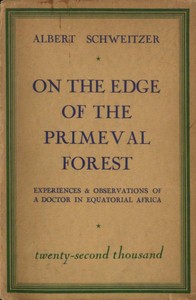
length
54,622 words
a few pages a day
~8 min
finished in
29 days
full read
3h 48m
At Folio's default of ten pages a day, you finish On the edge of the primeval forest in about 29 days — roughly 8 minutes of reading each morning.
The opening
the first pages of On the edge of the primeval forest, free
I gave up my position of professor in the University of Strasbourg, my literary work, and my organ-playing, in order to go as a doctor to Equatorial Africa. How did that come about?
I had read about the physical miseries of the natives in the virgin forests; I had heard about them from missionaries, and the more I thought about it the stranger it seemed to me that we Europeans trouble ourselves so little about the great humanitarian task which offers itself to us in far-off lands. The parable of Dives and Lazarus seemed to me to have been spoken directly of us! We are Dives, for, through the advances of medical science, we now know a great deal about disease and pain, and have innumerable means of fighting them: yet we take as a matter of course the incalculable advantages which this new wealth gives us! Out there in the colonies, however, sits wretched Lazarus, the coloured folk, who suffers from illness {2} and pain just as much as we do, nay, much more, and has absolutely no means of fighting them. And just as Dives sinned against the poor man at his gate because for want of thought he never put himself in his place and let his heart and conscience tell him what he ought to do, so do we sin against the poor man at our gate.
* * * * *
The two or three hundred doctors whom the European States maintain as medical officers in the colonial world could undertake only a very small part (so I argued to myself) of the huge task, even if the majority of them were not there for the benefit, first of all, of the white colonists and the troops. Society in general must recognise this work of humanity to be its task, and there must come a time when doctors go out into the world of their own free will, but sent and supported by society and in numbers corresponding to the need, to work for the benefit of the natives. Then only shall we be recognising and beginning to act upon the responsibility in respect of the coloured races which lies upon us as inheritors of the world's civilisation.
[Sidenote: The decision]
Moved by these thoughts I resolved, when already thirty years old, to study medicine and to put my ideas to the test out there. At the beginning of 1913 I graduated as M.D. That same spring I started with my wife, who had qualified as a nurse, for the River Ogowe in Equatorial Africa, there to begin my active work.
I chose this locality because some Alsatian missionaries in the service of the Paris Evangelical Mission {3} had told me that a doctor was badly needed there on account of the constantly spreading sleeping sickness. The mission was prepared also to place at my disposal one of the houses at their station at Lambarene, and to allow me to build a hospital in their grounds, promising further to give me help with the work.
The actual expenses of the undertaking, however, I had to provide myself, and to that I devoted what I had earned by giving organ concerts, together with the profits from my book on Bach, which had appeared in German, French, and English. In this way the old Thomas Cantor of Leipsig, Johann Sebastian himself, helped me in the provision of a hospital for negroes in the virgin forest, and kind friends in Germany, France, and Switzerland contributed money. When we left Europe, the undertaking was securely financed for two years, the expenses--apart from the journey out and back--being, as I reckoned, about 15,000 francs[1] a year, and this calculation proved to be very nearly correct.
[1] I.e., about £600 p.a. at the then normal rate of exchange.
Keep going from exactly here — Folio remembers your place and serves the next portion tomorrow.
continue reading On the edge of the primeval forestAbout this free edition
On the edge of the primeval forest by Albert Schweitzer (1875-1965) is free to read in full. Folio serves it in daily portions you can actually finish, tracks your streak and reading position across devices, and reads every page aloud with a built-in narrator. The text comes from Project Gutenberg.
More like On the edge of the primeval forest
The quest of the historical Jesus
Albert Schweitzer

The Autobiography of Benjamin Franklin
Benjamin Franklin
Narrative of the Life of Frederick Douglass
Folio
Narrative of the Life of Frederick Douglass
Frederick Douglass
My Bondage and My Freedom
Folio
My Bondage and My Freedom
Frederick Douglass
The Story of My Life
Folio
The Story of My Life
Helen Keller

Up from Slavery
Booker T. Washington
Incidents in the Life of a Slave Girl
Folio
Incidents in the Life of a Slave Girl
Harriet Jacobs
Twelve Years a Slave
Solomon Northup