length
199,079 words
a few pages a day
~8 min
finished in
105 days
full read
13h 49m
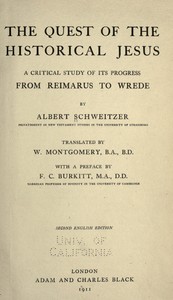
At Folio's default of ten pages a day, you finish The quest of the historical Jesus in about 105 days — roughly 8 minutes of reading each morning.
The opening
the first pages of The quest of the historical Jesus, free
_The book here translated is offered to the English‐speaking public in the belief that it sets before them, as no other book has ever done, the history of the struggle which the best‐equipped intellects of the modern world have gone through in endeavouring to realise for themselves the historical personality of our Lord._
_Every one nowadays is aware that traditional Christian doctrine about Jesus Christ is encompassed with difficulties, and that many of the statements in the Gospels appear incredible in the light of modern views of history and nature. But when the alternative of _“Jesus or Christ”_ is put forward, as it has been in a recent publication, or when we are bidden to choose between the Jesus of history and the Christ of dogma, few except professed students know what a protean and kaleidoscopic figure the _“Jesus of history” is. Like the Christ in the Apocryphal Acts of John, He has appeared in different forms to different minds. “We know Him right well,” says Professor Weinel.(1) What a claim!
_Among the many bold paradoxes enunciated in this history of the Quest, there is one that meets us at the outset, about which a few words may be said here, if only to encourage those to persevere to the end who might otherwise be repelled halfway—the paradox that the greatest attempts to write a Life of Jesus have been written with hate.(2) It is in full accordance with this faith that Dr. Schweitzer gives, in paragraph after paragraph, the undiluted expression of the views of men who agree only in their unflinching desire to attain historical truth. We are not accustomed to be so ruthless in England. We sometimes tend to forget that the Gospel has moved the world, and we think our faith and devotion to it so tender and delicate a thing that it will break, if it be not handled with the utmost circumspection. So we become dominated __ by phrases and afraid of them. Dr. Schweitzer is not afraid of phrases, if only they have been beaten out by real contact with facts. And those who read to the end will see that the crude sarcasm of Reimarus and the unflinching scepticism of Bruno Bauer are not introduced merely to shock and by way of contrast. Each in his own way made a real contribution to our understanding of the greatest historical problem in the history of our race. We see now that the object of attack was not the historical Jesus after all, but a temporary idea of Him, inadequate because it did not truly represent Him or the world in which He lived. And by hearing the writers’ characteristic phrases, uncompromising as they may be, by looking at things for a moment from their own point of view, different as it may be from ours, we are able to be more just, not only to these men of a past age, but also to the great Problem that occupied them, as it also occupies us._
_For, as Father Tyrrell has been pointing out in his last most impressive message to us all, Christianity is at the Cross Roads. If the Figure of our Lord is to mean anything for us we must realise it for ourselves. Most English readers of the New Testament have been too long content with the rough and ready Harmony of the Four Gospels that they unconsciously construct. This kind of _“Harmony” is not a very convincing picture when looked into, if only because it almost always conflicts with inconvenient statements of the Gospels themselves, statements that have been omitted from the “Harmony”, not on any reasoned theory, but simply from inadvertence or the difficulty of fitting them in. We treat the Life of our Lord too much as it is treated in the Liturgical “Gospels”, as a simple series of disconnected anecdotes.
_Dr. Schweitzer’s book does not pretend to be an impartial survey. He has his own solution of the problems, and it is not to be expected that English students will endorse the whole of his view of the Gospel History, any more than his German fellow‐workers have done. But valuable and suggestive as I believe his constructive work to be in its main outlines, I venture to think his grasp of the nature and complexity of the great Quest is even more remarkable, and his exposition of it cannot fail to stimulate us in England. Whatever we may think of Dr. Schweitzer’s solution or that of his opponents, we too have to reckon with the Son of Man who was expected to come before the apostles had gone over the cities of Israel, the Son of Man who would come in His Kingdom before some that heard our Lord speak should taste death, the Son of Man who came to give His life a ransom for many, whom _ they would see hereafter coming with the clouds of heaven. “Who is this Son of Man?” Dr. Schweitzer’s book is an attempt to give the full historical value and the true historical setting to these fundamental words of the Gospel of Jesus.
Keep going from exactly here — Folio remembers your place and serves the next portion tomorrow.
continue reading The quest of the historical JesusAbout this free edition
The quest of the historical Jesus by Albert Schweitzer (1875-1965) is free to read in full. Folio serves it in daily portions you can actually finish, tracks your streak and reading position across devices, and reads every page aloud with a built-in narrator. The text comes from Project Gutenberg.
More like The quest of the historical Jesus

On the edge of the primeval forest
Albert Schweitzer
Meditations
Folio
Meditations
Marcus Aurelius

The Enchiridion
Epictetus

Thus Spake Zarathustra
Friedrich Nietzsche
Beyond Good and Evil
Folio
Beyond Good and Evil
Friedrich Nietzsche
The Genealogy of Morals
Folio
The Genealogy of Morals
Friedrich Nietzsche
The Republic
Folio
The Republic
Plato
Apology
Folio
Apology
Plato