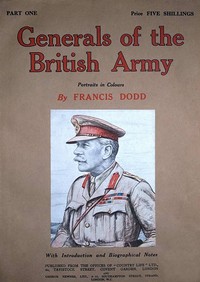
Generals of the British Army
free to read
length
16,457 words
a few pages a day
~8 min
finished in
9 days
full read
1h 9m
At Folio's default of ten pages a day, you finish Generals of the British Army in about 9 days — roughly 8 minutes of reading each morning.
The opening
the first pages of Generals of the British Army, free
This small portrait gallery of British generals represents, in fair epitome, the drama of British history. Each of the officers who figure here has behind him a varied story of fighting in strange places, under all sorts of conditions, as well as in the tense atmosphere of modern scientific war; each of them has first had to struggle against heavy odds before arriving at the conditions which at present obtain on the Western front. Infantrymen, cavalrymen, artillerists, they have come through a fiery trial to command large bodies of troops in the most terrible struggle of our history.
The part of their story that is concerned in this war is memorable, and may we not say it, memorably fine? For these are not the leaders of that vast host whose shadow has hung over Europe for so many years, whose numbers and efficiency have been the evil dream of the international situation; but of that small contingent that, for an ideal, took the field light-heartedly, against the vast German horde. Even the Belgian army was more numerous than the Expeditionary Force that struck its first blow before Mons; and these leaders have memories of the days when it was the equal in nothing, save undaunted courage and tactical ability, of the army in whose path it stood.
They have seen every type of fighting. The war of movements with its swift changes and long hazards was their first experience, an experience that none of those who took part in it will ever forget. For some terrible days the British army stood between the Allies and disaster; but the experience it bought was handed on to the enemy in a series of engagements, the lesson of which he softens by proclaiming the first seven divisions to have been unique. The admission is sufficiently revealing, for the handful of troops ought to have been crushed at Mons; or, escaping thence, should have been penned into Maubeuge; or, evading that trap, should have met annihilation at Le Cateau. But they fought coolly, were manoeuvred skilfully, saving themselves by sheer fighting ability from the tide which threatened to overwhelm them.
Only consummate leaders could have taken an army to the Marne. The army ought to have been wiped out long before. The Germans had fully resolved upon it, they had the men and guns to encompass it, their long-perfected plans depended upon it. The British, wearied by the pressure of a hurried retreat, fought almost without cover against a great concentration of guns. But not only did they fight with superb spirit; they fought also with that instinctive appreciation of tactics which comes from perfectly assimilated experience. When the German blow had over reached itself, the British Generals were able to advance, threaten the left wing of Von Kluck's army when his right was dealing with General Manoury's outflanking movement on the Ourcq, outmanoeuvre and outfight the enemy on the Aisne and secure tactical advantages of the first importance. In the victory of the Marne not the least wonderful of many arresting features was this effective recoil of the army which the Germans had announced to be "dispersed" ten days before.
After the battle of the Aisne, the army, moved en bloc from the heart of France, where the war of positions was beginning to develop, appeared on the extreme left flank of the Allied forces, manoeuvring towards the East in the effort to outflank the Germans. Here, out of a struggle of cross-purposes, there emerged, little by little, the outlines of a titanic battle for the possession of the Channel coast. The Belgian army had fallen back from Antwerp upon the sea, covered by an army corps pushed from the coast in a precarious venture towards Bruges and Ghent; and the handful of British divisions stood between the picked troops of the Germans and the goal they had failed to value before it was lost. Many of these generals tasted the bitter savour of those days when it seemed impossible that flesh and blood could withstand the unceasing onslaught of ever fresh troops--of the Bavarians, the Guard, and picked Prussian regiments--and of the pounding of an overwhelming weight of metal. German critics have said that this army was one of non-commissioned officers, and certainly not even the racial stubbornness could have saved the situation if it had not been wedded to high ability, if undaunted courage had not been equalled by the resolute skill of the command. The first battle of Ypres was the first in which the Germans and the British fought à outrance, and no one to-day is ignorant of the result. The Germans broke off the engagement and thereby acknowledged their defeat. The British had not turned the line. That was impossible with their resources. But they had held the Germans off from their goal and inflicted upon them one of the bloodiest defeats in history.
Keep going from exactly here — Folio remembers your place and serves the next portion tomorrow.
continue reading Generals of the British ArmyAbout this free edition
Generals of the British Army by Francis Dodd (1874-1949) is free to read in full. Folio serves it in daily portions you can actually finish, tracks your streak and reading position across devices, and reads every page aloud with a built-in narrator. The text comes from Project Gutenberg.
More like Generals of the British Army
Admirals of the British Navy
Francis Dodd

The Autobiography of Benjamin Franklin
Benjamin Franklin
Narrative of the Life of Frederick Douglass
Folio
Narrative of the Life of Frederick Douglass
Frederick Douglass
My Bondage and My Freedom
Folio
My Bondage and My Freedom
Frederick Douglass
The Story of My Life
Folio
The Story of My Life
Helen Keller

Up from Slavery
Booker T. Washington
Incidents in the Life of a Slave Girl
Folio
Incidents in the Life of a Slave Girl
Harriet Jacobs

Twelve Years a Slave
Solomon Northup