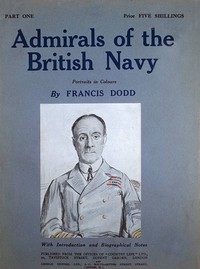
Admirals of the British Navy
free to read
length
12,769 words
a few pages a day
~8 min
finished in
7 days
full read
53 min
At Folio's default of ten pages a day, you finish Admirals of the British Navy in about 7 days — roughly 8 minutes of reading each morning.
The opening
the first pages of Admirals of the British Navy, free
Note: Project Gutenberg also has an HTML version of this file which includes the original illustrations. See 41399-h.htm or 41399-h.zip: (https://www.gutenberg.org/cache/epub/41399/pg41399-images.html) or (https://www.gutenberg.org/files/41399/41399-h.zip)
Images of the original pages are available through Internet Archive. See http://archive.org/details/admiralsofbritis00dodduoft
Transcriber's note:
Text enclosed by underscores is in italics (italics).
Text enclosed by equal signs is in bold face (=bold=).
ADMIRALS OF THE BRITISH NAVY
Portraits in Colours by
FRANCIS DODD
With Introduction and Biographical Notes
Published from the Offices of "Country Life," Ltd., 20, Tavistock Street, Covent Garden, London; and George Newnes, Ltd., 8-11, Southampton Street, Strand, London, W.C. 2. MCMXVII
CONTENTS
INTRODUCTION
I.--JELLICOE, ADMIRAL SIR JOHN R., G.C.B., O.M., G.C.V.O.
II.--BURNEY, ADMIRAL SIR CECIL, G.C.M.G., K.C.B., D.S.O.
III.--MADDEN, ADMIRAL SIR C. E., K.C.B., K.C.M.G., C.V.O.
IV.--PHILLIMORE, REAR-ADMIRAL R. F., C.B., M.V.O.
V.--BACON, VICE-ADMIRAL SIR R. H. S., K.C.B., K.C.V.O., D.S.O.
VI.--DE ROBECK, VICE-ADMIRAL SIR J. M., K.C.B.
VII.--NAPIER, VICE-ADMIRAL T. D. W., C.B., M.V.O.
VIII.--BROCK, REAR-ADMIRAL SIR OSMOND de B., K.C.V.O., C.B., C.M.G.
IX.--HALSEY, REAR-ADMIRAL LIONEL, C.B., C.M.G.
X.--PAKENHAM, VICE-ADMIRAL SIR W. C., K.C.B., K.C.V.O.
XI.--PAINE, COMMODORE GODFREY M., C.B., M.V.O.
XII.--TYRWHITT, COMMODORE SIR R. Y., K.C.B., D.S.O.
INTRODUCTION
If the English are singularly incurious about their Navy, that attitude must not be thought to imply neglect. On the contrary, it is a blend of admiration, respect, and, above all, confidence, induced very largely by the Navy itself. For so long has the Navy minded its own silent business that we--otherwise so inquisitive a people--have come to look upon it as beyond examination and (normally too eager to cut open the drum and explore its resources) trustfully to leave it to its own devices, conscious that those devices are wholly in our own interests. As Matthew Arnold said in his sonnet to Shakespeare:
Others abide our question, thou art free--
so do we address the Navy. For, although it baffles curiosity and ends by eliminating it, it is only to substitute faith. We do not take for granted all the things that we cannot understand: sometimes, indeed, we deny them; but we are satisfied to take for granted the Navy. We know that it is there. Where "there" is we may have no notion; by "there" we mean probably everywhere. The Navy is not only there, the Navy is everywhere, and therefore all's well. That is our simple creed.
A further cause for this quiet and unusual acceptivity is to be found in the medium in which the Navy works--the sea itself. The sea has ever been a barrier to investigation, and the Navy and the sea are one. Public opinion is land-made, and landsmen have neither time nor inclination to cope with the riddles of the ocean, which to most of us is vague and inimical, the home of risks and discomforts which it is wiser to avoid. Well content to consider her, from a safe distance, as a Sphinx, we are very happy that to others has fallen the perilous lot of patrolling her and very full of gratitude for their courage and success.
If the Army, on the contrary, is so much under the microscope, it is largely because it has few or no mysteries. We know the rules. Armies are made up of men like ourselves (only better). They advance as we do, by putting one foot before another, on the solid earth. Their movements are followable, even if we cannot always understand them; daily bulletins are printed in the public Press. But the Navy keeps its secrets. Not only have we no notion where it is, but we should be little the wiser as to its inner purposes if, scanning the illimitable and capricious waves, it should be our fortune to descry here and there a flotilla of its dark grey hulls. Even in harbour most men pointing out a cruiser to their children say "That's a dreadnought"--a state of confusion bred and fostered by the strange, dark, dangerous element in which the Navy has its being.
Keep going from exactly here — Folio remembers your place and serves the next portion tomorrow.
continue reading Admirals of the British NavyAbout this free edition
Admirals of the British Navy by Francis Dodd (1874-1949) is free to read in full. Folio serves it in daily portions you can actually finish, tracks your streak and reading position across devices, and reads every page aloud with a built-in narrator. The text comes from Project Gutenberg.
More like Admirals of the British Navy
Generals of the British Army
Francis Dodd

The Autobiography of Benjamin Franklin
Benjamin Franklin
Narrative of the Life of Frederick Douglass
Folio
Narrative of the Life of Frederick Douglass
Frederick Douglass
My Bondage and My Freedom
Folio
My Bondage and My Freedom
Frederick Douglass
The Story of My Life
Folio
The Story of My Life
Helen Keller

Up from Slavery
Booker T. Washington
Incidents in the Life of a Slave Girl
Folio
Incidents in the Life of a Slave Girl
Harriet Jacobs

Twelve Years a Slave
Solomon Northup