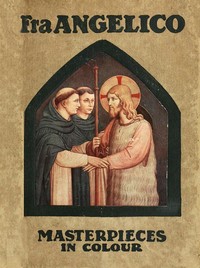
length
8,309 words
a few pages a day
~8 min
finished in
5 days
full read
35 min
At Folio's default of ten pages a day, you finish Fra Angelico in about 5 days — roughly 8 minutes of reading each morning.
The opening
the first pages of Fra Angelico, free
Round the peaceful life and delicately imaginative work of Guido da Vicchio, the Florentine artist who is known to the world at large as Fra Angelico, critics and laymen continue to wage a fierce controversy. While few are heard to deny the merit of the artist's exquisite achievement, it is hard to find, even among those who are interested in early Florentine religion and art, men who can agree about Fra Angelico's positions between the monastery and the studio. "He was a man with a beautiful mind," says one; "a light of the Church, a saint by temperament, and he chanced to be a painter." "You are entirely wrong," says the supporter of the opposing theory; "he was a Heaven-sent artist who chanced to take the vows."
So the schools of art and theology rage furiously together, after the fashion of the two men who approached a statue from opposite sides and quarrelled because one said that the shield carried by the bronze figure was made of gold, and the other said it was made of silver. Incensed by each other's obstinacy they drew swords and fought until they both fell helpless to the ground, only to be assured by a third traveller, who chanced to pass by, that the shield had gold on one side and silver on the other.
[Illustration: PLATE II.--A FIGURE OF CHRIST
Detail from San Marco's Convent in Florence. This striking example of the master's mature art reveals in most favourable light his exquisite conception of Christ. Although this is no more than part of a picture, it has been reproduced here in order that the details of the handling may be appreciated.]
Standing well apart from the enthusiasts of both sides, the average man sees that Fra Angelico was an artist of remarkable attainments and at the same time a devout, God-fearing friar, who seems to have deserved a great part at least of the praise he received from the honeyed pen of Giorgio Vasari. Naturally enough the modern artist finds in Fra Angelico, or "Beato" Angelico as he is sometimes called, one of the most interesting painters of the fifteenth century, and he does not bother about the fact that his hero chanced to be a Dominican brother. Very devout Catholics, on the other hand, will approach Fra Angelico's work on the literary side, and will be profoundly conscious of the fact that he was the first great artist of Italy who, realising the maternity of the Madonna, represented her as a mother full of human affection, and the Holy Child as a beautiful baby boy. It is the painter's abiding claim to our regard that he brought life to his walls and panels, that they present the living, palpitating sentiment of men and women and children, that he painted for us the flowers that blossomed round him and the countryside through which he wandered in his hours of ease. The technical achievement, the gradual but steady improvement in dealing with composition and masses of colour, the extraordinary change from the stiff early figures to the supple ones of the later years, the splendid growth of the artistic sense, from all these things the devotee turns aside. He is not unconscious of the change, for the results achieved by the painter account for the spectator's riper and fuller appreciation, but he cannot analyse it. Of far more moment to him is the thought that all Fra Angelico's life and art were given to the service of the Church, that he laboured without ceasing to present the Gospel stories in the most attractive form, despising the material rewards that awaited such achievements as his. Ease, luxury and the praise of the world at large the Dominican dismissed with fine indifference, believing that his reward would come when his task was ended, and the work of his hands should praise him in the gates. "Here," his orthodox latter-day admirers say, "is the man of noble convictions and pure life, who stood for all that was best in religion. As he chanced to have the gifts of a painter, he used those gifts to develop his mission. Painting with him was no more than a means to an end, and that end was the glorification of God." The dispute must needs be endless; for we cannot see through the four centuries that separate us from the artist, and every man takes from a picture some echo of what he brought to it.
Keep going from exactly here — Folio remembers your place and serves the next portion tomorrow.
continue reading Fra AngelicoAbout this free edition
Fra Angelico by James Mason is free to read in full. Folio serves it in daily portions you can actually finish, tracks your streak and reading position across devices, and reads every page aloud with a built-in narrator. The text comes from Project Gutenberg.
More like Fra Angelico
Bernardino Luini
James Mason

The Autobiography of Benjamin Franklin
Benjamin Franklin
Narrative of the Life of Frederick Douglass
Folio
Narrative of the Life of Frederick Douglass
Frederick Douglass
My Bondage and My Freedom
Folio
My Bondage and My Freedom
Frederick Douglass
The Story of My Life
Folio
The Story of My Life
Helen Keller

Up from Slavery
Booker T. Washington
Incidents in the Life of a Slave Girl
Folio
Incidents in the Life of a Slave Girl
Harriet Jacobs
Twelve Years a Slave
Solomon Northup