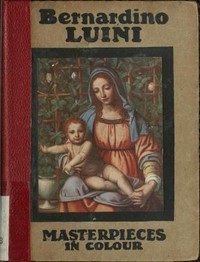
length
8,568 words
a few pages a day
~8 min
finished in
5 days
full read
36 min
At Folio's default of ten pages a day, you finish Bernardino Luini in about 5 days — roughly 8 minutes of reading each morning.
The opening
the first pages of Bernardino Luini, free
In the beginning of the long and fascinating history of Italian Art we see that the spirit of the Renaissance first fluttered over the minds of men much as the spirit of life is said have moved over the face of the waters before the first chapter of creation's marvellous story was written. Beginnings were small, progress was slow, and the lives of the great artists moved very unevenly to their appointed end.
There were some who rose to fame and fortune during their life, and then died so completely that no biography can hope to rouse any interest in their work among succeeding generations.
There were others who worked in silence and without réclame of any sort, content with the respect and esteem of those with whom they came into immediate contact, indifferent to the plaudits of the crowd or the noisy praises of those who are not qualified to judge. True servants of the western world's religion, they translated work into terms of moral life, and moral life into terms of work. Merit like truth will out, and when time has sifted good work from bad and spurious reputations from genuine ones, many men who fluttered the dovecotes of their own generation disappear from sight altogether; some others who wrought unseen, never striving to gain the popular ear or eye, rise on a sudden to heights that might have made them giddy had they lived to be conscious of their own elevation. They were lowly, but their fame inherits the earth.
Bernardino Luini, the subject of this little study, calls us away from the great art centres--from Venice and Florence and Rome; his record was made and is to be found to-day amid the plains of Lombardy. Milan is not always regarded as one of the great art centres of Italy in spite of the Brera, the Ambrosiana, and the Poldi Pezzoli Palace collections, but no lover of pictures ever went for the first time to the galleries of Milan in a reverent spirit and with a patient eye without feeling that he had discovered a painter of genius. He may not even have heard his name before, but he will come away quite determined to learn all he may about the man who painted the wonderful frescoes that seem destined to retain their spiritual beauty till the last faint trace of the design passes beyond the reach of the eye, the man who painted the panel picture of the "Virgin of the Rose Trees," reproduced with other of his master-works in these pages.
[Illustration: PLATE II.--IL SALVATORE
(In the Ambrosiana, Milan)
This picture, one of the treasures of the beautiful collection in the Pinacoteca of Ambrosiana in the Piazza della Rosa, hangs by the same artist's picture of "John the Baptist as a Child." The right hand of Christ is raised in the attitude of benediction, and the head has a curiously genuine beauty. The preservation of this picture is wonderful, the colouring retains much of its early glow. The head is almost feminine in its tenderness and bears a likeness to Luini's favourite model.]
Keep going from exactly here — Folio remembers your place and serves the next portion tomorrow.
continue reading Bernardino LuiniAbout this free edition
Bernardino Luini by James Mason is free to read in full. Folio serves it in daily portions you can actually finish, tracks your streak and reading position across devices, and reads every page aloud with a built-in narrator. The text comes from Project Gutenberg.
More like Bernardino Luini

Fra Angelico
James Mason

The Autobiography of Benjamin Franklin
Benjamin Franklin
Narrative of the Life of Frederick Douglass
Folio
Narrative of the Life of Frederick Douglass
Frederick Douglass
My Bondage and My Freedom
Folio
My Bondage and My Freedom
Frederick Douglass
The Story of My Life
Folio
The Story of My Life
Helen Keller

Up from Slavery
Booker T. Washington
Incidents in the Life of a Slave Girl
Folio
Incidents in the Life of a Slave Girl
Harriet Jacobs
Twelve Years a Slave
Solomon Northup