length
62,916 words
a few pages a day
~8 min
finished in
34 days
full read
4h 22m
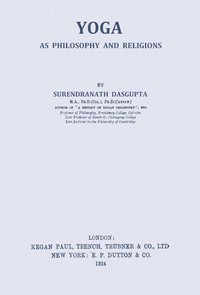
At Folio's default of ten pages a day, you finish Yoga as philosophy and religion in about 34 days — roughly 8 minutes of reading each morning.
The opening
the first pages of Yoga as philosophy and religion, free
This little volume is an attempt at a brief exposition of the philosophical and religious doctrines found in Patañjali’s Yoga-sūtra as explained by its successive commentaries of Vyāsa, Vācaspati, Vijñāna Bhikshu, and others. The exact date of Patañjali cannot be definitely ascertained, but if his identity with the other Patañjali, the author of the Great Commentary (Mahābhāshya) on Pāṇini’s grammar, could be conclusively established, there would be some evidence in our hands that he lived in 150 B.C. I have already discussed this subject in the first volume of my A History of Indian Philosophy, where the conclusion to which I arrived was that, while there was some evidence in favour of their identity, there was nothing which could be considered as being conclusively against it. The term Yoga, according to Patañjali’s definition, means the final annihilation (nirodha) of all the mental states (cittavṛtti) involving the preparatory stages in which the mind has to be habituated to being steadied into particular types of graduated mental states. This was actually practised in India for a long time before Patañjali lived; and it is very probable that certain philosophical, psychological, and practical doctrines associated with it were also current long before Patañjali. Patañjali’s work is, however, the earliest systematic compilation on the subject that is known to us. It is impossible, at this distance of time, to determine the extent to which Patañjali may claim originality. Had it not been for the labours of the later commentators, much of what is found in Patañjali’s aphorisms would have remained extremely obscure and doubtful, at least to all those who were not associated with such ascetics as practised them, and who derived the theoretical and practical knowledge of the subject from their preceptors in an upward succession of generations leading up to the age of Patañjali, or even before him. It is well to bear in mind that Yoga is even now practised in India, and the continuity of traditional instruction handed down from teacher to pupil is not yet completely broken.
If anyone wishes methodically to pursue a course which may lead him ultimately to the goal aimed at by Yoga, he must devote his entire life to it under the strict practical guidance of an advanced teacher. The present work can in no sense be considered as a practical guide for such purposes. But it is also erroneous to think—as many uninformed people do—that the only interest of Yoga lies in its practical side. The philosophical, psychological, cosmological, ethical, and religious doctrines, as well as its doctrines regarding matter and change, are extremely interesting in themselves, and have a definitely assured place in the history of the progress of human thought; and, for a right understanding of the essential features of the higher thoughts of India, as well as of the practical side of Yoga, their knowledge is indispensable.
The Yoga doctrines taught by Patañjali are regarded as the highest of all Yogas (Rājayoga), as distinguished from other types of Yoga practices, such as Haṭhayoga or Mantrayoga. Of these Haṭhayoga consists largely of a system of bodily exercises for warding off diseases, and making the body fit for calmly bearing all sorts of physical privations and physical strains. Mantrayoga is a course of meditation on certain mystical syllables which leads to the audition of certain mystical sounds. This book does not deal with any of these mystical practices nor does it lay any stress on the performance of any of those miracles described by Patañjali. The scope of this work is limited to a brief exposition of the intellectual foundation—or the theoretical side—of the Yoga practices, consisting of the philosophical, psychological, cosmological, ethical, religious, and other doctrines which underlie these practices. The affinity of the system of Sāṃkhya thought, generally ascribed to a mythical sage, Kapila, to that of Yoga of Patañjali is so great on most important points of theoretical interest that they may both be regarded as two different modifications of one common system of ideas. I have, therefore, often taken the liberty of explaining Yoga ideas by a reference to kindred ideas in Sāṃkhya. But the doctrines of Yoga could very well have been compared or contrasted with great profit with the doctrines of other systems of Indian thought. This has purposely been omitted here as it has already been done by me in my Yoga Philosophy in relation to other Systems of Indian Thought, the publication of which has for long been unavoidably delayed. All that may be expected from the present volume is that it will convey to the reader the essential features of the Yoga system of thought. How far this expectation will be realized from this book it will be for my readers to judge. It is hoped that the chapter on “Kapila and Pātañjala School of Sāṃkhya” in my A History of Indian Philosophy (Vol. I. Cambridge University Press, 1922) will also prove helpful for the purpose.
Keep going from exactly here — Folio remembers your place and serves the next portion tomorrow.
continue reading Yoga as philosophy and religionAbout this free edition
Yoga as philosophy and religion by Surendranath Dasgupta (1885-1952) is free to read in full. Folio serves it in daily portions you can actually finish, tracks your streak and reading position across devices, and reads every page aloud with a built-in narrator. The text comes from Project Gutenberg.
More like Yoga as philosophy and religion
A History of Indian Philosophy
Folio
A History of Indian Philosophy
Surendranath Dasgupta
The Upanishads
Folio
The Upanishads
Swami Paramananda
The Yoga Sutras of Patanjali
Folio
The Yoga Sutras of Patanjali
Patañjali
The Persian Mystics: Jami
Folio
The Persian Mystics: Jami
Jami
A Letter to a Hindu
Folio
A Letter to a Hindu
Leo Tolstoy
Lives of the Necromancers
Folio
Lives of the Necromancers
William Godwin
The Witch-Cult in Western Europe
Folio
The Witch-Cult in Western Europe
Margaret Alice Murray
Witch, Warlock, and Magician
Folio
Witch, Warlock, and Magician
W. H. Davenport Adams