Lives of the Necromancers
Folio
Lives of the Necromancers
free to read
length
109,824 words
a few pages a day
~8 min
finished in
58 days
full read
7h 38m
At Folio's default of ten pages a day, you finish Lives of the Necromancers in about 58 days — roughly 8 minutes of reading each morning.
The opening
the first pages of Lives of the Necromancers, free
The main purpose of this book is to exhibit a fair delineation of the credulity of the human mind. Such an exhibition cannot fail to be productive of the most salutary lessons.
One view of the subject will teach us a useful pride in the abundance of our faculties. Without pride man is in reality of little value. It is pride that stimulates us to all our great undertakings. Without pride, and the secret persuasion of extraordinary talents, what man would take up the pen with a view to produce an important work, whether of imagination and poetry, or of profound science, or of acute and subtle reasoning and intellectual anatomy? It is pride in this sense that makes the great general and the consummate legislator, that animates us to tasks the most laborious, and causes us to shrink from no difficulty, and to be confounded and overwhelmed with no obstacle that can be interposed in our path.
Nothing can be more striking than the contrast between man and the inferior animals. The latter live only for the day, and see for the most part only what is immediately before them. But man lives in the past and the future. He reasons upon and improves by the past; he records the acts of a long series of generations: and he looks into future time, lays down plans which he shall be months and years in bringing to maturity, and contrives machines and delineates systems of education and government, which may gradually add to the accommodations of all, and raise the species generally into a nobler and more honourable character than our ancestors were capable of sustaining.
Man looks through nature, and is able to reduce its parts into a great whole. He classes the beings which are found in it, both animate and inanimate, delineates and describes them, investigates their properties, and records their capacities, their good and evil qualities, their dangers and their uses.
Nor does he only see all that is; but he also images all that is not. He takes to pieces the substances that are, and combines their parts into new arrangements. He peoples all the elements from the world of his imagination. It is here that he is most extraordinary and wonderful. The record of what actually is, and has happened in the series of human events, is perhaps the smallest part of human history. If we would know man in all his subtleties, we must deviate into the world of miracles and sorcery. To know the things that are not, and cannot be, but have been imagined and believed, is the most curious chapter in the annals of man. To observe the actual results of these imaginary phenomena, and the crimes and cruelties they have caused us to commit, is one of the most instructive studies in which we can possibly be engaged. It is here that man is most astonishing, and that we contemplate with most admiration the discursive and unbounded nature of his faculties.
But, if a recollection of the examples of the credulity of the human mind may in one view supply nourishment to our pride, it still more obviously tends to teach us sobriety and humiliation. Man in his genuine and direct sphere is the disciple of reason; it is by this faculty that he draws inferences, exerts his prudence, and displays the ingenuity of machinery, and the subtlety of system both in natural and moral philosophy. Yet what so irrational as man? Not contented with making use of the powers we possess, for the purpose of conducing to our accommodation and well being, we with a daring spirit inquire into the invisible causes of what we see, and people all nature with Gods "of every shape and size" and angels, with principalities and powers, with beneficent beings who "take charge concerning us lest at any time we dash our foot against a stone," and with devils who are perpetually on the watch to perplex us and do us injury. And, having familiarised our minds with the conceptions of these beings, we immediately aspire to hold communion with them. We represent to ourselves God, as "walking in the garden with us in the cool of the day," and teach ourselves "not to forget to entertain strangers, lest by so doing we should repel angels unawares."
Keep going from exactly here — Folio remembers your place and serves the next portion tomorrow.
continue reading Lives of the NecromancersAbout this free edition
Lives of the Necromancers by William Godwin (1756-1836) is free to read in full. Folio serves it in daily portions you can actually finish, tracks your streak and reading position across devices, and reads every page aloud with a built-in narrator. The text comes from Project Gutenberg.
Books like Lives of the Necromancers
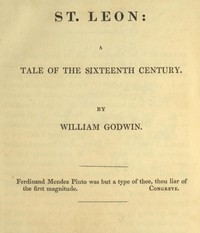
St. Leon: A Tale of the Sixteenth Century
William Godwin
Caleb Williams; Or, Things as They Are
Folio
Caleb Williams; Or, Things as They Are
William Godwin
Damon and Delia: A Tale
Folio
Damon and Delia: A Tale
William Godwin
Imogen: A Pastoral Romance
Folio
Imogen: A Pastoral Romance
William Godwin
Thoughts on Man, His Nature, Productions and Discoveries
Folio
Thoughts on Man, His Nature, Productions and Discoveries
William Godwin
Four Early Pamphlets
Folio
Four Early Pamphlets
William Godwin
The Upanishads
Folio
The Upanishads
Swami Paramananda
The Yoga Sutras of Patanjali
Folio
The Yoga Sutras of Patanjali
Patañjali