length
23,699 words
a few pages a day
~8 min
finished in
13 days
full read
1h 39m
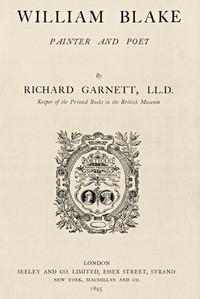
At Folio's default of ten pages a day, you finish William Blake, Painter and Poet in about 13 days — roughly 8 minutes of reading each morning.
The opening
the first pages of William Blake, Painter and Poet, free
The position of William Blake among artists is exceptional. Of no other painter of like distinction, save Dante Rossetti, can it be said that his fame as a poet has fully rivalled his fame as a painter; much less that, in the opinion of some, his fame as a seer ought to have exceeded both. Many painters, from Reynolds downwards, have written admirably upon art; in some instances, notably Haydon’s, the worth of their precepts greatly exceeds that of their performance. But, Rossetti always excepted, perhaps no other painter of great distinction, save Michael Angelo alone, has achieved high renown in poetry, and the compass of Michael Angelo’s poetical work is infinitesimal in comparison with his work as an artist. Again, the literary achievements of an Angelo or a Reynolds admit of clear separation from their performances as artists. The critic who approaches them from the artistic side may, if he pleases, omit the literary side entirely from consideration. This is impossible with Blake, for not only do the artistic and the poetical monuments of his genius nearly balance each other in merit and in their claim upon the attention of posterity, but they are the offspring of the same creative impulse, and are indissolubly fused together by the process adopted for their execution. A study of Blake, therefore, must include more literary discussion than would be allowable in a monograph on any other artist. The poet and painter in Blake, moreover, are but manifestations of the more comprehensive character of seer, which suggests inquiries alien to both these arts; while the personal character of the man is so fascinating, and his intellectual character so perplexing, that the investigation of either of them might afford, and often has afforded, material for a prolonged discussion. In the following pages it will be our object, whenever compelled to quit the safe ground of biographical narrative, to subordinate all else to the consideration of Blake as an artist; but the Blake of the brush is too emphatically the Blake of the pen to be long dissociated from him, and neither can be detached from the background of abnormal visionary faculty.
* * * * *
From a certain point of view, artists may be regarded as divisible into three classes: those who regard the material world as an unquestionable solid reality, whose accurate representation is the one mission of Art; those to whom it is a mere hieroglyphic of an essential existence transcending it; and those who, uniting the two conceptions, are at the same time idealists and realists. The greatest artists generally belong to the latter class, and with reason, for a literal adherence to matter of fact almost implies defect of imagination; while an extravagant idealism may be, to say the least, a convenient excuse for defects of technical skill. It is difficult to know whether to class the works of the very greatest artists as realistic or idealistic. Take Albert Dürer’s Melancholia. It is a hieroglyph, a symbol, an expression of something too intense to be put into words; a delineation of what the painter beheld with the inner eye alone. Yet every detail is as correct and true to fact as the most uninspired Dutchman could have made it. Take Titian’s Bacchus and Ariadne, and observe how separate details which the artist may have actually noticed, are combined into a whole which has never been beheld, save by the spiritual vision, since the last thyrsus was brandished by the last Mænad. Yet, though the creators of such scenes are the greatest, some realists, such as Velasquez, have in virtue of surpassing technical execution asserted a nearly equal rank. The case is different when we come to the enthusiasts and visionaries, whose art is wholly symbolic, who have given us little that can be enjoyed as art for art’s sake, without reference to the ideas of which it is made the vehicle. In many very interesting artists, such as Wiertz and Calvert and Vedder, and in many isolated works of great masters, such as Giorgione’s Venetian Pastoral, the feeling is so much in excess of the execution--admirable as this may be--that the result is rather a poem than a picture. But only one artist who has deliberately made himself the prophet of this tendency, who has avowedly and defiantly discarded all purpose from his works save that of spiritual suggestiveness, seems to have ever been admitted as a candidate for very high artistic honours, and he is our countryman, William Blake.
Keep going from exactly here — Folio remembers your place and serves the next portion tomorrow.
continue reading William Blake, Painter and PoetAbout this free edition
William Blake, Painter and Poet by Richard Garnett (1835-1906) is free to read in full. Folio serves it in daily portions you can actually finish, tracks your streak and reading position across devices, and reads every page aloud with a built-in narrator. The text comes from Project Gutenberg.
More like William Blake, Painter and Poet
Life of John Milton
Folio
Life of John Milton
Richard Garnett
The Age of Dryden
Folio
The Age of Dryden
Richard Garnett
The Autobiography of Benjamin Franklin
Benjamin Franklin
Narrative of the Life of Frederick Douglass
Folio
Narrative of the Life of Frederick Douglass
Frederick Douglass
My Bondage and My Freedom
Folio
My Bondage and My Freedom
Frederick Douglass
The Story of My Life
Folio
The Story of My Life
Helen Keller
Up from Slavery
Booker T. Washington
Incidents in the Life of a Slave Girl
Folio
Incidents in the Life of a Slave Girl
Harriet Jacobs