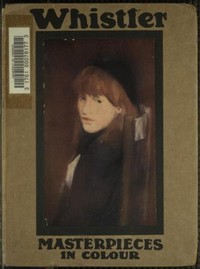
length
10,809 words
a few pages a day
~8 min
finished in
6 days
full read
45 min
At Folio's default of ten pages a day, you finish Whistler in about 6 days — roughly 8 minutes of reading each morning.
The opening
the first pages of Whistler, free
At the time when Rossetti and his circle were foregathering chiefly at Rossetti's house, quiet Chelsea scarcely knew how daily were associations added which will always cluster round her name. Whistler's share in those associations is very large, and he has left in his paintings the memory of many a night, as he returned beside the river. Before Whistler painted it, night was more opaque than it is now. It had been viewed only through the window of tradition. It was left for a man of the world coming out of an artificial London room to paint its stillness, and also to show us that we ourselves had made night more beautiful, with ghostly silver and gold; and to tell us that the dark bridges that sweep into it do not interrupt--that we cannot interrupt, the music of nature.
The figure of Whistler emerges: with his extreme concern as to his appearance, his careful choice of clothes, his hair so carefully arranged. He had quite made up his mind as to the part he intended to play and the light in which he wished to be regarded. He had a dual personality. Himself as he really was and the personality which he put forward as himself. In a sense he never went anywhere unaccompanied; he was followed and watched by another self that would perhaps have been happier at home. Tiring of this he would disappear from society for a time. Other men's ringlets fall into their places accidentally--so it might be with the young Disraeli. Other men's clothes have seemed characteristic without any of this elaborate pose. He chose his clothes with a view to their being characteristic, which is rather different and less interesting than the fact of their becoming so because he, Whistler, wore them. Other men are dandies, with little conception of the grace of their part; with Whistler a supreme artist stepped into the question. He designed himself. Nor had he the illusions of vanity, but a groundwork of philosophy upon which every detail of his personal life was part of an elaborate and delicately designed structure, his art the turret of it all, from which he saw over the heads of others. There is no contradiction between the dandy and his splendid art. He lived as exquisitely and carefully as he painted. Literary culture, merely, in his case was not great perhaps, yet he could be called one of the most cultured figures of his time. In every direction he marked the path of his mind with fastidious borders. And it is interesting that he should have painted the greatest portrait of Carlyle, who, we will say, represented in English literature Goethe's philosophy of culture, which if it has an echo in the plastic arts, has it in the work of Whistler. In his "Heretics" Mr. G. K. Chesterton condemned Whistler for going in for the art of living--I think he says the miserable art of living--I have not seen the book for a long time, but surely the fact that Whistler was more than a private workman, that his temperament had energy enough to turn from the ardours of his work to live this other part of life--indicates extraordinary vitality rather than any weakness. Whistler was never weak: he came very early to an understanding of his limitations, and well within those limitations took his stand. Because of this his art was perfect. In it he declined to dissipate his energy in any but its natural way. In that way he is as supreme as any master. Attacked from another point his whole art seems but a cobweb of beautiful ingenuity--sustained by evasions. Whistler, one thinks, would have been equally happy and meteorically successful in any profession; one can imagine what an enlivening personality his would have been in a Parliamentary debate, and how fascinating. Any public would have suited him. Art was just an accident coming on the top of many other gifts. It took possession of him as his chief gift, but without it he was singularly well equipped to play a prominent part in the world. As things happened all his other energy went to forward, indirectly and directly, the claims of art. Perhaps his methods of self-advancement were not so beautiful as his art, and his wit was of a more robust character. For this we should be very glad; the world would have been too ready to overlook his delicate work--except that it had to feed his inordinate ambition. At first it recognised his wit and then it recognised his art, or did its level best to, in answer to his repeated challenges.
[Illustration: PLATE II.--NOCTURNE, ST. MARK'S, VENICE
(In the possession of John J. Cowan, Esq.)
This picture was first exhibited in the winter of 1886 at the Royal Society of British Artists. The painter's election as President of the Society taking place just after the hanging of the exhibition. A newspaper criticism at the time was to the effect that the only note-worthy fact about the painting was the price, £630, "just about twenty shillings to the square inch." The figure of an investment, we may add, which was to improve beyond the wildest calculations.]
It is easier to explain Whistler's personality than his work. In his lifetime most people had recognised all the force of his personality, but it was not so with his art. In this he is as a player of violin music, or a composer after the fashion of the masters of music--his relationship to the subject which suggests the motif, of course, could not be quite so slight as theirs--but it was their standpoint that he adopted and so approached his art from another direction than the ordinary one. To a great extent he established the unity of the arts. Without being a musical man, through painting he divined the mission of music and passed from the one art almost into the other. And the effort above everything else for self-expression was in its essence a musical one too, as also the fact that he never allowed a line or brushmark to survive that was not as sensitively inspired--played we might almost say--as the touch of a player, playing with great expression, upon the keyboard of his piano. This quality of touch--how much it counts for in the art of Whistler--as it counts in music. It is one of the essential things which we have to understand about his work, to appreciate and enjoy it.
Keep going from exactly here — Folio remembers your place and serves the next portion tomorrow.
continue reading WhistlerAbout this free edition
Whistler by T. Martin Wood (1875-1919) is free to read in full. Folio serves it in daily portions you can actually finish, tracks your streak and reading position across devices, and reads every page aloud with a built-in narrator. The text comes from Project Gutenberg.
More like Whistler

The Autobiography of Benjamin Franklin
Benjamin Franklin
Narrative of the Life of Frederick Douglass
Folio
Narrative of the Life of Frederick Douglass
Frederick Douglass
My Bondage and My Freedom
Folio
My Bondage and My Freedom
Frederick Douglass
The Story of My Life
Folio
The Story of My Life
Helen Keller

Up from Slavery
Booker T. Washington
Incidents in the Life of a Slave Girl
Folio
Incidents in the Life of a Slave Girl
Harriet Jacobs
Twelve Years a Slave
Solomon Northup
The Narrative of Sojourner Truth
Folio
The Narrative of Sojourner Truth
Sojourner Truth