length
12,076 words
a few pages a day
~8 min
finished in
7 days
full read
50 min
At Folio's default of ten pages a day, you finish What I believe in about 7 days — roughly 8 minutes of reading each morning.
The opening
the first pages of What I believe, free
Man is a part of Nature, not something contrasted with Nature. His thoughts and his bodily movements follow the same laws that describe the motions of stars and atoms. The physical world is large compared with Man――larger than it was thought to be in Dante’s time, but not so large as it seemed a hundred years ago. Both upward and downward, both in the large and in the small, science seems to be reaching limits. It is thought that the universe is of finite extent in space, and that light could travel round it in a few hundred millions of years. It is thought that matter consists of electrons and protons, which are of finite size, and of which there are only a finite number in the world. Probably their changes are not continuous, as used to be thought, but proceed by jerks, which are never smaller than a certain minimum jerk. The laws of these changes can apparently be summed up in a small number of very general principles, which determine the past and the future of the world when any small section of its history is known.
Physical science is thus approaching the stage when it will be complete, and therefore uninteresting. Given the laws governing the motions of electrons and protons, the rest is merely geography――a collection of particular facts telling their distribution throughout some portion of the world’s history. The total number of facts of geography required to determine the world’s history is probably finite; theoretically, they could all be written down in a big book to be kept at Somerset House, with a calculating machine attached, which, by turning a handle, would enable the inquirer to find out the facts at other times than those recorded. It is difficult to imagine anything less interesting, or more different from the passionate delights of incomplete discovery. It is like climbing a high mountain and finding nothing at the top except a restaurant where they sell ginger-beer, surrounded by fog but equipped with wireless. Perhaps in the time of Ahmes the multiplication-table was exciting.
Of this physical world, uninteresting in itself, Man is a part. His body, like other matter, is composed of electrons and protons, which, so far as we know, obey the same laws as those not forming part of animals or plants. There are some who maintain that physiology can never be reduced to physics, but their arguments are not very convincing and it seems prudent to suppose that they are mistaken. What we call our “thoughts” seem to depend upon the organization of tracks in the brain in the same sort of way in which journeys depend upon roads and railways. The energy used in thinking seems to have a chemical origin; for instance, a deficiency of iodine will turn a clever man into an idiot. Mental phenomena seem to be bound up with material structure. If this be so, we cannot suppose that a solitary electron or proton can “think”; we might as well expect a solitary individual to play a football match. We also cannot suppose that an individual’s thinking survives bodily death, since that destroys the organization of the brain, and dissipates the energy which utilized the brain-tracks.
God and immortality, the central dogmas of the Christian religion, find no support in science. It cannot be said that either doctrine is essential to religion, since neither is found in Buddhism. (With regard to immortality, this statement in an unqualified form might be misleading, but it is correct in the last analysis). But we in the West have come to think of them as the irreducible minimum of theology. No doubt people will continue to entertain these beliefs, because they are pleasant, just as it is pleasant to think ourselves virtuous and our enemies wicked. But for my part I cannot see any ground for either. I do not pretend to be able to prove that there is no God. I equally cannot prove that Satan is a fiction. The Christian God may exist; so may the Gods of Olympus, or of ancient Egypt, or of Babylon. But no one of these hypotheses is more probable than any other: they lie outside the region of even probable knowledge, and therefore there is no reason to consider any of them. I shall not enlarge upon this question, as I have dealt with it elsewhere.[A]
[A] See my Philosophy of Leibniz, Chapter XV.
Keep going from exactly here — Folio remembers your place and serves the next portion tomorrow.
continue reading What I believeAbout this free edition
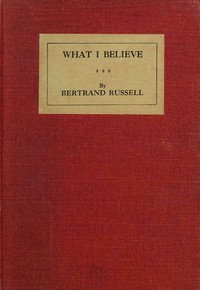
What I believe by Bertrand Russell (1872-1970) is free to read in full. Folio serves it in daily portions you can actually finish, tracks your streak and reading position across devices, and reads every page aloud with a built-in narrator. The text comes from Project Gutenberg.
More like What I believe
The Problems of Philosophy
Folio
The Problems of Philosophy
Bertrand Russell
The Analysis of Mind
Folio
The Analysis of Mind
Bertrand Russell
Mysticism and Logic and Other Essays
Folio
Mysticism and Logic and Other Essays
Bertrand Russell
Proposed Roads to Freedom
Folio
Proposed Roads to Freedom
Bertrand Russell
Free Thought and Official Propaganda
Folio
Free Thought and Official Propaganda
Bertrand Russell
The Practice and Theory of Bolshevism
Folio
The Practice and Theory of Bolshevism
Bertrand Russell
Political Ideals
Folio
Political Ideals
Bertrand Russell

The Problem of China
Bertrand Russell