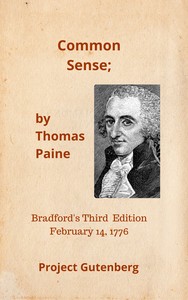
The Writings of Thomas Paine, Complete
free to read
length
403,127 words
a few pages a day
~8 min
finished in
213 days
full read
28h
At Folio's default of ten pages a day, you finish The Writings of Thomas Paine, Complete in about 213 days — roughly 8 minutes of reading each morning.
The opening
the first pages of The Writings of Thomas Paine, Complete, free
THOMAS PAINE, in his Will, speaks of this work as The American Crisis, remembering perhaps that a number of political pamphlets had appeared in London, 1775-1776, under general title of "The Crisis." By the blunder of an early English publisher of Paine's writings, one essay in the London "Crisis" was attributed to Paine, and the error has continued to cause confusion. This publisher was D. I. Eaton, who printed as the first number of Paine's "Crisis" an essay taken from the London publication. But his prefatory note says: "Since the printing of this book, the publisher is informed that No. 1, or first Crisis in this publication, is not one of the thirteen which Paine wrote, but a letter previous to them." Unfortunately this correction is sufficiently equivocal to leave on some minds the notion that Paine did write the letter in question, albeit not as a number of his "Crisis "; especially as Eaton's editor unwarrantably appended the signature "C. S.," suggesting "Common Sense." There are, however, no such letters in the London essay, which is signed "Casca." It was published August, 1775, in the form of a letter to General Gage, in answer to his Proclamation concerning the affair at Lexington. It was certainly not written by Paine. It apologizes for the Americans for having, on April 19, at Lexington, made "an attack upon the King's troops from behind walls and lurking holes." The writer asks: "Have not the Americans been driven to this frenzy? Is it not common for an enemy to take every advantage?" Paine, who was in America when the affair occurred at Lexington, would have promptly denounced Gage's story as a falsehood, but the facts known to every one in America were as yet not before the London writer. The English "Crisis" bears evidence throughout of having been written in London. It derived nothing from Paine, and he derived nothing from it, unless its title, and this is too obvious for its origin to require discussion. I have no doubt, however, that the title was suggested by the English publication, because Paine has followed its scheme in introducing a "Crisis Extraordinary." His work consists of thirteen numbers, and, in addition to these, a "Crisis Extraordinary" and a "Supernumerary Crisis." In some modern collections all of these have been serially numbered, and a brief newspaper article added, making sixteen numbers. But Paine, in his Will, speaks of the number as thirteen, wishing perhaps, in his characteristic way, to adhere to the number of the American Colonies, as he did in the thirteen ribs of his iron bridge. His enumeration is therefore followed in the present volume, and the numbers printed successively, although other writings intervened.
The first "Crisis" was printed in the Pennsylvania Journal, December 19, 1776, and opens with the famous sentence, "These are the times that try men's souls"; the last "Crisis" appeared April 19,1783, (eighth anniversary of the first gun of the war, at Lexington,) and opens with the words, "The times that tried men's souls are over." The great effect produced by Paine's successive publications has been attested by Washington and Franklin, by every leader of the American Revolution, by resolutions of Congress, and by every contemporary historian of the events amid which they were written. The first "Crisis" is of especial historical interest. It was written during the retreat of Washington across the Delaware, and by order of the Commander was read to groups of his dispirited and suffering soldiers. Its opening sentence was adopted as the watchword of the movement on Trenton, a few days after its publication, and is believed to have inspired much of the courage which won that victory, which, though not imposing in extent, was of great moral effect on Washington's little army.
THE CRISIS
THE CRISIS I. (THESE ARE THE TIMES THAT TRY MEN'S SOULS)
THESE are the times that try men's souls. The summer soldier and the sunshine patriot will, in this crisis, shrink from the service of their country; but he that stands it now, deserves the love and thanks of man and woman. Tyranny, like hell, is not easily conquered; yet we have this consolation with us, that the harder the conflict, the more glorious the triumph. What we obtain too cheap, we esteem too lightly: it is dearness only that gives every thing its value. Heaven knows how to put a proper price upon its goods; and it would be strange indeed if so celestial an article as FREEDOM should not be highly rated. Britain, with an army to enforce her tyranny, has declared that she has a right (not only to TAX) but "to BIND us in ALL CASES WHATSOEVER," and if being bound in that manner, is not slavery, then is there not such a thing as slavery upon earth. Even the expression is impious; for so unlimited a power can belong only to God.
Whether the independence of the continent was declared too soon, or delayed too long, I will not now enter into as an argument; my own simple opinion is, that had it been eight months earlier, it would have been much better. We did not make a proper use of last winter, neither could we, while we were in a dependent state. However, the fault, if it were one, was all our own*; we have none to blame but ourselves. But no great deal is lost yet. All that Howe has been doing for this month past, is rather a ravage than a conquest, which the spirit of the Jerseys, a year ago, would have quickly repulsed, and which time and a little resolution will soon recover.
Keep going from exactly here — Folio remembers your place and serves the next portion tomorrow.
continue reading The Writings of Thomas Paine, CompleteAbout this free edition
The Writings of Thomas Paine, Complete by Thomas Paine (1737-1809) is free to read in full. Folio serves it in daily portions you can actually finish, tracks your streak and reading position across devices, and reads every page aloud with a built-in narrator. The text comes from Project Gutenberg.
More like The Writings of Thomas Paine, Complete
Common Sense
Thomas Paine
The Rights of Man
Folio
The Rights of Man
Thomas Paine
The Age of Reason
Folio
The Age of Reason
Thomas Paine
The History of the Peloponnesian War
Folio
The History of the Peloponnesian War
Thucydides
The History of Herodotus
Folio
The History of Herodotus
Herodotus
The Gallic Wars
Folio
The Gallic Wars
Julius Caesar
Anabasis
Folio
Anabasis
Xenophon
The Lives of the Twelve Caesars
Folio
The Lives of the Twelve Caesars
Suetonius