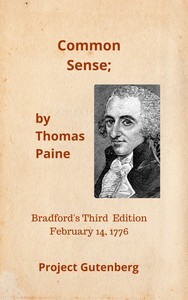
Common Sense
first published 1776 · free to read
length
21,984 words
a few pages a day
~8 min
finished in
12 days
full read
1h 32m
At Folio's default of ten pages a day, you finish Common Sense in about 12 days — roughly 8 minutes of reading each morning.
The opening
the first pages of Common Sense, free
Of the Origin and Design of Government in general, with concise Remarks on the English Constitution. Of Monarchy and Hereditary Succession Thoughts on the present State of American Affairs Of the present Ability of America, with some miscellaneous Reflections
A new edition, with several additions in the body of the work. To which is added an appendix; together with an address to the people called Quakers.
Man knows no Master save creating Heaven Or those whom choice and common good ordain.
Thomson.
PHILADELPHIA
Printed and sold by W. & T. Bradford, February 14, 1776.
MDCCLXXVI
Common Sense By Thomas Paine
INTRODUCTION.
Perhaps the sentiments contained in the following pages, are not yet sufficiently fashionable to procure them general favor; a long habit of not thinking a thing wrong, gives it a superficial appearance of being right, and raises at first a formidable outcry in defense of custom. But the tumult soon subsides. Time makes more converts than reason.
As a long and violent abuse of power, is generally the Means of calling the right of it in question (and in Matters too which might never have been thought of, had not the Sufferers been aggravated into the inquiry) and as the King of England hath undertaken in his own Right, to support the Parliament in what he calls Theirs, and as the good people of this country are grievously oppressed by the combination, they have an undoubted privilege to inquire into the pretensions of both, and equally to reject the usurpation of either.
In the following sheets, the author hath studiously avoided every thing which is personal among ourselves. Compliments as well as censure to individuals make no part thereof. The wise, and the worthy, need not the triumph of a pamphlet; and those whose sentiments are injudicious, or unfriendly, will cease of themselves unless too much pains are bestowed upon their conversion.
The cause of America is in a great measure the cause of all mankind. Many circumstances hath, and will arise, which are not local, but universal, and through which the principles of all Lovers of Mankind are affected, and in the Event of which, their Affections are interested. The laying a Country desolate with Fire and Sword, declaring War against the natural rights of all Mankind, and extirpating the Defenders thereof from the Face of the Earth, is the Concern of every Man to whom Nature hath given the Power of feeling; of which Class, regardless of Party Censure, is the
AUTHOR
P.S. The Publication of this new Edition hath been delayed, with a View of taking notice (had it been necessary) of any Attempt to refute the Doctrine of Independance: As no Answer hath yet appeared, it is now presumed that none will, the Time needful for getting such a Performance ready for the Public being considerably past.
Who the Author of this Production is, is wholly unnecessary to the Public, as the Object for Attention is the Doctrine itself, not the Man. Yet it may not be unnecessary to say, That he is unconnected with any Party, and under no sort of Influence public or private, but the influence of reason and principle.
Philadelphia, February 14, 1776
OF THE ORIGIN AND DESIGN OF GOVERNMENT IN GENERAL, WITH CONCISE REMARKS ON THE ENGLISH CONSTITUTION.
Some writers have so confounded society with government, as to leave little or no distinction between them; whereas they are not only different, but have different origins. Society is produced by our wants, and government by our wickedness; the former promotes our happiness positively by uniting our affections, the latter negatively by restraining our vices. The one encourages intercourse, the other creates distinctions. The first a patron, the last a punisher.
Society in every state is a blessing, but government even in its best state is but a necessary evil; in its worst state an intolerable one; for when we suffer, or are exposed to the same miseries by a government, which we might expect in a country without government, our calamity is heightened by reflecting that we furnish the means by which we suffer. Government, like dress, is the badge of lost innocence; the palaces of kings are built on the ruins of the bowers of paradise. For were the impulses of conscience clear, uniform, and irresistibly obeyed, man would need no other lawgiver; but that not being the case, he finds it necessary to surrender up a part of his property to furnish means for the protection of the rest; and this he is induced to do by the same prudence which in every other case advises him out of two evils to choose the least. Wherefore, security being the true design and end of government, it unanswerably follows that whatever form thereof appears most likely to ensure it to us, with the least expence and greatest benefit, is preferable to all others.
Keep going from exactly here — Folio remembers your place and serves the next portion tomorrow.
continue reading Common SenseAbout this free edition
Common Sense by Thomas Paine (1737-1809) is free to read in full. Folio serves it in daily portions you can actually finish, tracks your streak and reading position across devices, and reads every page aloud with a built-in narrator. The text comes from Project Gutenberg.
Books like Common Sense
The Rights of Man
Folio
The Rights of Man
Thomas Paine
The Age of Reason
Folio
The Age of Reason
Thomas Paine
The Writings of Thomas Paine, Complete
Thomas Paine
The History of the Peloponnesian War
Folio
The History of the Peloponnesian War
Thucydides
The History of Herodotus
Folio
The History of Herodotus
Herodotus
The Gallic Wars
Folio
The Gallic Wars
Julius Caesar
Anabasis
Folio
Anabasis
Xenophon
The Lives of the Twelve Caesars
Folio
The Lives of the Twelve Caesars
Suetonius