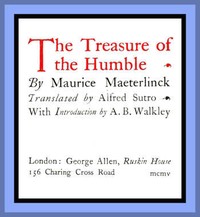
length
33,743 words
a few pages a day
~8 min
finished in
18 days
full read
2h 21m
At Folio's default of ten pages a day, you finish The Treasure of the Humble in about 18 days — roughly 8 minutes of reading each morning.
The opening
the first pages of The Treasure of the Humble, free
WITH M. Maeterlinck as a dramatist the world is pretty well acquainted. This little volume presents him in the new character of a philosopher and an æsthetician. And it is in some sort an ‘apology’ for his theatre, the one being to the other as theory to practice. Reversing the course prescribed by Mr. Squeers for his pupils, M. Maeterlinck, having cleaned w-i-n-d-e-r, winder, now goes and spells it. He began by visualising and synthetising his ideas of life; here you shall find him trying to analyse these ideas and consumed with anxiety to tell us the truth that is in him. It is not a truth for all markets; he is at no pains to conceal that. He appeals, as every mystic must, to the elect; M. Anatole France would say, to the âmes bien nées. If we are not sealed of the tribe of Plotinus, he warns us to go elsewhere. ‘If, plunging thine eyes into thyself—it is this same Plotinus that he is quoting—‘thou dost not feel the charm of beauty, it is in vain that, thy disposition being such, thou shouldst seek the charm of beauty; for thou wouldst seek it only with that which is ugly and impure. Therefore it is that the discourse we hold here is not addressed to all men.’ If we are to follow him in his expedition to a philosophic Ultima Thule, we must have the mind for that adventure. ‘We are here,’ as he tells us elsewhere of the ‘stiff’ but, it seems, ‘admirable’ Ruysbroeck, ‘all of a sudden on the borderland of human thought and far across the Arctic circle of the spirit. There is no ordinary cold, no ordinary dark there, and yet you shall find there naught but flames and light. But to those who arrive without having trained their minds to these new perceptions, the light and the flames are as dark and as cold as though they were painted.’ This means that the intelligence, the reason, will not suffice of themselves; we must have faith. There are passages in the book which may provoke a sniff from Mr. Worldly Wiseman; but we must beware of the Voltairean spirit, or this will be a closed book to us. ‘We live by admiration, hope, and love,’ said Wordsworth. And we understand by them, M. Maeterlinck would add. I fear we are not all of us found worthy of the mystical frame of mind. But it is a psychological fact, like another; and if we can only examine it from the outside, we can at least bring patience and placidity to the task. The point is: has M. Maeterlinck anything to say? It will be found, I think, that he has.
All men, the world has long been assured, are born Aristotelians or Platonists. There cannot be a doubt about M. Maeterlinck’s philosophic birthright. He may say, as Paul Verlaine sang:
Moi, j’allais rêvant du divin Platon, Sous l’œil clignotant des bleus becs de gaz.
More strictly, he is a Neo-Platonist. His remark about the Admirable Ruysbroeck’s idea is equally true of his own. ‘I fancy that all those who have not lived in the intimacy of Plato and of the Neo-Platonists of Alexandria, will not go far with this reading.’ He quotes Plotinus, ‘the great Plotinus, who, of all the intellects known to me, draws the nearest to the divine.’ He cites Porphyry and the Gnostics and Swedenborg. These are not exactly popular authors of the moment. But M. Maeterlinck, it is plain, has devoured them; his is not what Pope called ‘index-learning.’ Plotinus (205-270 A.D.) stood between two worlds, the old and the new; and he made the best of both. He enlarged the boundaries of art by discerning in the idea of beauty an inward and spiritual grace not to be found in the ‘Platonic idea.’ That, too, is what M. Maeterlinck is striving for: a larger idea of beauty, and a better apprehension of its inward and spiritual grace.
His cardinal doctrine will, I conjecture, prove to be something like this. What should be of most account for us all is not external fact, but the supra-sensuous world. ‘What we know is not interesting’; the really interesting things are those which we can only divine—the veiled life of the soul, the crepuscular region of subconsciousness, our ‘borderland’ feelings, all that lies in the strange ‘neutral zone’ between the frontiers of consciousness and unconsciousness. The mystery of life is what makes life worth living. ‘’Twas a little being of mystery, like every one else,’ says the old King Arkel of the dead Mélisande. We are such stuff as dreams are made of, might be the ‘refrain’ of all M. Maeterlinck’s plays, and of most of these essays. He is penetrated by the feeling of the mystery in all human creatures, whose every act is regulated by far-off influences and obscurely rooted in things unexplained. Mystery is within us and around us. Of reality we can only get now and then the merest glimpse. Our senses are too gross. Between the invisible world and our own there is doubtless an intimate concordance; but it escapes us. We grope among shadows towards the unknown. Even the new conquests of what we vainly suppose to be ‘exact’ thought only deepen the mystery of life. There is, for example, the Schopenhauerian theory of love. We had fancied we could at least choose our loves in freedom: but ‘we are told that a thousand centuries divide us from ourselves when we choose the woman we love, and that the first kiss of the betrothed is but the seal which thousands of hands, craving for birth, have impressed upon the lips of the mother they desire.’ And so with the ‘heredity’ of the men of science. ‘We know that the dead do not die. We know that it is not in our churches they are to be found, but in the houses, the habits of us all.’ What was there in the old notion of Destiny so mysterious as this double thraldom of ours—thraldom to the dead and to the unborn? Conclusion: mysticism is your only wear. In the mystics alone is certitude. ‘If it be true, as has been said, that every man is a Shakespeare in his dreams, we have to ask ourselves whether every man, in his waking life, is not an inarticulate mystic, a thousandfold more transcendental than those circumscribed by speech.’ In silence is our only chance of knowing one another. And ‘mystic truths have over ordinary truths a strange privilege; they can neither age nor die.’ From all this you see M. Maeterlinck’s train of thought. He would fix our minds upon the obscure, pre-conscious, what M. Faguet calls the incunabulary life of the soul. He finds no epithets too fine for this: the higher life, the transcendental life, the divine life, the absolute life.
Keep going from exactly here — Folio remembers your place and serves the next portion tomorrow.
continue reading The Treasure of the HumbleAbout this free edition
The Treasure of the Humble by Maurice Maeterlinck (1862-1949) is free to read in full. Folio serves it in daily portions you can actually finish, tracks your streak and reading position across devices, and reads every page aloud with a built-in narrator. The text comes from Project Gutenberg.
More like The Treasure of the Humble
Ruysbroeck and the Mystics
Maurice Maeterlinck
The Unknown Guest
Folio
The Unknown Guest
Maurice Maeterlinck
Wisdom and Destiny
Folio
Wisdom and Destiny
Maurice Maeterlinck
Our Friend the Dog
Maurice Maeterlinck
The Buried Temple
Folio
The Buried Temple
Maurice Maeterlinck
Death
Maurice Maeterlinck
The Inner Beauty
Folio
The Inner Beauty
Maurice Maeterlinck
Our Eternity
Maurice Maeterlinck