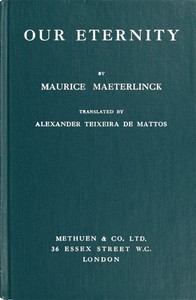
length
34,025 words
a few pages a day
~8 min
finished in
18 days
full read
2h 22m
At Folio's default of ten pages a day, you finish Our Eternity in about 18 days — roughly 8 minutes of reading each morning.
The opening
the first pages of Our Eternity, free
That is where we stand. For us, death is the one event that counts in our life and in our universe. It is the point whereat all that escapes our vigilance unites and conspires against our happiness. The more our thoughts struggle to turn away from it, the closer do they press around it. The more we dread it, the more dreadful it becomes, for it but thrives on our fears. He who seeks to forget it has his memory filled with it; he who tries to shun it meets naught else. It clouds everything with its shadow. But though we think of death incessantly, we do so unconsciously, without learning to know death. We compel our attention to turn its back upon it, instead of going to it with uplifted head. All the forces which might avail to face death we exhaust in averting our will from it. We deliver death into the groping hands of instinct and we grant it not one hour of our intelligence. Is it surprising that the idea of death, which should be the most perfect and the most luminous of ideas—being the most persistent and the most inevitable—remains the flimsiest and the only one that is a laggard? How should we know the one power which we never look in the face? How could it have profited by gleams kindled only to help us escape it? To fathom its abysses, we wait until the most enfeebled, the most disordered moments of our life arrive. We do not think of death until we have no longer the strength, I will not say, to think, but even to breathe. A man returning among us from another century would have difficulty in recognizing, in the depths of a present-day soul, the image of his gods, of his duty, of his love or of his universe; but the figure of death, when everything has changed around it and when even that which composes it and upon which it depends has vanished, he would find almost untouched, rough-drawn as it was by our fathers, hundreds, nay, thousands of years ago. Our intelligence, grown so bold and active, has not worked upon this figure, has not, so to speak, retouched it in any way. Though we may no longer believe in the tortures of the damned, all the vital cells of the most sceptical among us are still steeped in the appalling mystery of the Hebrew Sheol, the pagan Hades, or the Christian Hell. Though it may no longer be lighted by very definite flames, the gulf still opens at the end of life and, if less known, is all the more formidable. And, therefore, when the impending hour strikes to which we dared not raise our eyes, everything fails us at the same time. Those two or three uncertain ideas whereon, without examining them, we had meant to lean give way like rushes beneath the weight of the last minutes. In vain we seek a refuge among reflexions that are illusive or are strange to us and do not know the roads to our heart. No one awaits us on the last shore where all is unprepared, where naught remains afoot save terror.
3
Bossuet, the great poet of the tomb, says:
“It is not worthy of a Christian”—and I would add, of a man—“to postpone his struggle with death until the moment when it arrives to carry him off.”
It were a salutary thing for each of us to work out his idea of death in the light of his days and the strength of his intelligence and stand by it. He would say to death:
“I know not who you are, or I would be your master; but, in days when my eyes saw clearer than to-day, I learnt what you were not: that is enough to prevent you from becoming mine.”
He would thus bear, graven on his memory, a tried image against which the last agony would not prevail and from which the phantom-stricken eyes would draw fresh comfort. Instead of the terrible prayer of the dying, which is the prayer of the depths, he would say his own prayer, that of the peaks of his existence, where would be gathered, like angels of peace, the most lucid, the most rarefied thoughts of his life. Is not that the prayer of prayers? After all, what is a true and worthy prayer, if not the most ardent and disinterested effort to reach and grasp the unknown?
4
“The doctors and the priests,” said Napoleon, “have long been making death grievous.”
And Bacon wrote:
“Pompa mortis magis terret quam mors ipsa.”
Let us, then, learn to look upon death as it is in itself, free from the horrors of matter and stripped of the terrors of the imagination. Let us first get rid of all that goes before and does not belong to it. Thus, we impute to it the tortures of the last illness; and that is not just. Illnesses have nothing in common with that which ends them. They form part of life and not of death. We readily forget the most cruel sufferings that restore us to health; and the first sun of convalescence destroys the most unbearable memories of the chamber of pain. But let death come; and at once we overwhelm it with all the evil done before it. Not a tear but is remembered and used as a reproach, not a cry of pain but becomes a cry of accusation. Death alone bears the weight of the errors of nature or the ignorance of science that have uselessly prolonged torments in whose name we curse death because it puts a term to them.
5
Keep going from exactly here — Folio remembers your place and serves the next portion tomorrow.
continue reading Our EternityAbout this free edition
Our Eternity by Maurice Maeterlinck (1862-1949) is free to read in full. Folio serves it in daily portions you can actually finish, tracks your streak and reading position across devices, and reads every page aloud with a built-in narrator. The text comes from Project Gutenberg.
More like Our Eternity
The Treasure of the Humble
Maurice Maeterlinck
Ruysbroeck and the Mystics
Maurice Maeterlinck
The Unknown Guest
Folio
The Unknown Guest
Maurice Maeterlinck
Wisdom and Destiny
Folio
Wisdom and Destiny
Maurice Maeterlinck
Our Friend the Dog
Maurice Maeterlinck
The Buried Temple
Folio
The Buried Temple
Maurice Maeterlinck
Death
Maurice Maeterlinck
The Inner Beauty
Folio
The Inner Beauty
Maurice Maeterlinck