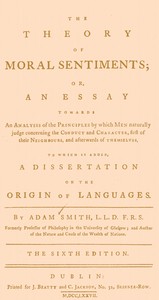
The Theory of Moral Sentiments
free to read
length
117,352 words
a few pages a day
~8 min
finished in
62 days
full read
8h 9m
At Folio's default of ten pages a day, you finish The Theory of Moral Sentiments in about 62 days — roughly 8 minutes of reading each morning.
The opening
the first pages of The Theory of Moral Sentiments, free
Of the effects of prosperity and adversity upon the judgment of mankind with regard to the propriety of action; and why it is more easy to obtain their approbation in the one state than in the other 64
CHAP. I. _That though our sympathy with sorrow is generally a more lively sensation than our sympathy with joy, it commonly falls much more short of the violence of what is naturally felt by the person principally concerned_ ibid.
CHAP. II. Of the origin of ambition, and of the distinction of ranks 74
CHAP. III. Of the stoical philosophy 89
PART II.
Of Merit and Demerit; or of the objects of reward and punishment.
SECTION I.
Of the sense of merit and demerit 97
CHAP. I. _That whatever appears to be the proper object of gratitude, appears to deserve reward; and that, in the same manner, whatever appears to be the proper object of resentment, appears to deserve punishment_ 98
CHAP. II. Of the proper objects of gratitude and resentment 102
CHAP. III. _That where there is no approbation of the conduct of the person who confers the benefit, there is little sympathy with the gratitude of him who receives it: and that, on the contrary, where there is no disapprobation of the motives of the person who does the mischief, there is no sort of sympathy with the resentment of him who suffers it_ 106
CHAP. IV. Recapitulation of the foregoing chapters 109
CHAP. V. The analysis of the sense of merit and demerit 112
SECTION II.
Of justice and beneficence 119
CHAP. I. Comparison of those two virtues ibid.
CHAP. II. Of the sense of justice, of remorse, and of the consciousness of merit 126
CHAP. III. Of the utility of this constitution of nature 132
SECTION III.
Of the influence of fortune upon the sentiments of mankind, with regard to the merit or demerit of actions 145
CHAP. I. Of the causes of this influence of fortune 148
CHAP. II. Of the extent of this influence of fortune 154
CHAP. III. Of the final cause of this irregularity of sentiments 167
PART III.
Of the foundation of our judgments concerning our own sentiments and conduct, and of the sense of duty.
CHAP. I. Of the consciousness of merited praise or blame 173
CHAP. II. In what manner our own judgments refer to what ought to be the judgments of others: and of the origin of general rules 180
CHAP. III. Of the influence and authority of the general rules of morality, and that they are justly regarded as the laws of the Deity 207
CHAP. IV. In what cases the sense of duty ought to be the sole principle of our conduct; and in what cases it ought to concur with other motives 223
PART IV.
Of the effect of utility upon the sentiments of approbation.
CHAP. I. Of the beauty which the appearance of Utility bestows upon all the productions of art, and of the extensive influence of this species of beauty 237
CHAP. II. Of the beauty which the appearance of utility bestows upon the characters and actions of men; and how far the perception of this beauty may be regarded as one of the original principles of approbation 250
PART V.
Of the influence of custom and fashion upon the sentiments of moral approbation and disapprobation.
CHAP. I. Of the influence of custom and fashion upon our notions of beauty and deformity 261
CHAP. II. Of the influence of custom and fashion upon moral sentiments 271
PART VI.
Of Systems of Moral Philosophy.
SECTION I.
Of the questions which ought to be examined in a theory of moral sentiments 291
SECTION II.
Of the different accounts which have been given of the nature of virtue 294
CHAP. I. Of those systems which make virtue consist in propriety 295
Keep going from exactly here — Folio remembers your place and serves the next portion tomorrow.
continue reading The Theory of Moral SentimentsAbout this free edition
The Theory of Moral Sentiments by Adam Smith (1723-1790) is free to read in full. Folio serves it in daily portions you can actually finish, tracks your streak and reading position across devices, and reads every page aloud with a built-in narrator. The text comes from Project Gutenberg.
More like The Theory of Moral Sentiments
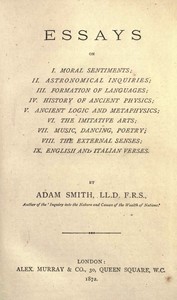
The Essays of Adam Smith
Adam Smith

An Inquiry into the Nature and Causes of the Wealth of Nations
Adam Smith
Meditations
Folio
Meditations
Marcus Aurelius

The Enchiridion
Epictetus

Thus Spake Zarathustra
Friedrich Nietzsche
Beyond Good and Evil
Folio
Beyond Good and Evil
Friedrich Nietzsche
The Genealogy of Morals
Folio
The Genealogy of Morals
Friedrich Nietzsche
The Republic
Folio
The Republic
Plato