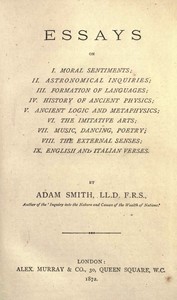
The Essays of Adam Smith
free to read
length
242,744 words
a few pages a day
~8 min
finished in
128 days
full read
16h 51m
At Folio's default of ten pages a day, you finish The Essays of Adam Smith in about 128 days — roughly 8 minutes of reading each morning.
The opening
the first pages of The Essays of Adam Smith, free
ADAM SMITH, the author of these Essays and of the 'Inquiry into the Nature and Causes of the Wealth of Nations,' was born at Kirkaldy, June 5, 1723, a few months after the death of his father. He was a sickly child, and indulged by his mother, who was the object of his filial gratitude for sixty years. When about three years old, and at the house of Douglass of Strathenry, his mother's brother, he was carried off by tinkers or gipsies, but soon recovered from them. At the burgh school of his native town he made rapid progress, and soon attracted notice by his passion for books, and by the extraordinary powers of his memory. His weakness of body prevented him joining in athletic sports, but his generous and friendly temperament made him a favourite with his schoolmates; and he was noted then, as through after life, for absence in company and a habit of speaking to himself when alone. From the grammar school of Kirkaldy, he was sent, in 1737, to the University of Glasgow, whence, in 1740, he went to Baliol College, Oxford, enjoying an exhibition on the Snell foundation. When at Glasgow College, his favourite studies were mathematics and natural philosophy, but that did not long divert his mind from pursuits more congenial to him, more particularly the political history of mankind, which gave scope to the power of his comprehensive genius, and gratified his ruling passion of contributing to the happiness and the improvement of society. To his early taste for Greek generally, may be due the clearness and fulness with which he states his political reasonings. At Oxford he employed himself frequently in the practice of translation, with a view to the improvement of his own style, and used to commend such exercises to all who cultivate the art of composition. He also cultivated with the greatest care the study of languages; and his knowledge of them led him to a peculiar experience in everything that could illustrate the institutions, the manners, and the ideas of different ages and nations.
After a residence at Oxford of seven years, he returned to Kirkaldy, and lived two years with his mother, engaged in studies, but without any fixed plan for his future life. He had been originally destined for the Church of England; but not finding the ecclesiastical profession suitable to his taste, he took chance of obtaining some of those moderate preferments, to which literary attainments lead in Scotland. Removing to Edinburgh in 1748, he read lectures on rhetoric and belles lettres, under the patronage of Lord Kames; and when in Edinburgh became intimate with David Hume.
In 1751 he was elected Professor of Logic in the University of Glasgow; and, the year following, he became Professor of Moral Philosophy there; a situation he held for thirteen years, and used to look back on as the most useful and happy of his life; and, though but a narrow scene for his ambition, may have led to the future eminence of his literary character. In delivering his lectures, Mr. Smith trusted {2} almost entirely to extemporary elocution. His manner, though not graceful, was plain and unaffected, and he never failed to interest his hearers. Each discourse consisted commonly of several distinct propositions, which he successively endeavoured to prove and illustrate. At first he often appeared to speak with hesitation; but, as he advanced, the matter seemed to crowd upon him, his manner became warm and animated, and his expression easy and fluent. His reputation as a philosopher attracted a multitude of students from a great distance to the University; and those branches of science which he taught became fashionable, and his opinions were the chief topics of discussion in the clubs and literary societies of Glasgow. While Adam Smith became thus eminent as a public lecturer, he was gradually laying the foundation of a more extensive reputation by preparing for the press his System of Morals; and the first edition of his Essays appeared in **1759, under the title of THE THEORY OF MORAL SENTIMENTS.
Keep going from exactly here — Folio remembers your place and serves the next portion tomorrow.
continue reading The Essays of Adam SmithAbout this free edition
The Essays of Adam Smith by Adam Smith (1723-1790) is free to read in full. Folio serves it in daily portions you can actually finish, tracks your streak and reading position across devices, and reads every page aloud with a built-in narrator. The text comes from Project Gutenberg.
More like The Essays of Adam Smith
The Theory of Moral Sentiments
Adam Smith
An Inquiry into the Nature and Causes of the Wealth of Nations
Adam Smith
Meditations
Folio
Meditations
Marcus Aurelius
The Enchiridion
Epictetus
Thus Spake Zarathustra
Friedrich Nietzsche
Beyond Good and Evil
Folio
Beyond Good and Evil
Friedrich Nietzsche
The Genealogy of Morals
Folio
The Genealogy of Morals
Friedrich Nietzsche
The Republic
Folio
The Republic
Plato