length
40,345 words
a few pages a day
~8 min
finished in
22 days
full read
2h 48m
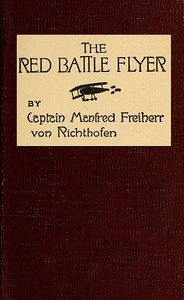
At Folio's default of ten pages a day, you finish The Red Battle Flyer in about 22 days — roughly 8 minutes of reading each morning.
The opening
the first pages of The Red Battle Flyer, free
SOME time ago a Naval Officer who was engaged on particularly hazardous duty was discussing calmly the chances that he and his like had of surviving the war, assuming that it continued for several more years and that his particular branch of it increased its intensity. He wound up his remarks by saying, "The chief reason why I particularly want to survive the finish is that I'm so keen on comparing notes with our opposite members in the German Navy."
That is the answer to those who ask, as an important official gentleman asked recently, why this English translation of Rittmeister von Richthofen's book should be published. It gives our flying people an opportunity of comparing notes with one of Germany's star-turn fighting pilots, just as that excellent book by "Contact" gives the Germans the chance of gathering the atmosphere of the Royal Flying Corps as it was in 1916 and 1917.
"The Red Battle-Flyer" has evidently been carefully censored by the German authorities. Also it has possibly been touched up here and there for propagandist purposes. Consequently, although the narrative as it stands is extraordinarily interesting, the book as a whole is still more interesting on account of what one reads between the lines, and of what one can deduce from the general outlook of the writer. There is, perhaps, little to learn of immediate topical interest, but there is much that explains things which were rather difficult to understand in the past, and the understanding of such points gives one a line of reasoning which should be useful to our active-service aviators in the future.
When one makes due allowance for the propagandist nature of the book, which gives one the general impression of the writing of a gentleman prepared for publication by a hack journalist, one forms a distinctly favorable mental picture of the young Rittmeister Baron von Richthofen. Our old friend Froissart is credited with the statement that in his age of chivalry it was always "impossible to inculcate into the German knights the true spirit of knightliness." Which seems to indicate that the practical German mind of those days could not understand the whimsicalities of the Latin ideas of chivalry, which--for example--bade a knight against whose shield an opponent "brake his spear" haul off out of the fight till the lance-less enemy unsheathed his sword and "drave into the combat" again. Probably the Hun of those days proceeded to stick his opponent in the midriff--wherever it may be--and so finished the fight.
In the same true spirit of knightliness an Englishman knocks a man down and then stands back so that he can get up and have another chance, whereas a more practical person would take excellent care that his opponent never got up till he had acknowledged himself beaten. It is all a matter of the point of view, and largely no doubt a matter of education. However, making due allowance for the point of view, one finds surprisingly little Hunnishness in von Richthofen's manners or methods as set forth in print.
It is one of the accepted facts of the war that the German aviators have displayed greater chivalry than any other branch of the German services. It was a common occurrence for their pilots to fly over our lines in the course of their business, and, by way of variety from that business, to drop packets containing letters from captured British aviators, or the personal belongings of the dead. One gathers that these acts of courtesy have become less frequent of late, owing to the intensification of aerial warfare, but it seems that captured and killed aviators still receive the full courtesies of war from the German aviators, whatever may be the fate of prisoners in other hands afterwards.
It is not surprising therefore to find that, taking him all round, Rittmeister von Richthofen conveys to one the general impression that, mutatis mutandis, he is very like an English public school boy of good family. His egotism, as one finds it in the book, is the egotism of a young man who is frankly pleased with himself, but is more elated by his good luck than by his cleverness.
Keep going from exactly here — Folio remembers your place and serves the next portion tomorrow.
continue reading The Red Battle FlyerAbout this free edition
The Red Battle Flyer by Manfred Freiherr von Richthofen (1892-1918) is free to read in full. Folio serves it in daily portions you can actually finish, tracks your streak and reading position across devices, and reads every page aloud with a built-in narrator. The text comes from Project Gutenberg.
More like The Red Battle Flyer

The Autobiography of Benjamin Franklin
Benjamin Franklin
Narrative of the Life of Frederick Douglass
Folio
Narrative of the Life of Frederick Douglass
Frederick Douglass
My Bondage and My Freedom
Folio
My Bondage and My Freedom
Frederick Douglass
The Story of My Life
Folio
The Story of My Life
Helen Keller

Up from Slavery
Booker T. Washington
Incidents in the Life of a Slave Girl
Folio
Incidents in the Life of a Slave Girl
Harriet Jacobs

Twelve Years a Slave
Solomon Northup
The Narrative of Sojourner Truth
Folio
The Narrative of Sojourner Truth
Sojourner Truth