The Recollections of Alexis de Tocqueville
Folio
length
103,806 words
a few pages a day
~8 min
finished in
55 days
full read
7h 13m
At Folio's default of ten pages a day, you finish The Recollections of Alexis de Tocqueville in about 55 days — roughly 8 minutes of reading each morning.
The opening
the first pages of The Recollections of Alexis de Tocqueville, free
Alexis de Tocqueville made his entrance in political life in 1839.[1] At the outbreak of the Revolution of February he was in the prime of his age and in the maturity of his talent. He threw himself into the struggle, resolving to devote himself to the interests of the country and of society, and he was one of the first among those whole-hearted, single-minded men who endeavoured to keep the Republic within a wise and moderate course by steering clear of the two-fold perils of Cæsarism on the one hand and revolution on the other. A dangerous and thankless enterprise, of which the difficulties were never hidden from a mind so clear-sighted as his, and of which he soon foresaw the ephemeral duration.
[1: At the age of 34. Alexis Clérel de Tocqueville was born in 1805 at Verneuil. His father was the Comte de Tocqueville, who was made a peer of France and a prefect under the Restoration; his mother, née Mlle. de Rosambo, was a grand-daughter of Malesherbes. Alexis de Tocqueville was appointed an assistant judge, and in 1831 was sent to America, in company with G. de Beaumont to study the penal system in that continent. On his return he published a treatise on this subject; and in 1835 appeared his great work on American Democracy, which secured his election to the Academy of Moral Science in 1839 and to the French Academy in 1841. Two years earlier he had been sent to the Chamber as deputy for the arrondissement of Valognes in Normandy, in which the paternal property of Tocqueville was situated; and this seat he retained until his withdrawal from political life. He died in 1859.--A.T. de M.]
After the fall of his short-lived ministry, which had been filled with so many cares and such violent agitation, thinking himself removed for a time (it was to be for ever) from the conduct of public affairs, he went first to Normandy and then to Sorrento, on the Bay of Naples, in search of the peace and repose of which he stood in need. The intellect, however, but rarely shows itself the docile slave of the will, and his, to which idleness was a cause of real suffering, immediately set about to seek an object worthy of its attention. This was soon found in the great drama of the French Revolution, which attracted him irresistibly, and which was destined to form the subject-matter of his most perfect work.
It was at this time, while Alexis de Tocqueville was also preoccupied by the daily increasing gravity of the political situation at home, that he wrote the Recollections now first published. These consisted of mere notes jotted down at intervals on odds and ends of paper; and it was not until the close of his life that, yielding to the persuasions of his intimates, he gave a reluctant consent to their publication. He took a certain pleasure in thus retracing and, as it were, re-enacting the events in which he had taken part, the character of which seemed the more transient, and the more important to establish definitely, inasmuch as other events came crowding on, precipitating the crisis and altering the aspect of affairs. Thus those travellers who, steering their adventurous course through a series of dangerous reefs, alight upon a wild and rugged island, where they disembark and live for some days, and when about to depart for ever from its shores, throw back upon it a long and melancholy gaze before it sinks from their eyes in the immensity of the waves. Already the Assembly had lost its independence; the reign of constitutional liberty, under which France had lived for thirty-three years, was giving way; and, in the words of the famous phrase, "The Empire was a fact."
Keep going from exactly here — Folio remembers your place and serves the next portion tomorrow.
continue reading The Recollections of Alexis de TocquevilleAbout this free edition
The Recollections of Alexis de Tocqueville by Alexis de Tocqueville (1805-1859) is free to read in full. Folio serves it in daily portions you can actually finish, tracks your streak and reading position across devices, and reads every page aloud with a built-in narrator. The text comes from Project Gutenberg.
More like The Recollections of Alexis de Tocqueville
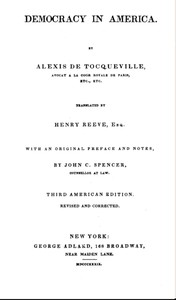
Democracy in America
Alexis de Tocqueville
American Institutions and Their Influence
Folio
American Institutions and Their Influence
Alexis de Tocqueville

The Autobiography of Benjamin Franklin
Benjamin Franklin
Narrative of the Life of Frederick Douglass
Folio
Narrative of the Life of Frederick Douglass
Frederick Douglass
My Bondage and My Freedom
Folio
My Bondage and My Freedom
Frederick Douglass
The Story of My Life
Folio
The Story of My Life
Helen Keller

Up from Slavery
Booker T. Washington
Incidents in the Life of a Slave Girl
Folio
Incidents in the Life of a Slave Girl
Harriet Jacobs