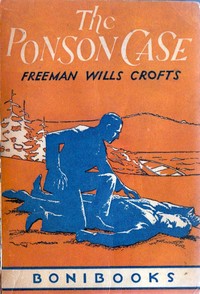
length
84,258 words
a few pages a day
~8 min
finished in
45 days
full read
5h 51m
At Folio's default of ten pages a day, you finish The Ponson case in about 45 days — roughly 8 minutes of reading each morning.
The opening
the first pages of The Ponson case, free
The dying sun of a July evening shone rosily on the old Georgian house of Luce Manor, mellowing the cold grey of the masonry, bringing out with soft shadow its cornices and mouldings, and softening and blurring its hard outlines. A fine old house, finely set on the summit of a low hill, and surrounded by wonderful old trees, it seemed to stand symbolical of the peace, security, and solid comfort of upper-class rural England.
This impression was not lessened by the outlook from the terrace in front. Below, and already shadowed by the trees beyond from the sun’s rays, was a small Dutch garden, its walks and beds showing up faintly in the gathering gloom. To the right the drive swept off in an easy curve until it disappeared between two rows of beeches, celebrated in all the county round for their age and size. At the side of the house, and reached through a rose pergola, was the walled English garden, with its masses of colour, its laden bushes, and its range of glass houses. In front, beyond the lawn, whose oaks and elms stood singly like sentinels guarding the house, the country rolled away to a line of distant hills, while to the left, an opening in the trees gave a glimpse of the Cranshaw River, with behind a near horizon of tree-covered slopes.
Within, in a large room panelled in black oak, the master of the house sat at dinner. He was alone, the only other members of the household, his wife and his daughter Enid, being from home on a visit. Sir William Ponson, a self-made man, had retired from business some ten years before our story opens and, selling his interest in the large ironworks of which he was head, had bought Luce Manor and settled down to end his days in the rôle of a country squire. Though obviously a nouveau riche, and still retaining the somewhat brusque manners of his hard, northern upbringing, he had nevertheless been received with more cordiality into the local society than usually happens in such cases. For Sir William, though he had thus risen in the social scale, remained a simple, honourable, kindly old man, a little headstrong and short tempered perhaps, but anxious to be just, and quick to apologise if he found himself in the wrong.
It was seldom that Sir William partook of a solitary meal. He was fond of society, and kept open house for all who cared to visit him. He had rented some shooting, and though the fishing in the river was not good, it at least was fishing. The tennis courts were always in perfect condition, and there was a sporting golf course at the neighbouring town of Halford. But it spoke well for Sir William that, of all his acquaintances, those whom he liked best to welcome were his old, somewhat unpolished business friends from the north, by few of whom these pursuits were properly appreciated. In this he had the full sympathy of his wife, a stout, placid lady of uncertain age, who ruled over his household with leisurely, easy-going sway.
Enid Ponson, their only daughter, a young woman of some thirty summers, was a favourite everywhere. Not exactly beautiful, she was yet good to look at, with her pale complexion, dark eyes, and winning smile. But it was her wonderful charm that endeared her to those with whom she came in contact, as well as the sweetness and kindliness of her disposition. That she was unmarried was only explained by the fact that the man to whom she had been engaged had been killed during the Great War. Enid and her father were close comrades and allies. She adored him, while Sir William’s chief thought was centred in his daughter, upon whom he thought the sun rose and set.
When the family were alone it was Sir William’s custom after dinner to join his wife and Enid in the music room, where for hours the latter would sing and play, while her father smoked cigar after cigar, and the elder woman placidly knitted or crocheted. But tonight, being entirely alone, he retired at once from the table to his library, where he would sit, reading and smoking, till about ten or later he would ring for Parkes, the butler, to bring him his nightly tumbler of hot punch.
Keep going from exactly here — Folio remembers your place and serves the next portion tomorrow.
continue reading The Ponson caseAbout this free edition
The Ponson case by Freeman Wills Crofts (1879-1957) is free to read in full. Folio serves it in daily portions you can actually finish, tracks your streak and reading position across devices, and reads every page aloud with a built-in narrator. The text comes from Project Gutenberg.
More like The Ponson case
The Cask
Freeman Wills Crofts
The Pit-Prop Syndicate
Folio
The Pit-Prop Syndicate
Freeman Wills Crofts

Inspector French's greatest case
Freeman Wills Crofts
The Starvel Hollow tragedy
Freeman Wills Crofts
The sea mystery
Freeman Wills Crofts
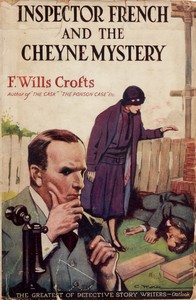
The Cheyne mystery
Freeman Wills Crofts
The purple sickle murders
Freeman Wills Crofts
The Adventures of Sherlock Holmes
Arthur Conan Doyle