length
112,932 words
a few pages a day
~8 min
finished in
60 days
full read
7h 51m
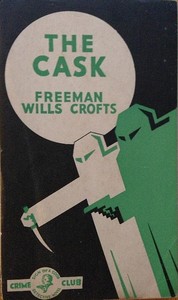
At Folio's default of ten pages a day, you finish The Cask in about 60 days — roughly 8 minutes of reading each morning.
The opening
the first pages of The Cask, free
Mr. Avery, managing director of the Insular and Continental Steam Navigation Company, had just arrived at his office. He glanced at his inward letters, ran his eye over his list of engagements for the day, and inspected the return of the movements of his Company’s steamers. Then, after spending a few moments in thought, he called his chief clerk, Wilcox.
‘I see the Bullfinch is in this morning from Rouen,’ he said. ‘I take it she’ll have that consignment of wines for Norton and Banks?’
‘She has,’ replied the chief clerk, ‘I’ve just rung up the dock office to inquire.’
‘I think we ought to have it specially checked from here. You remember all the trouble they gave us about the last lot. Will you send some reliable man down? Whom can you spare?’
‘Broughton could go. He has done it before.’
‘Well, see to it, will you, and then send in Miss Johnson, and I shall go through the mail.’
The office was the headquarters of the Insular and Continental Steam Navigation Company, colloquially known as the I. and C., and occupied the second floor of a large block of buildings at the western end of Fenchurch Street. The Company was an important concern, and owned a fleet of some thirty steamers ranging from 300 to 1000 tons burden, which traded between London and the smaller Continental ports. Low freights was their specialty, but they did not drive their boats, and no attempt was made to compete with the more expensive routes in the matter of speed. Under these circumstances they did a large trade in all kinds of goods other than perishables.
Mr. Wilcox picked up some papers and stepped over to the desk at which Tom Broughton was working.
‘Broughton,’ he said, ‘Mr. Avery wants you to go down at once to the docks and check a consignment of wines for Norton and Banks. It came in last night from Rouen in the Bullfinch. These people gave us a lot of trouble about their last lot, disputing our figures, so you will have to be very careful. Here are the invoices, and don’t take the men’s figures but see each cask yourself.’
‘Right, sir,’ replied Broughton, a young fellow of three-and-twenty, with a frank, boyish face and an alert manner. Nothing loath to exchange the monotony of the office for the life and bustle of the quays, he put away his books, stowed the invoices carefully in his pocket, took his hat and went quickly down the stairs and out into Fenchurch Street.
It was a brilliant morning in early April. After a spell of cold, showery weather, there was at last a foretaste of summer in the air, and the contrast made it seem good to be alive. The sun shone with that clear freshness seen only after rain. Broughton’s spirits rose as he hurried through the busy streets, and watched the ceaseless flow of traffic pouring along the arteries leading to the shipping.
His goal was St. Katherine’s Docks, where the Bullfinch was berthed, and, passing across Tower Hill and round two sides of the grim old fortress, he pushed on till he reached the basin in which the steamer was lying. She was a long and rather low vessel of some 800 tons burden, with engines amidships, and a single black funnel ornamented with the two green bands that marked the Company’s boats. Recently out from her annual overhaul, she looked trim and clean in her new coat of black paint. Unloading was in progress, and Broughton hurried on board, anxious to be present before any of the consignment of wine was set ashore.
He was just in time, for the hatches of the lower forehold, in which the casks were stowed, had been cleared and were being lifted off as he arrived. As he stood on the bridge deck waiting for the work to be completed he looked around.
Several steamers were lying in the basin. Immediately behind, with her high bluff bows showing over the Bullfinch’s counter, was the Thrush, his Company’s largest vessel, due to sail that afternoon for Corunna and Vigo. In the berth in front lay a Clyde Shipping Company’s boat bound for Belfast and Glasgow and also due out that afternoon, the smoke from her black funnel circling lazily up into the clear sky. Opposite was the Arcturus, belonging to the I. and C.’s rivals, Messrs. Babcock and Millman, and commanded by ‘Black Mac,’ so called to distinguish him from the Captain M‘Tavish of differently coloured hair, ‘Red Mac,’ who was master of the same Company’s Sirius. To Broughton these boats represented links with the mysterious, far-off world of romance, and he never saw one put to sea without longing to go with her to Copenhagen, Bordeaux, Lisbon, Spezzia, or to whatever other delightful-sounding place she was bound.
Keep going from exactly here — Folio remembers your place and serves the next portion tomorrow.
continue reading The CaskAbout this free edition
The Cask by Freeman Wills Crofts (1879-1957) is free to read in full. Folio serves it in daily portions you can actually finish, tracks your streak and reading position across devices, and reads every page aloud with a built-in narrator. The text comes from Project Gutenberg.
More like The Cask
The Pit-Prop Syndicate
Folio
The Pit-Prop Syndicate
Freeman Wills Crofts

Inspector French's greatest case
Freeman Wills Crofts

The Starvel Hollow tragedy
Freeman Wills Crofts

The Ponson case
Freeman Wills Crofts
The sea mystery
Freeman Wills Crofts

The Cheyne mystery
Freeman Wills Crofts

The purple sickle murders
Freeman Wills Crofts

The Adventures of Sherlock Holmes
Arthur Conan Doyle