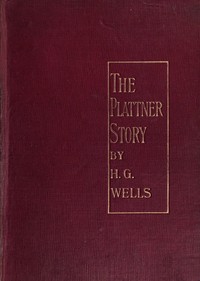
The Plattner Story, and Others
first published 1897 · free to read
length
77,868 words
a few pages a day
~8 min
finished in
41 days
full read
5h 24m
At Folio's default of ten pages a day, you finish The Plattner Story, and Others in about 41 days — roughly 8 minutes of reading each morning.
The opening
the first pages of The Plattner Story, and Others, free
Whether the story of Gottfried Plattner is to be credited or not, is a pretty question in the value of evidence. On the one hand, we have seven witnesses--to be perfectly exact, we have six and a half pairs of eyes, and one undeniable fact; and on the other we have--what is it?--prejudice, common sense, the inertia of opinion. Never were there seven more honest-seeming witnesses; never was there a more undeniable fact than the inversion of Gottfried Plattner's anatomical structure, and--never was there a more preposterous story than the one they have to tell! The most preposterous part of the story is the worthy Gottfried's contribution (for I count him as one of the seven). Heaven forbid that I should be led into giving countenance to superstition by a passion for impartiality, and so come to share the fate of Eusapia's patrons! Frankly, I believe there is something crooked about this business of Gottfried Plattner; but what that crooked factor is, I will admit as frankly, I do not know. I have been surprised at the credit accorded to the story in the most unexpected and authoritative quarters. The fairest way to the reader, however, will be for me to tell it without further comment.
Gottfried Plattner is, in spite of his name, a free-born Englishman. His father was an Alsatian who came to England in the Sixties, married a respectable English girl of unexceptionable antecedents, and died, after a wholesome and uneventful life (devoted, I understand, chiefly to the laying of parquet flooring), in 1887. Gottfried's age is seven-and-twenty. He is, by virtue of his heritage of three languages, Modern Languages Master in a small private school in the South of England. To the casual observer he is singularly like any other Modern Languages Master in any other small private school. His costume is neither very costly nor very fashionable, but, on the other hand, it is not markedly cheap or shabby; his complexion, like his height and his bearing, is inconspicuous. You would notice, perhaps, that, like the majority of people, his face was not absolutely symmetrical, his right eye a little larger than the left, and his jaw a trifle heavier on the right side. If you, as an ordinary careless person, were to bare his chest and feel his heart beating, you would probably find it quite like the heart of anyone else. But here you and the trained observer would part company. If you found his heart quite ordinary, the trained observer would find it quite otherwise. And once the thing was pointed out to you, you too would perceive the peculiarity easily enough. It is that Gottfried's heart beats on the right side of his body.
Now, that is not the only singularity of Gottfried's structure, although it is the only one that would appeal to the untrained mind. Careful sounding of Gottfried's internal arrangements, by a well-known surgeon, seems to point to the fact that all the other unsymmetrical parts of his body are similarly misplaced. The right lobe of his liver is on the left side, the left on his right; while his lungs, too, are similarly contraposed. What is still more singular, unless Gottfried is a consummate actor, we must believe that his right hand has recently become his left. Since the occurrences we are about to consider (as impartially as possible), he has found the utmost difficulty in writing, except from right to left across the paper with his left hand. He cannot throw with his right hand, he is perplexed at meal times between knife and fork, and his ideas of the rule of the road--he is a cyclist--are still a dangerous confusion. And there is not a scrap of evidence to show that before these occurrences Gottfried was at all left-handed.
Keep going from exactly here — Folio remembers your place and serves the next portion tomorrow.
continue reading The Plattner Story, and OthersAbout this free edition
The Plattner Story, and Others by H. G. Wells (1866-1946) is free to read in full. Folio serves it in daily portions you can actually finish, tracks your streak and reading position across devices, and reads every page aloud with a built-in narrator. The text comes from Project Gutenberg.
More like The Plattner Story, and Others

The Wheels of Chance: A Bicycling Idyll
H. G. Wells

The Time Machine
H. G. Wells

The War of the Worlds
H. G. Wells
The Invisible Man
H. G. Wells

The Island of Doctor Moreau
H. G. Wells
The First Men in the Moon
H. G. Wells
The Sleeper Awakes
Folio
The Sleeper Awakes
H. G. Wells
The Food of the Gods and How It Came to Earth
Folio
The Food of the Gods and How It Came to Earth
H. G. Wells