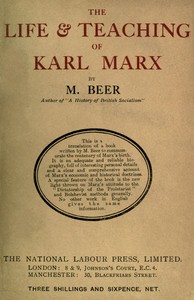
The life and teaching of Karl Marx
free to read
length
41,331 words
a few pages a day
~8 min
finished in
22 days
full read
2h 52m
At Folio's default of ten pages a day, you finish The life and teaching of Karl Marx in about 22 days — roughly 8 minutes of reading each morning.
The opening
the first pages of The life and teaching of Karl Marx, free
Karl Marx belongs to the ranks of those philosophical and sociological thinkers who throw potent thought-ferment into the world, and set in motion the masses of mankind. They awaken slumbering doubts and contradictions. They proclaim new modes of thought, new social forms. Their systems may sooner or later become obsolete, and the ruthless march of time may finally overthrow their intellectual edifice; meanwhile, however, they stimulate into activity the minds of countless men, inflame countless human hearts, imprinting on them characteristics which are transmitted to coming generations. This is the grandest and finest work to which any human being can be called. Because these thinkers have lived and worked, their contemporaries and successors think more clearly, feel more intensely, and are richer in knowledge and self-consciousness.
The history of philosophy and of social science is comprised in such systems and generalisations. They are the index to the annals of mankind. None of these systems is complete, none comprehends all human motives and capacities, none exhausts all the forces and currents of human society. They all express only fragmentary truths, which, however, become effective and achieve success because they are shining lights amidst the intellectual confusion of the generation which gives them birth, bringing it to a consciousness of the questions of the time, rendering its further development less difficult, and enabling its strongest spirits to stand erect, with fixity of purpose, in critical periods.
Hegel expresses himself in a similar sense where he remarks: "When the refutation of a philosophy is spoken of, this is usually meant in an abstract negative (completely destructive) sense, so that the confuted philosophy has no longer any validity whatever, and is set aside and done with. If this be so, the study of the history of philosophy must be regarded as a thoroughly depressing business, seeing that this study teaches that every system of philosophy which has arisen in the course of time has found its refutation. But if it is as good as granted that every philosophy has been refuted, yet at the same time it must be also asserted that no philosophy has been refuted, nor ever can be refuted ... for every philosophical system is to be considered as the presentation of a particular moment or a particular stage in the evolutionary process of the idea. The history of philosophy ... is not, in its totality, a gallery of the aberrations of the human intellect, but is rather to be compared to a pantheon of deities."
--("Hegel, Encyclopædia," vol. 1, section 86, note 2.)
What Hegel says here about philosophy is true also of systems of social science, and styles and forms in art. The displacement of one system by another reflects the historical sequence of the various stages of social evolution. The characteristic which is common to all these systems is their vitality.
In spite of their defects and difficulties there surges through them a living spirit from the influence of which contemporaries cannot escape. Opponents may put themselves to endless trouble to contradict such systems, and show up their shortcomings and inconsistencies, and yet, with all their pains, they do not succeed in attaining their object; their logical sapping and mining, their passionate attacks break against the vital spirit which the creative genius has breathed into his work. The deep impression made on us by this vitality is one of the main factors in the formation of our judgments upon scientific and artistic achievements. Mere formal perfection and beauty through which the life of the times does not throb can never create this impression.
Keep going from exactly here — Folio remembers your place and serves the next portion tomorrow.
continue reading The life and teaching of Karl MarxAbout this free edition
The life and teaching of Karl Marx by Max Beer (1864-1943) is free to read in full. Folio serves it in daily portions you can actually finish, tracks your streak and reading position across devices, and reads every page aloud with a built-in narrator. The text comes from Project Gutenberg.
More like The life and teaching of Karl Marx

The Autobiography of Benjamin Franklin
Benjamin Franklin
Narrative of the Life of Frederick Douglass
Folio
Narrative of the Life of Frederick Douglass
Frederick Douglass
My Bondage and My Freedom
Folio
My Bondage and My Freedom
Frederick Douglass
The Story of My Life
Folio
The Story of My Life
Helen Keller

Up from Slavery
Booker T. Washington
Incidents in the Life of a Slave Girl
Folio
Incidents in the Life of a Slave Girl
Harriet Jacobs
Twelve Years a Slave
Solomon Northup
The Narrative of Sojourner Truth
Folio
The Narrative of Sojourner Truth
Sojourner Truth