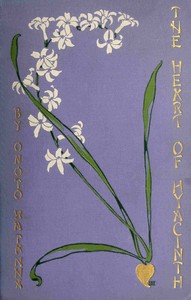
The Heart of Hyacinth
free to read
length
34,817 words
a few pages a day
~8 min
finished in
19 days
full read
2h 25m
At Folio's default of ten pages a day, you finish The Heart of Hyacinth in about 19 days — roughly 8 minutes of reading each morning.
The opening
the first pages of The Heart of Hyacinth, free
Note: Project Gutenberg also has an HTML version of this file which includes the original illustrations. See 63653-h.htm or 63653-h.zip: (https://www.gutenberg.org/cache/epub/63653/pg63653-images.html) or (https://www.gutenberg.org/files/63653/63653-h.zip)
Images of the original pages are available through Internet Archive. See https://archive.org/details/heartofhyacinth00wata_0
Transcriber’s note:
Text that was in italics is enclosed by underscores (italics).
[Illustration:
HYACINTH]
------------------------------------------------------------------------
THE HEART OF HYACINTH
by
ONOTO WATANNA
Illustrated
Decorations by Kiyokichi Sano
Publisher’s Logo
New York and London Harper & Brothers Publishers M-C-M-I-I-I
Copyright, 1903, by Harper & Brothers.
All rights reserved. Published September, 1903.
------------------------------------------------------------------------
ILLUSTRATIONS
HYACINTH Frontispiece
“KOMA LIFTED HER IN HIS ARMS” 42
“‘NOW, COME, LITTLE ONE: COME, GIVE ME 70 THAT WELCOME HOME’”
“HE KNELT IN A RAPT SILENCE BESIDE HER” 200
------------------------------------------------------------------------
THE HEART OF HYACINTH
------------------------------------------------------------------------
THE HEART OF HYACINTH
I
The City of Sendai, on the north-eastern coast of Japan, raises its head queenly-wise towards the sun, as though conscious of its own matchless beauty and that which envelops it on all sides. Here, where the waters flow into the Pacific, the surges are never heard. Neptune seems to have forgotten his anger in the presence of such peerless beauty.
Near to Sendai there is a bay called Matsushima. Here Nature has flung out her favors with more than lavish hand; for throughout the bay she has scattered jewel-like rocks, whose white sides rise above the waters, and whose surface gives nutrition to the graceful pine-trees which find their roots within the stone. Near to a thousand rocks they are said to number, and save for the one called Hadakajima, or Naked Island, all are crowned with pine-trees.
The historic temple Zuiganjii is situated at the base of a hill a few cho from the beach. About the temple are the tombs and sepulchres of the great Date family, once the feudal lords of Sendai. There is a huge image of Date Masamune, whose far-seeing mind sent an envoy to Rome early in the seventeenth century. The sepulchres are, for the most part, in the hollowed caves of the range of rocky hills behind the temples. Nameless flowers, large and brilliant in color, bloom about the tombs of these proud, slumbering lords. Mount Tomi bends its noble head in homage towards the glories of a past generation. The air is very still and cool. Silence enshrines and deifies all.
The inhabitants of Sendai and the little fishing village on the northern shore of the bay were simple, gentle folk. As though affected by the slumberous beauty of the hills and mountains hedging them in upon all sides, these let their life glide by with slow and sweetly sleepy tread. Not even the shock of the Restoration had brought this region’s people into that prophetic regard for the future which pervaded all other parts of the empire. The change-compelling progress which pressed in upon all sides seemed not as yet to have laid its withering finger upon fair Matsushima. Like their home, the inhabitants clung to their hermit existence.
When an English ship, having ploughed its way through the waters of the Pacific, sent out its men in boats to take the bay’s soundings, the people were not alarmed, but greatly mystified. The strange white men made their way in their smaller boats to the shore. A missionary and his wife were landed.
A little home, on a small hill situated only a short distance from the Temple Zuiganjii, they built for themselves. Afterwards, native artisans raised for them a larger structure, where for many years they patiently taught the gospel of Jesus Christ. The people gradually learned to love and reverence their pale teachers. There came a time when the little band, which had at first gone desultorily and curiously to the mission-house, began to see what the strangers termed “the light.” Then the Christian Church in far-away England enrolled a little list of converts to their religion.
Keep going from exactly here — Folio remembers your place and serves the next portion tomorrow.
continue reading The Heart of HyacinthAbout this free edition
The Heart of Hyacinth by Onoto Watanna (1875-1954) is free to read in full. Folio serves it in daily portions you can actually finish, tracks your streak and reading position across devices, and reads every page aloud with a built-in narrator. The text comes from Project Gutenberg.