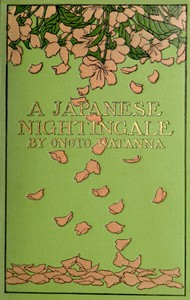
A Japanese Nightingale
free to read
length
32,521 words
a few pages a day
~8 min
finished in
18 days
full read
2h 16m
At Folio's default of ten pages a day, you finish A Japanese Nightingale in about 18 days — roughly 8 minutes of reading each morning.
The opening
the first pages of A Japanese Nightingale, free
The last rays of sunset were tingeing the land, lingering in splendor above the bay. The waters had caught the golden glow, and, miser-like, seemingly made effort to keep it with them; but, inexorably, the lowering sun drew away its gilding light, leaving the waters a dark green. The shadows began to darken, faint stars peeped out of the heavens, and slowly, unwillingly, the day's last ray followed the sunken sun to rest; and with its vanishment a pale moon stole overhead and threw a seraphic light over all things.
Out in the bay that the sun had left was a tiny island, and on this a Japanese business man, who must also have been an artist, had built a tea-house and laid out a garden. Such an island! In the sorcerous moonlight, one might easily believe it the witch-work of an Oriental Merlin. Running in every direction were narrow jinrikisha roads, which crossed bewildering little creeks, spanned by entrancing bridges. These were round and high, and curved in the centre, and clinging vines and creeping, nameless flowers crawled up the sides and twined about the tiny steps which ascended to the bridges. After crossing a bridge shaped thus, a straight bridge is forever an outrage to the eye and sense. And all along the beach of this island was pure white sand, which looked weirdly whiter where the moonbeams loitered and played hide-and-seek under the tree-shadows.
The seekers of pleasure who made their way out to the little island on this night moored their boats here in the shadows beneath the trees, and drove in fairy vehicles, pulled by picturesque runners, clear around the island, under the pine-trees, over miniature brooks, into the mysterious dark of a forest. Suddenly they were in a blaze of swinging, dazzling lights, laughter and music, chatter, the clattering of dishes, the twang of the samisen, the ron-ton-ton of the biwa. They had reached the garden and the tea-house.
Some pleasure-loving Japanese were giving a banquet in honor of the full moon, and the moon, just over their heads, clothed in glorious raiment, and sitting on a sky-throne of luminous silver, was attending the banquet in person, surrounded by myriad twinkling stars, who played at being her courtiers. Each of the guests had his own little mat, table, and waitress. They sat in a semicircle, and drank the sake hot, in tiny cups that went thirty or more to the pint; or the Kyoto beer that had been ordered for the foreigners who were the chief guests this evening. This is the toast the Japanese made to the moon: "May she with us drink a cup of immortality!" and then each wished the one nearest him ten thousand years of joy.
Now the moon-path widened on the bay, and the moon itself expanded and grew more luminous as though in proud sympathy and understanding of the thousand banquets held in her honor this night. All the music and noise and clatter and revel had gradually ceased, and for a time an eloquent silence was everywhere. Huge glowing fire-flies, flitting back and forth like tiny twinkling stars, seemed to be the only things stirring.
Some one snuffed the candles in the lanterns, and threw a large mat in the centre of the garden, and dusted it extravagantly with rice flour. Then a shaft of light, that might have been the combination of a thousand moonbeams, was flashed on the mat from an opening in the upper part of the house, and out of the shadows sprang on to the mat a wild, vivid little figure, clad in scintillating robes that reflected every ray of light thrown on them; and, with her coming, the air was filled with the weird, wholly fascinating music of the koto and samisen.
She pirouetted around on the tips of the toes of one little foot, clapped her hands, and courtesied to the four corners of the earth. Her dance was one of the body rather than of the feet, as back and forth she swerved. There was a patter, patter, patter. Her garments seemed endowed with life, and took on a sorrowing appearance; the lights changed to accompany her; the music sobbed and quivered. It had begun to rain! She was raining! It seemed almost as if the pitter-patter of her feet were the falling of tiny raindrops; the sadness of her garments had increased, and now they seemed to be weeping, at first gradually, then faster and still faster, until finally she was a storm--a dark, blowing, lightning storm. From above the light shot down in quick, sharp flashes, the drums clashed madly, the koto wept on, and the samisen shrieked vindictively.
Keep going from exactly here — Folio remembers your place and serves the next portion tomorrow.
continue reading A Japanese NightingaleAbout this free edition
A Japanese Nightingale by Onoto Watanna (1875-1954) is free to read in full. Folio serves it in daily portions you can actually finish, tracks your streak and reading position across devices, and reads every page aloud with a built-in narrator. The text comes from Project Gutenberg.