length
56,415 words
a few pages a day
~8 min
finished in
30 days
full read
3h 55m
At Folio's default of ten pages a day, you finish The Forgotten Planet in about 30 days — roughly 8 minutes of reading each morning.
The opening
the first pages of The Forgotten Planet, free
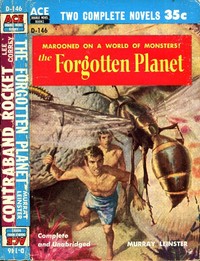
Beneath dense gray clouds through which no sun shone lay a forgotten planet. It was a nightmare world of grotesque and terrifying animal-plant life. Gigantic beetles, spiders, bugs and ants filled the putrid, musty earth--ready to kill and devour anything in sight.
There were men amidst this horror--men who cringed and ran from the ravening monsters and huddled in the mushroom forests at night.
Burl was one of these creatures. But one day inspiration hit Burl. He would find a weapon--he would fight back.
And with this idea the first step was taken in man's most desperate flight for freedom in this most horrible of all worlds. But it was only a first step.
About the characters in this book:
This is something of an oddity among fiction stories, because some of its characters may be met in person if you wish. Down at the nearest weed-patch or thicket you are quite likely to see a large and unusually perfect spider-web with a zig-zag silk ribbon woven into its center. Its engineer is the yellow-banded garden spider (Epeira Fasciata) whose abdomen may be as big as your thumb. I do not name it to impress you, but to suggest a sort of science-fiction experience.
Take a bit of straw and disturb the web. Don't break the cables. Simply tap them a bit. The spider will know by the feel of things that you aren't prey and that it can't eat you. So it will set out frightening you away. It will run nimbly to the center of the web and shake itself violently. The whole web will vibrate, so that presently the spider may be swinging through an arc inches in length, and blurred by the speed of its swing. You are supposed to be scared. When you are alarmed enough, the spider will stop.
That spider, very much magnified, is in this book with crickets and grasshoppers and divers beetles you may not know personally. But this is not an insect book, but science-fiction. If the habits of the creatures in it are authentic, it is because they are much more dramatic and interesting than things one can invent.
Murray Leinster
PROLOGUE
The Survey-Ship Tethys made the first landing on the planet, which had no name. It was an admirable planet in many ways. It had an ample atmosphere and many seas, which the nearby sun warmed so lavishly that a perpetual cloud-bank hid them and most of the solid ground from view. It had mountains and continents and islands and high plateaus. It had day and night and wind and rain, and its mean temperature was within the range to which human beings could readily accommodate. It was rather on the tropic side, but not unpleasant.
But there was no life on it.
No animals roamed its continents. No vegetation grew from its rocks. Not even bacteria struggled with its stones to turn them into soil. So there was no soil. Rock and stones and gravel and even sand--yes. But no soil in which any vegetation could grow. No living thing, however small, swam in its oceans, so there was not even mud on its ocean-bottoms. It was one of that disappointing vast majority of worlds which turned up when the Galaxy was first explored. People couldn't live on it because nothing had lived there before.
Its water was fresh and its oceans were harmless. Its air was germ-free and breathable. But it was of no use whatever for men. The only possible purpose it could serve would have been as a biological laboratory for experiments involving things growing in a germ-free environment. But there were too many planets like that already. When men first traveled to the stars they made the journey because it was starkly necessary to find new worlds for men to live on. Earth was over-crowded--terribly so. So men looked for new worlds to move to. They found plenty of new worlds, but presently they were searching desperately for new worlds where life had preceded them. It didn't matter whether the life was meek and harmless, or ferocious and deadly. If life of any sort were present, human beings could move in. But highly organized beings like men could not live where there was no other life.
Keep going from exactly here — Folio remembers your place and serves the next portion tomorrow.
continue reading The Forgotten PlanetAbout this free edition
The Forgotten Planet by Murray Leinster (1896-1975) is free to read in full. Folio serves it in daily portions you can actually finish, tracks your streak and reading position across devices, and reads every page aloud with a built-in narrator. The text comes from Project Gutenberg.
More like The Forgotten Planet
The Vault
Murray Leinster

Dames
Murray Leinster
The Mad Planet
Folio
The Mad Planet
Murray Leinster
Space Tug
Folio
Space Tug
Murray Leinster
Space Platform
Folio
Space Platform
Murray Leinster
The Pirates of Ersatz
Murray Leinster
Creatures of the Abyss
Murray Leinster
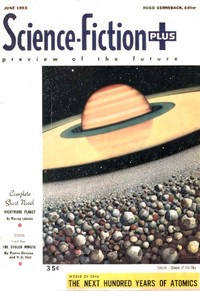
Nightmare Planet
Murray Leinster