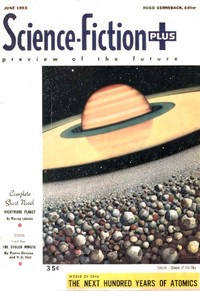
length
16,128 words
a few pages a day
~8 min
finished in
9 days
full read
1h 7m
At Folio's default of ten pages a day, you finish Nightmare Planet in about 9 days — roughly 8 minutes of reading each morning.
The opening
the first pages of Nightmare Planet, free
_In science-fiction, as in all categories of fiction, there are stories that are so outstanding from the standpoint of characterization, concept, and background development that they remain popular for decades. Two such stories were Murray Leinster's The Mad Planet and Red Dust. Originally published in 1923, they have been reprinted frequently both here and abroad. They are now scheduled for book publication. Especially for this magazine, Murray Leinster has written the final story in the series. It is not necessary to have read the previous stories to enjoy this one. Once again, Burl experiences magnificent adventures against a colorful background, but to the whole the author has added philosophical and psychological observations that give this story a flavor seldom achieved in science-fiction._
Under his real name of Will Fitzgerald Jenkins, the author has sold to The Saturday Evening Post, Colliers', Today's Woman, in fact every important publication in America. He has had over 1200 stories published, 15 books and 35 science-fiction stories anthologized. His writing earned him a listing in Who's Who in America.
* * * * *
The Directory-ship Tethys made the first landing on the planet, L216^{12}. It was a goodly world, with an ample atmosphere and many seas, which the nearby sun warmed so lavishly that a perpetual cloud-bank hid them and all the solid ground from view. It had mountains and islands and high plateaus. It had day and night and rain. It had an equable climate, rather on the tropical side. But it possessed no life.
No animals roamed its solid surface. No vegetation grew from its rocks. Not even bacteria struggled with the stones to turn them into soil. No living thing, however small, swam in its oceans. It was one of that disappointing vast majority of otherwise admirable worlds which was unsuited for colonization solely because it had not been colonized before. It could be used for biological experiments in a completely germ-free environment, or ships could land upon it for water and supplies of air. The water was pure and the air breathable, but it had no other present utility. Such was the case with an overwhelming number of Earth-type planets when first discovered in the exploration of the galaxy. Life simply hadn't started there.
So the ship which first landed upon it made due note for the Galactic Directory and went away, and no other ship came near the planet for eight hundred years.
But nearly a millennium later, the Seed-Ship Orana arrived. It landed and carefully seeded the useless world. It circled endlessly above the clouds, dribbling out a fine dust comprised of the spores of every conceivable microorganism that could break down rock to powder and turn the powder to organic matter. It also seeded with moulds and fungi and lichens, and everything that could turn powdery primitive soil into stuff on which higher forms of life could grow. The Orana seeded the seas with plankton. Then it, too, went away.
Centuries passed. Then the Ecological Preparation Ship Ludred swam to the planet from space. It was a gigantic ship of highly improbable construction and purpose. It found the previous seeding successful. Now there was soil which swarmed with minute living things. There were fungi which throve monstrously. The seas stank of teeming minuscule life-forms. There were even some novelties on land, developed by strictly local conditions. There were, for example, paramecium as big as grapes, and yeasts had increased in size so that they bore flowers visible to the naked eye. The life on the planet was not aboriginal, though. It had all been planted by the seed-ship of centuries before.
Keep going from exactly here — Folio remembers your place and serves the next portion tomorrow.
continue reading Nightmare PlanetAbout this free edition
Nightmare Planet by Murray Leinster (1896-1975) is free to read in full. Folio serves it in daily portions you can actually finish, tracks your streak and reading position across devices, and reads every page aloud with a built-in narrator. The text comes from Project Gutenberg.
More like Nightmare Planet

The Vault
Murray Leinster

Dames
Murray Leinster
The Mad Planet
Folio
The Mad Planet
Murray Leinster
Space Tug
Folio
Space Tug
Murray Leinster
Space Platform
Folio
Space Platform
Murray Leinster
The Pirates of Ersatz
Murray Leinster
Creatures of the Abyss
Murray Leinster

The Runaway Skyscraper
Murray Leinster