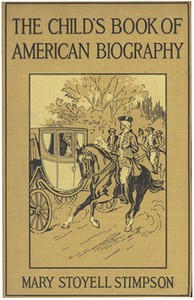
The Child's Book of American Biography
free to read
length
45,416 words
a few pages a day
~8 min
finished in
24 days
full read
3h 9m
At Folio's default of ten pages a day, you finish The Child's Book of American Biography in about 24 days — roughly 8 minutes of reading each morning.
The opening
the first pages of The Child's Book of American Biography, free
No one ever tells a story about the early days in America without bringing in the name of George Washington. In fact he is called the Father of our country. But he did not get this name until he was nearly sixty years old; and all kinds of interesting things, like taming wild colts, fighting Indians, hunting game, fording rivers, and commanding an army, had happened to him before that. He really had a wonderful life.
George Washington was born in Virginia almost two hundred years ago. Virginia was not a state then. Indeed, there were no states. Every colony from Maine to Georgia was owned by King George, who sent men from England to govern them.
At the time of George Washington's birth, Virginia was the richest of the thirteen colonies. George's father, Augustine Washington, had a fine old southern farmhouse set in the midst of a large tobacco plantation. This farm of a thousand acres was on the Potomac River. The Washington boys (George had two older brothers and several younger ones) had plenty of room to play in, and George had a pony, Hero, of his own.
George was eleven years old when his father died, and his mother managed the plantation and brought up the children. George never gave her any trouble. He had good lessons at school and was willing to help her at home. He was a fine wrestler and could row and swim. Indeed, he liked the water so well, that he fancied he might lead the life of a sailor, carrying tobacco from the Potomac River to England. He heard stories of vessels meeting pirates and thought it would be very exciting. But his English uncle warned Mrs. Washington that it would be a hard life for her son, and she coaxed him to give up the idea.
George had shown that he could do the work of a man on the farm when he was only sixteen. He was tall and strong and had a firm will. He had great skill in breaking colts and understood planting and harvesting, as well as tobacco raising. Being good at figures, he learned surveying. Surveying is the science of measuring land so that an owner will know just how much he has, how it lies, and what it adjoins, so that he can cut it into lots and set the measurements all down on paper. George was a fine land surveyor, and when he went to visit a half-brother, Lawrence Washington, who had a beautiful new home on the Potomac, which he called Mount Vernon, an English nobleman, Lord Fairfax, who owned the next estate, hired George to go all over his land in Virginia and put on paper for him the names of the people who lived in the Shenandoah valley, the way the roads ran, and the size of his different plantations. He really did not know how much land he owned, for King Charles the Second had given an immense amount of land to his grandfather. But he thought it was quite time to find out, and he was sure George Washington was an honest lad who would do the work well.
Lord Fairfax spoke so highly of George that he was made surveyor of the colony. The outdoor life, and the long tramps in the sunshine made George's tall frame fill out, and he became one of the stoutest and handsomest young men in the colony.
Lawrence Washington was ill and had to go to a warmer climate, so he took George with him for help and company. Lawrence did not live and left the eight-thousand-acre estate, Mount Vernon, to George. This made George Washington a rich man at twenty.
The French and English began to discover that there was fine, rich land on either side of the Ohio River, and each laid claim to it. Now the Indians had been wandering through the forests of that region, camping and fishing where they chose, and they felt the land belonged to them. They grew ugly and sulky toward the English with whom up to this time they had been very friendly. It looked as if there would be war.
"Some one must go and talk to these Frenchmen," said Dinwiddie, the English governor at Virginia, "whom shall we send?"
Keep going from exactly here — Folio remembers your place and serves the next portion tomorrow.
continue reading The Child's Book of American BiographyAbout this free edition
The Child's Book of American Biography by Mary Stoyell Stimpson is free to read in full. Folio serves it in daily portions you can actually finish, tracks your streak and reading position across devices, and reads every page aloud with a built-in narrator. The text comes from Project Gutenberg.
More like The Child's Book of American Biography
The Autobiography of Benjamin Franklin
Benjamin Franklin
Narrative of the Life of Frederick Douglass
Folio
Narrative of the Life of Frederick Douglass
Frederick Douglass
My Bondage and My Freedom
Folio
My Bondage and My Freedom
Frederick Douglass
The Story of My Life
Folio
The Story of My Life
Helen Keller
Up from Slavery
Booker T. Washington
Incidents in the Life of a Slave Girl
Folio
Incidents in the Life of a Slave Girl
Harriet Jacobs
Twelve Years a Slave
Solomon Northup
The Narrative of Sojourner Truth
Folio
The Narrative of Sojourner Truth
Sojourner Truth