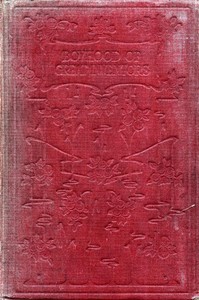
The Boyhood of Great Inventors
free to read
length
31,186 words
a few pages a day
~8 min
finished in
17 days
full read
2h 10m
At Folio's default of ten pages a day, you finish The Boyhood of Great Inventors in about 17 days — roughly 8 minutes of reading each morning.
The opening
the first pages of The Boyhood of Great Inventors, free
People who have been on a long sea voyage, and have ended by sailing up the English Channel, tell us how their hearts beat high, after weary weeks and months at sea, when the cry went up while as yet land was a mere shadowy outline, "The Eddystone in sight!" For the gleaming lighthouse standing immovable in the midst of boiling waves and great mountains of blinding white spray spells "home" to the voyager.
To us the "stone" round which the waters ceaselessly churn and "eddy" speaks of John Smeaton, the man who built it. The great engineer has been in his grave now for more than a century, but his most lasting monument stood for longer than that time firm as a rock.
John Smeaton was born in 1724, near Leeds. Not the Leeds of to-day--a bustling, smoky centre of manufacture--but a quaint little town hemmed in by green country fields and lanes. It was in one of these that Austhorpe Lodge stood, the house of Smeaton's father, a lawyer in Leeds.
We shall yet come across many boyhoods tinged with shadow and struggle, and are not sorry to find this one happy, fondly tended, and bright with sunshine. There was no pinch in the lot of the Smeatons, no grinding poverty that we sometimes find to spur a boy to manhood before his time. Little John was cradled, as it were, in love. As a child his parents taught him at home. He was not eager to mix with other boys in outdoor romp or play, and very early, while yet hardly more than a baby, he showed a strong love for pulling his toys to pieces to see what they were made of! Never was he happier than when he could get hold of a cutting-tool with which to shape toy pumps and houses and windmills. Another amusement of his babyhood was to divide squares and circles!
As a boy he was rather quiet and thoughtful, though his tongue straightway loosed the moment anything in the shape of a workman came to his father's house. He was then always to be found on the spot, and with eager eyes fixed on their every movement, he would unconsciously "pose" them with eager questions--such questions as from the boyish lips made them shake their heads and stare at him dumb and stupid.
And all the time the boyish brain was deeply plotting, and it was ever that he might "go and do likewise." One day, after watching a millwright at work, his anxious parents were alarmed by the sight of their boy perched on the top of the barn fastening a windmill to the roof! At another time, when a pump was being made in the village, by good luck a piece of bored lead came in little John's way. He promptly set to work and made a toy one after the pattern of the big one, and even managed to make it raise water.
But his greatest childish feat took place on his discovering a fire-engine being erected at a colliery in the village to pump the water out of the mine. He was constantly on the spot, eagerly watching it as it slowly progressed, and quickly his boyish brain grasped the whole.
He went home and began with trembling fingers one day to copy it. His father had given him an outhouse with bench and tools to carry out his hobby, and soon the engine worked. He looked round to see what he could use it upon, and espied the fish-pond. So he began to pump out the water till he had pumped the whole place dry. When his father came home it was to find an empty pond, and all his fish lying dead at the bottom!
And now John had to leave his beloved workshop for school in Leeds. And there it seemed as if the boy showed up quite a different side of himself. The bright, eager alertness that marked him at home or with the workmen about Austhorpe was gone. He was quiet with the boys--out of his element. He did not care for their rough play. He was like a fish out of water. Silent, shy, even stupid--the boys nicknamed him "Fooley Smeaton."
But though he might be dull at school, the boy's real education was surely going on at home among his pumps and model engines, his lathes and chisels.
Keep going from exactly here — Folio remembers your place and serves the next portion tomorrow.
continue reading The Boyhood of Great InventorsAbout this free edition
The Boyhood of Great Inventors by A. Fraser Robertson is free to read in full. Folio serves it in daily portions you can actually finish, tracks your streak and reading position across devices, and reads every page aloud with a built-in narrator. The text comes from Project Gutenberg.
More like The Boyhood of Great Inventors
The Autobiography of Benjamin Franklin
Benjamin Franklin
Narrative of the Life of Frederick Douglass
Folio
Narrative of the Life of Frederick Douglass
Frederick Douglass
My Bondage and My Freedom
Folio
My Bondage and My Freedom
Frederick Douglass
The Story of My Life
Folio
The Story of My Life
Helen Keller

Up from Slavery
Booker T. Washington
Incidents in the Life of a Slave Girl
Folio
Incidents in the Life of a Slave Girl
Harriet Jacobs
Twelve Years a Slave
Solomon Northup
The Narrative of Sojourner Truth
Folio
The Narrative of Sojourner Truth
Sojourner Truth