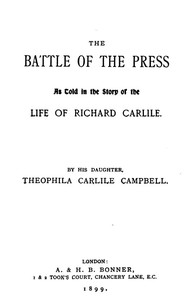
length
98,568 words
a few pages a day
~8 min
finished in
52 days
full read
6h 51m
At Folio's default of ten pages a day, you finish The battle of the press in about 52 days — roughly 8 minutes of reading each morning.
The opening
the first pages of The battle of the press, free
In presenting to the present generation of England and America the comprehensive though necessarily condensed history of the life and work of the great pioneer in the cause of mental freedom, I am actuated by two principal motives, the foremost of which is the desirable duty of presenting to the people of to-day a faithful account of the work done by Carlile and the enormous sacrifices he made, as well as the terrible imprisonments he endured in the accomplishment of the task he set himself to do, namely, to establish for his countrymen a really Free Press, and the right of free oral discussion, as, up to his time, neither right had ever been accorded to any of the peoples of Europe by either Church or State.
In the prosecution of his self-appointed task he was assailed by the reigning powers with all the malignity and religious fury that characterised the days of the Inquisition. No lie was too black to be hurled at him, no motive too low to be imputed to him, the minds of his countrymen were purposely influenced against him in order that they might not understand his real object--that of benefiting them--and to divert attention from his enemies' misdoing. So he was given the horns, hoofs, and tail of Satan himself, and invested with all the attributes of this fallen angel. It is not to be wondered at that the majority of the people at that time were so influenced, when we consider the very limited resources of the times in regard to information. Almost all of this was carried and given by word of mouth, and it was naturally colored by the views or feelings of those who gave it out.
To rescue the name of a true friend of the people from the undeserved obloquy or silence under which it has been so long obscured, and to place his memory and name where it truly belongs in the list of the honored dead of his country, and in the hearts of his countrymen, there to dwell as long as English history lasts, is the second motive. In doing this we may turn upon all the evidences, both public and private, the modern searchlight of critical investigation, and I am satisfied that when the clouds of malignant abuse and the mass of unsubstantiated charges that were heaped upon his name and fame by those who were interested in doing so are cleared away, his name and the record of his life will stand out from the past as a star of the first magnitude stands out from the darkened sky of night--bright, clear, and pure.
I therefore, with confidence, commit the record of Carlile, as a man with the highest aims, unselfish purpose, and finest motives, who gave the efforts of a noble life and high moral purpose for the advancement of truth and the benefit of his fellow-men, to an enlightened and unbiassed generation, not doubting that it will recognise the true merit of the man and appreciate the value of his accomplishments for the benefit not only of his countrymen but of the world at large.
THEOPHILA CARLILE CAMPBELL.
THE BATTLE OF THE PRESS, AS TOLD IN THE LIFE OF RICHARD CARLILE
CHAPTER I. INTRODUCTORY
"Yet shall remembrance from oblivion's veil, Relieve your scene and sigh with grief sincere, And soft compassion at your tragic tale, In silent tribute pay her kindred tear."
We who rejoice in a Free Press to-day can hardly realise the condition of the Press in Europe at the opening of the nineteenth century. In England, eighty years ago, he who dared to express opinions in opposition to the Established Church, or in any way offensive to the government of the day, rendered himself liable to heavy fines and severe imprisonment. The following extract will show better, perhaps, than anything else what a deplorable state the Press was in when Richard Carlile entered upon his great fight, and the obstacles he had to encounter:--
"It is difficult to imagine a more degraded and dangerous position than that in which every political writer was placed in the year 1817. In the first place, he was subject by a Secretary of State's warrant to be imprisoned upon suspicion under the suspension of the Habeas Corpus Act. Secondly he was open to an ex-officio information under which he would be compelled to find bail or be imprisoned. The power of ex-officio information had been extended so as to compel bail by an Act of 1808; but from 1808 to 1811, during which three years forty such informations were laid, only one person was held to bail."*
Keep going from exactly here — Folio remembers your place and serves the next portion tomorrow.
continue reading The battle of the pressAbout this free edition
The battle of the press by Theophila Carlile Campbell (1837-1913) is free to read in full. Folio serves it in daily portions you can actually finish, tracks your streak and reading position across devices, and reads every page aloud with a built-in narrator. The text comes from Project Gutenberg.
More like The battle of the press

The Autobiography of Benjamin Franklin
Benjamin Franklin
Narrative of the Life of Frederick Douglass
Folio
Narrative of the Life of Frederick Douglass
Frederick Douglass
My Bondage and My Freedom
Folio
My Bondage and My Freedom
Frederick Douglass
The Story of My Life
Folio
The Story of My Life
Helen Keller

Up from Slavery
Booker T. Washington
Incidents in the Life of a Slave Girl
Folio
Incidents in the Life of a Slave Girl
Harriet Jacobs
Twelve Years a Slave
Solomon Northup
The Narrative of Sojourner Truth
Folio
The Narrative of Sojourner Truth
Sojourner Truth