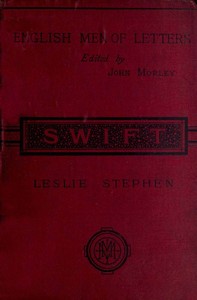
length
64,107 words
a few pages a day
~8 min
finished in
34 days
full read
4h 27m
At Folio's default of ten pages a day, you finish Swift in about 34 days — roughly 8 minutes of reading each morning.
The opening
the first pages of Swift, free
The chief materials for a life of Swift are to be found in his writings and correspondence. The best edition is the second of the two edited by Scott (1814 and 1824).
In 1751 Lord Orrery published Remarks upon the Life and Writings of Dr. Jonathan Swift. Orrery, born 1707, had known Swift from about 1732. His remarks give the views of a person of quality of more ambition than capacity, and more anxious to exhibit his own taste than to give full or accurate information.
In 1754, Dr. Delany published Observations upon Lord Orrery's Remarks, intended to vindicate Swift against some of Orrery's severe judgments. Delany, born about 1685, became intimate with Swift soon after the dean's final settlement in Ireland. He was then one of the authorities of Trinity College, Dublin. He is the best contemporary authority, so far as he goes.
In 1756 Deane Swift, grandson of Swift's uncle Godwin, and son-in-law to Swift's cousin and faithful guardian, Mrs. Whiteway, published an Essay upon the Life, Writings, and Character of Dr. Jonathan Swift, in which he attacks both his predecessors. Deane Swift, born about 1708, had seen little or nothing of his cousin till the year 1738, when the dean's faculties were decaying. His book is foolish and discursive. Deane Swift's son, Theophilus, communicated a good deal of doubtful matter to Scott, on the authority of family tradition.
In 1765 Hawkesworth, who had no personal knowledge, prefixed a life of Swift to an edition of the works which adds nothing to our information. In 1781 Johnson, when publishing a very perfunctory life of Swift as one of the poets, excused its shortcomings on the ground of having already communicated his thoughts to Hawkesworth. The life is not only meagre but injured by one of Johnson's strong prejudices.
In 1785 Thomas Sheridan produced a pompous and dull life of Swift. He was the son of Swift's most intimate companion during the whole period subsequent to the final settlement in Ireland. The elder Sheridan, however, died in 1738; and the younger, born in 1721, was still a boy when Swift was becoming imbecile.
Contemporary writers, except Delany, have thus little authority; and a number of more or less palpably fictitious anecdotes accumulated round their hero. Scott's life, originally published in 1814, is defective in point of accuracy. Scott did not investigate the evidence minutely, and liked a good story too well to be very particular about its authenticity. The book, however, shows his strong sense and genial appreciation of character; and remains, till this day, by far the best account of Swift's career.
A life which supplies Scott's defects in great measure was given by William Monck Mason, in 1819, in his History and Antiquities of the Church of St. Patrick. Monck Mason was an indiscriminate admirer, and has a provoking method of expanding undigested information into monstrous notes, after the precedent of Bayle. But he examined facts with the utmost care, and every biographer must respect his authority.
In 1875 Mr. Forster published the first instalment of a Life of Swift. This book, which contains the results of patient and thorough inquiry, was unfortunately interrupted by Mr. Forster's death, and ends at the beginning of 1711. A complete Life by Mr. Henry Craik is announced as about to appear.
Besides these books, I ought to mention an Essay upon the Earlier Part of the Life of Swift, by the Rev. John Barrett, B.D. and Vice-Provost of Trin. Coll. Dublin (London, 1808); and The Closing Years of Dean Swift's Life, by W. R. Wilde, M.R.I.A., F.R.C.S. (Dublin, 1849). This last is a very interesting study of the medical aspects of Swift's life. An essay by Dr. Bucknill, in Brain for Jan. 1882, is a remarkable contribution to the same subject.
CONTENTS.
PAGE
Keep going from exactly here — Folio remembers your place and serves the next portion tomorrow.
continue reading SwiftAbout this free edition
Swift by Leslie Stephen (1832-1904) is free to read in full. Folio serves it in daily portions you can actually finish, tracks your streak and reading position across devices, and reads every page aloud with a built-in narrator. The text comes from Project Gutenberg.
More like Swift
The English Utilitarians
Folio
The English Utilitarians
Leslie Stephen
Samuel Johnson
Folio
Samuel Johnson
Leslie Stephen
Alexander Pope
Folio
Alexander Pope
Leslie Stephen
The Autobiography of Benjamin Franklin
Benjamin Franklin
Narrative of the Life of Frederick Douglass
Folio
Narrative of the Life of Frederick Douglass
Frederick Douglass
My Bondage and My Freedom
Folio
My Bondage and My Freedom
Frederick Douglass
The Story of My Life
Folio
The Story of My Life
Helen Keller

Up from Slavery
Booker T. Washington