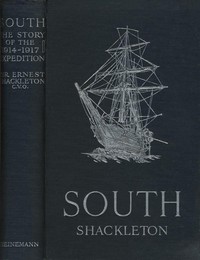
South: The Story of Shackleton's Last Expedition
by Ernest Shackleton (1874-1922)
first published 1919 · free to read
length
147,640 words
a few pages a day
~8 min
finished in
78 days
full read
10h 15m
At Folio's default of ten pages a day, you finish South: The Story of Shackleton's Last Expedition in about 78 days — roughly 8 minutes of reading each morning.
The opening
the first pages of South: The Story of Shackleton's Last Expedition, free
After the conquest of the South Pole by Amundsen, who, by a narrow margin of days only, was in advance of the British Expedition under Scott, there remained but one great main object of Antarctic journeyings—the crossing of the South Polar continent from sea to sea.
When I returned from the Nimrod Expedition on which we had to turn back from our attempt to plant the British flag on the South Pole, being beaten by stress of circumstances within ninety-seven miles of our goal, my mind turned to the crossing of the continent, for I was morally certain that either Amundsen or Scott would reach the Pole on our own route or a parallel one. After hearing of the Norwegian success I began to make preparations to start a last great journey—so that the first crossing of the last continent should be achieved by a British Expedition.
We failed in this object, but the story of our attempt is the subject for the following pages, and I think that though failure in the actual accomplishment must be recorded, there are chapters in this book of high adventure, strenuous days, lonely nights, unique experiences, and, above all, records of unflinching determination, supreme loyalty, and generous self-sacrifice on the part of my men which, even in these days that have witnessed the sacrifices of nations and regardlessness of self on the part of individuals, still will be of interest to readers who now turn gladly from the red horror of war and the strain of the last five years to read, perhaps with more understanding minds, the tale of the White Warfare of the South. The struggles, the disappointments, and the endurance of this small party of Britishers, hidden away for nearly two years in the fastnesses of the Polar ice, striving to carry out the ordained task and ignorant of the crises through which the world was passing, make a story which is unique in the history of Antarctic exploration.
Owing to the loss of the Endurance and the disaster to the Aurora, certain documents relating mainly to the organization and preparation of the Expedition have been lost; but, anyhow, I had no intention of presenting a detailed account of the scheme of preparation, storing, and other necessary but, to the general reader, unimportant affairs, as since the beginning of this century, every book on Antarctic exploration has dealt fully with this matter. I therefore briefly place before you the inception and organization of the Expedition, and insert here the copy of the programme which I prepared in order to arouse the interest of the general public in the Expedition.
“The Trans-continental Party.
“The first crossing of the Antarctic continent, from sea to sea via the Pole, apart from its historic value, will be a journey of great scientific importance.
“The distance will be roughly 1800 miles, and the first half of this, from the Weddell Sea to the Pole, will be over unknown ground. Every step will be an advance in geographical science. It will be learned whether the great Victoria chain of mountains, which has been traced from the Ross Sea to the Pole, extends across the continent and thus links up (except for the ocean break) with the Andes of South America, and whether the great plateau around the Pole dips gradually towards the Weddell Sea.
“Continuous magnetic observations will be taken on the journey. The route will lead towards the Magnetic Pole, and the determination of the dip of the magnetic needle will be of importance in practical magnetism. The meteorological conditions will be carefully noted, and this should help to solve many of our weather problems.
“The glaciologist and geologist will study ice formations and the nature of the mountains, and this report will prove of great scientific interest.
“Scientific Work by Other Parties.
“While the Trans-continental party is carrying out, for the British Flag, the greatest Polar journey ever attempted, the other parties will be engaged in important scientific work.
“Two sledging parties will operate from the base on the Weddell Sea. One will travel westwards towards Graham Land, making observations, collecting geological specimens, and proving whether there are mountains in that region linked up with those found on the other side of the Pole.
“Another party will travel eastward toward Enderby Land, carrying out a similar programme, and a third, remaining at the base, will study the fauna of the land and sea, and the meteorological conditions.
Keep going from exactly here — Folio remembers your place and serves the next portion tomorrow.
continue reading South: The Story of Shackleton's Last ExpeditionAbout this free edition
South: The Story of Shackleton's Last Expedition by Ernest Shackleton (1874-1922) is free to read in full. Folio serves it in daily portions you can actually finish, tracks your streak and reading position across devices, and reads every page aloud with a built-in narrator. The text comes from Project Gutenberg.
More like South: The Story of Shackleton's Last Expedition

The Autobiography of Benjamin Franklin
Benjamin Franklin
Narrative of the Life of Frederick Douglass
Folio
Narrative of the Life of Frederick Douglass
Frederick Douglass
My Bondage and My Freedom
Folio
My Bondage and My Freedom
Frederick Douglass
The Story of My Life
Folio
The Story of My Life
Helen Keller

Up from Slavery
Booker T. Washington
Incidents in the Life of a Slave Girl
Folio
Incidents in the Life of a Slave Girl
Harriet Jacobs
Twelve Years a Slave
Solomon Northup
The Narrative of Sojourner Truth
Folio
The Narrative of Sojourner Truth
Sojourner Truth