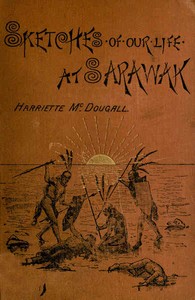
length
62,649 words
a few pages a day
~8 min
finished in
33 days
full read
4h 21m
At Folio's default of ten pages a day, you finish Sketches of Our Life at Sarawak in about 33 days — roughly 8 minutes of reading each morning.
The opening
the first pages of Sketches of Our Life at Sarawak, free
Nearly thirty years ago I published a little book of "Letters from Sarawak, addressed to a Child." This book is now out of print, and, on looking it over with a view to republication, I think it will be better to extend the story over the twenty years that Sarawak was our home, which will give some idea of the gradual progress of the mission.
This progress was often unavoidably impeded by the struggles of the infant State; for war drowns the voice of the missionary, and though the Sarawak Government always discouraged the Dyak practice of taking the heads of their enemies, still it could not at once be checked, and every expedition against lawless tribes, however righteous in its object, excited the old superstitions of those wild people. When their warriors returned from an expedition, the women of the tribe met them with dance and song, receiving the heads they brought with ancient ceremonies--"fondling the heads," as it was called; and for months afterwards keeping up, by frequent feasts, in which these heads were the chief attraction, the heathen customs which it was the object of the missionary to discourage.
I dare say, when we first settled at Sarawak, we thought that twenty years would plant Christian communities, and build Christian churches all over the country: but it is as well that we cannot overlook the future; and perhaps, considering the many difficulties which arose from time to time, from the missionaries themselves, and the unsettled country in which they laboured, we ought not to expect more results than have appeared. At any rate we have much to be thankful for, and as every year makes Sarawak a more important State, consolidates its Government, and extends civilization to its subjects, we may look for more success for the missionaries, who can now point to the peace and prosperity of the people, and say, "This is the fruit of Christianity and Christian rulers."
In giving a short account of our life in Borneo, I shall avoid alike all political questions, or, as much as possible, individual histories among the English community. It is already so long ago since we lived in that lovely place, that events, trials, joys, and the usual vicissitudes of life, are wrapt in that mellowing haze of the past, which, while it dims the vividness of feeling, throws a robe of charity over all, and perhaps causes actors and actions to assume a more true proportion to one another than when we walked amongst them. I have, however, not depended on memory alone for the records of twenty years, but have journals and letters to refer to, which my friends in England have been good enough to keep for me. Some parts of "Letters from Sarawak" I shall incorporate into the present little book, for as it treats of the first six years we lived there, and was written at that time, it is sure to be tolerably correct.
In those days, from 1847 to 1853, Sir James Brooke was very popular in England. The story of his first occupation of Sarawak, published in his journals, and the cruizes of her Majesty's ships in those eastern seas--the Dido and the Samarang--were read with avidity, and furnished the English public with a romance which had all the charm of novelty. However difficult and inconvenient it might be for the English Government to recognize a native State under an English rajah, who was at the same time a subject of the Queen of Great Britain, this question had not then arisen; and all classes, high and low, could applaud a brave and noble man, who had stepped out of the beaten track to spend his fortune and expose his life in the cause of savages. There were many fluctuations of sympathy and opinion in after years towards Sir James Brooke; but, through evil report and good report, through difficulty and danger, Sarawak has still advanced, and is as worthy of the interest of the best and wisest of mankind as it was in 1847. At this time, indeed, it seems to me to furnish a lesson in the management of native races which might be useful in our own colonies. English governors always set out with good intentions towards the natives of savage countries, but how is it that war almost always follows their occupation? Surely it is because the settlers go there, not in the interest of the native race, but their own, and the two interests are sure to clash in the long-run.
Keep going from exactly here — Folio remembers your place and serves the next portion tomorrow.
continue reading Sketches of Our Life at SarawakAbout this free edition
Sketches of Our Life at Sarawak by Henriette McDougall (1817-1886) is free to read in full. Folio serves it in daily portions you can actually finish, tracks your streak and reading position across devices, and reads every page aloud with a built-in narrator. The text comes from Project Gutenberg.
More like Sketches of Our Life at Sarawak

The Autobiography of Benjamin Franklin
Benjamin Franklin
Narrative of the Life of Frederick Douglass
Folio
Narrative of the Life of Frederick Douglass
Frederick Douglass
My Bondage and My Freedom
Folio
My Bondage and My Freedom
Frederick Douglass
The Story of My Life
Folio
The Story of My Life
Helen Keller

Up from Slavery
Booker T. Washington
Incidents in the Life of a Slave Girl
Folio
Incidents in the Life of a Slave Girl
Harriet Jacobs
Twelve Years a Slave
Solomon Northup
The Narrative of Sojourner Truth
Folio
The Narrative of Sojourner Truth
Sojourner Truth