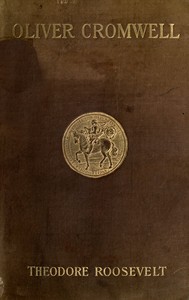
length
61,524 words
a few pages a day
~8 min
finished in
33 days
full read
4h 16m
At Folio's default of ten pages a day, you finish Oliver Cromwell in about 33 days — roughly 8 minutes of reading each morning.
The opening
the first pages of Oliver Cromwell, free
For over a century and a half after his death the memory of the greatest Englishman of the seventeenth century was looked upon with horror by the leaders of English thought, political and literary; the very men who were carrying to fruition Cromwell’s tremendous policies being often utterly ignorant that they were following in his footsteps. At last the scales began to drop from the most far-seeing eyes. Macaulay, with his eminently sane and wholesome spirit, held Cromwell and the social forces for which he stood—Puritanic and otherwise—at their real worth, and his judgment about them was, in all essentials, accurate. But the true appreciation of the place held by the greatest soldier-statesman of the seventeenth century began with the publication of his life and letters by Carlyle. The gnarled genius of the man who worshipped the heroes of the past as intensely as he feared and distrusted the heroes of the present, enabled him to write with a loftiness and intensity that befitted his subject. But Carlyle’s singular incapacity to “see veracity,” as he would himself have phrased it, made him at times not merely tell half-truths, but deliberately invert the truth. He was of that not uncommon cloistered type which shrinks shuddering from actual contact with whatever it, in theory, most admires, and which, therefore, is reduced in self-justification to misjudge and misrepresent those facts of past history which form precedents for what is going on before the author’s own eyes.
Cromwell lived in an age when it was not possible to realize a government based upon those large principles of social, political, and religious liberty in which—at any rate, during his earlier years—he sincerely believed; but the movement of which he was the head was the first of the great movements which, marching along essentially the same lines, have produced the English-speaking world as we at present know it. This primary fact Carlyle refused to see, or at least to admit. As the central idea of his work he states that the Puritanism of the Cromwellian epoch was the “last glimpse of the Godlike vanishing from this England; conviction and veracity giving place to hollow cant and formulism.... The last of all our Heroisms.... We have wandered far away from the ideas which guided us in that century, and indeed which had guided us in all preceding centuries, but of which that century was the ultimate manifestation; we have wandered very far; and must endeavor to return and connect ourselves therewith again.... I will advise my reader to forget the modern methods of reform; not to remember that he has ever heard of a modern individual called by the name of ‘Reformer,’ if he would understand what the old meaning of the word was. The Cromwells, Pyms, and Hampdens, who were understood on the Royalist side to be fire-brands of the devil, have had still worse measure from the Dry-as-Dust philosophies and sceptical histories of later times. They really did resemble fire-brands of the devil if you looked at them through spectacles of a certain color, for fire is always fire; but by no spectacles, only by mere blindness and wooden-eyed spectacles, can the flame-girt heaven’s messenger pass for a poor, mouldy Pedant and Constitution-monger such as these would make him out to be.”
This is good writing of its kind; but the thought is mere “hollow cant and unveracity;” not only far from the truth, but the direct reverse of the truth. It is itself the wail of the pedant who does not know that the flame-girt heaven’s messenger of truth is always a mere mortal to those who see him with the actual eyes of the flesh, although mayhap a great mortal; while to the closet philosopher his quality of flame-girtedness is rarely visible until a century or thereabouts has elapsed.
Keep going from exactly here — Folio remembers your place and serves the next portion tomorrow.
continue reading Oliver CromwellAbout this free edition
Oliver Cromwell by Theodore Roosevelt (1858-1919) is free to read in full. Folio serves it in daily portions you can actually finish, tracks your streak and reading position across devices, and reads every page aloud with a built-in narrator. The text comes from Project Gutenberg.
More like Oliver Cromwell
Hunting the Grisly, and Other Sketches
Folio
Hunting the Grisly, and Other Sketches
Theodore Roosevelt
Biological analogies in history
Theodore Roosevelt
Theodore Roosevelt: An Autobiography
Folio
Theodore Roosevelt: An Autobiography
Theodore Roosevelt
Through the Brazilian Wilderness
Folio
Through the Brazilian Wilderness
Theodore Roosevelt
American Ideals, and Other Essays
Theodore Roosevelt
Letters to His Children
Folio
Letters to His Children
Theodore Roosevelt
The Rough Riders
Folio
The Rough Riders
Theodore Roosevelt
Average Americans
Theodore Roosevelt