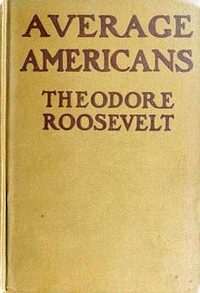
length
47,061 words
a few pages a day
~8 min
finished in
25 days
full read
3h 16m
At Folio's default of ten pages a day, you finish Average Americans in about 25 days — roughly 8 minutes of reading each morning.
The opening
the first pages of Average Americans, free
All our lives my father treated his sons and daughters as companions. When we were not with him he wrote to us constantly. Everything that we did we discussed with him whenever it was possible. All his children tried to live up to his principles. In the paragraphs from his letters below, he speaks often of the citizens of this country as "our people." It is for all these, equally with us, that the messages are intended.
"New Year's greetings to you! This may or may not be, on the whole, a happy New Year--almost certainly it will be in part at least a New Year of sorrow--but at least you and your brothers will be upborne by the self-reliant pride coming from having played well and manfully a man's part when the great crisis came, the great crisis that 'sifted out men's souls' and winnowed the chaff from the grain."--January 1, 1918.
"Large masses of people still vaguely feel that somehow I can say something which will avoid all criticism of the government and yet make the government instantly remedy everything that is wrong; whereas in reality nothing now counts except the actual doing of the work and that I am allowed to have no part in. Generals Wood and Crowder have been denied the chance to render service; appointments are made primarily on grounds of seniority, which in war time is much like choosing Poets Laureate on the same grounds."--August 23, 1917.
"At last, after seven months, we are, like Mr. Snodgrass, 'going to begin.' The National Guard regiments are just beginning to start for their camps, and within the next two weeks I should say that most of them would have started; and by the first of September I believe that the first of the National Army will begin to assemble in their camps.... I do nothing. Now and then, when I can't help myself, I speak, for it is necessary to offset in some measure the talk of the fools, traitors, pro-Germans, and pacifists; but really what we need against these is action, and that only the government can take. Words count for but little when the 'drumming guns' have been waked."--August 23, 1917.
"The regular officers are fine fellows, but for any serious work we should eliminate two thirds of the older men and a quarter of the younger men, and use the remainder as a nucleus for, say, three times their number of civilian officers. Except with a comparatively small number, too long a stay in our army--with its peculiar limitations--produces a rigidity of mind that refuses to face the actual conditions of modern warfare. But the wonder is that our army and navy have been able to survive in any shape after five years of Baker and Daniels."--September 17, 1917.
"Along many lines of preparation the work here is now going fairly fast--not much of a eulogy when we are in the ninth month of the war. But there cannot be much speed when military efficiency is subordinated to selfish personal politics, the gratification of malice, and sheer wooden-headed folly."--October 14, 1917.
"The socialist vote [in the New York mayoralty election] was rather ominous. Still, on the whole, it was only about one fifth of the total vote. It included the extreme pacifist crowd, as well as the vicious red-flag men, and masses of poor, ignorant people who, for example, would say. 'He'll give us five-cent milk,' which he could have given as readily as he could have given the moon."--November 7, 1917.
"Well, it's dreadful to have those we love go to the front; but it is even worse when they are not allowed to go to the front."--Letter to Mrs. Theodore Roosevelt, Jr., November 11, 1917.
"Yesterday mother and I motored down to the draft camp at Yaphank. First, I was immensely pleased with the type of the men, and the officers are just as good as the average of young West Pointers. I believe that in the end that army there will be as fine a body of fighting men as any nation in the world could desire to see under its banners. But there is still, after nearly three months that they have been called out, some shortage in warm clothes; there are modern rifles for only one man in six; there are only about four guns to an artillery brigade."--November 19, 1917.
Keep going from exactly here — Folio remembers your place and serves the next portion tomorrow.
continue reading Average AmericansAbout this free edition
Average Americans by Theodore Roosevelt (1887-1944) is free to read in full. Folio serves it in daily portions you can actually finish, tracks your streak and reading position across devices, and reads every page aloud with a built-in narrator. The text comes from Project Gutenberg.
More like Average Americans
Hunting the Grisly, and Other Sketches
Folio
Hunting the Grisly, and Other Sketches
Theodore Roosevelt

Biological analogies in history
Theodore Roosevelt
Theodore Roosevelt: An Autobiography
Folio
Theodore Roosevelt: An Autobiography
Theodore Roosevelt
Through the Brazilian Wilderness
Folio
Through the Brazilian Wilderness
Theodore Roosevelt
Oliver Cromwell
Theodore Roosevelt
American Ideals, and Other Essays
Theodore Roosevelt
Letters to His Children
Folio
Letters to His Children
Theodore Roosevelt
The Rough Riders
Folio
The Rough Riders
Theodore Roosevelt