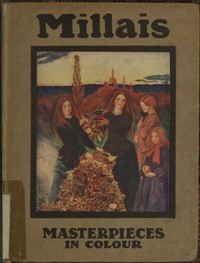
length
7,522 words
a few pages a day
~8 min
finished in
4 days
full read
31 min
At Folio's default of ten pages a day, you finish Millais in about 4 days — roughly 8 minutes of reading each morning.
The opening
the first pages of Millais, free
As a record of some half century of brilliant activity, and of practically unbroken success, the life-story of John Everett Millais is in many respects unlike those which can be told about the majority of artists who have played great parts in the modern art world. He had none of the hard struggle for recognition, or of the fight against adverse circumstances, which have too often embittered the earlier years of men destined to take eventually the highest rank in their profession. Things went well with him from the first; he gained attention at an age when most painters have barely begun to make a bid for popularity, and his position was assured almost before he had arrived at man's estate. He owed some of his success, no doubt, to his attractive and vigorous personality, but it was due in far greater measure to the extraordinary powers which he manifested from the very outset of his career.
[Illustration: PLATE II.--THE BOYHOOD OF RALEIGH (Tate Gallery)
It would not be inappropriate to describe the "Boyhood of Raleigh" as the prologue to the romance of which the last chapter is written in the "North-West Passage," for in both pictures the artist suggests the fascination of the adventurous life. Young Raleigh and his boy friend are under the spell of the story which the sailor is telling them, a story evidently of engrossing interest and stimulating to the imagination. The faces of the lads show how inspiring they find this tale of strange experiences in lands beyond the sea.]
For there was something almost sensational in the manner of his development, in his unusual precocity, and in the youthful self-confidence which enabled him to take a prominent place among the leaders of artistic opinion while he was still little more than a boy. So early was the proof given that he possessed absolutely uncommon powers, that he was not more than nine years old when he began serious art training; and so evident even then was his destiny that this training was commenced on the advice of Sir Martin Archer Shee, the President of the Royal Academy, to whom the child's performances had been submitted by parents anxious for an expert opinion. The President's declaration when he saw these early efforts, that "nature had provided for the boy's success," was emphatic enough to dissipate any doubts there might have been whether or not young Millais was to be encouraged in his artistic inclinations; and that this emphasis was justified by subsequent results no one to-day can dispute.
The family from which Millais sprang was not one with any past record of art achievement. His ancestors were men of action and inclined rather to be fighters than students of the arts. They were Normans who had settled in Jersey, and had for several hundred years been counted among the more important landholders in that island, where at different times they held several estates. From these ancestors Millais derived his energetic temperament and that militant activity which enabled him in his career as an artist to triumph signally over established prejudices--the qualities which undoubtedly helped him to make his power felt even by the people who were most opposed to him.
He was born on June 8th, 1829, at Southampton, where his parents were temporarily living, but his earliest years were spent in Jersey. It was in 1835 that he began to show definitely his artistic inclinations; he was at Dinan then with his parents and he amused himself there by making sketches of the country and people with success so remarkable that even strangers did not hesitate to recognise him as a budding genius. Three years later this estimate was confirmed by Sir Martin Archer Shee, and the boy was then sent to work at the art school which Henry Sass carried on in Bloomsbury, a school which had at that time a considerable reputation as a training place for art students, and in which most of the early Victorian painters received their preliminary education.
Keep going from exactly here — Folio remembers your place and serves the next portion tomorrow.
continue reading MillaisAbout this free edition
Millais by A. L. Baldry (1858-1939) is free to read in full. Folio serves it in daily portions you can actually finish, tracks your streak and reading position across devices, and reads every page aloud with a built-in narrator. The text comes from Project Gutenberg.
More like Millais
Leighton
A. L. Baldry

Burne-Jones
A. L. Baldry

The Autobiography of Benjamin Franklin
Benjamin Franklin
Narrative of the Life of Frederick Douglass
Folio
Narrative of the Life of Frederick Douglass
Frederick Douglass
My Bondage and My Freedom
Folio
My Bondage and My Freedom
Frederick Douglass
The Story of My Life
Folio
The Story of My Life
Helen Keller

Up from Slavery
Booker T. Washington
Incidents in the Life of a Slave Girl
Folio
Incidents in the Life of a Slave Girl
Harriet Jacobs