length
148,260 words
a few pages a day
~8 min
finished in
79 days
full read
10h 18m
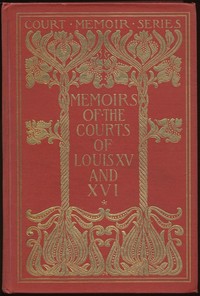
At Folio's default of ten pages a day, you finish Memoirs of the Courts of Louis XV and XVI in about 79 days — roughly 8 minutes of reading each morning.
The opening
the first pages of Memoirs of the Courts of Louis XV and XVI, free
We were obliged by circumstances, at one time, to read all the published memoirs relative to the reign of Louis XV., and had the opportunity of reading many others which may not see the light for a long time yet to come, as their publication at present would materially militate against the interest of the descendants of the writers; and we have no hesitation in saying that the Memoirs of Madame du Hausset are the only perfectly sincere ones amongst all those we know. Sometimes, Madame du Hausset mistakes, through ignorance, but never does she wilfully mislead, like Madame Campan, nor keep back a secret, like Madame Roland, and MM. Bezenval and Ferreires; nor is she ever betrayed by her vanity to invent, like the Due de Lauzun, MM. Talleyrand, Bertrand de Moleville, Marmontel, Madame d’Epinay, etc. When Madame du Hausset is found in contradiction with other memoirs of the same period, we should never hesitate to give her account the preference. Whoever is desirous of accurately knowing the reign of Louis XV. should run over the very wretched history of Lacretelle, merely for the dates, and afterwards read the two hundred pages of the naive du Hausset, who, in every half page, overturns half a dozen misstatements of this hollow rhetorician. Madame du Hausset was often separated from the little and obscure chamber in the Palace of Versailles, where resided the supreme power, only by a slight door or curtain, which permitted her to hear all that was said there. She had for a ‘cher ami’ the greatest practical philosopher of that period, Dr. Quesnay, the founder of political economy. He was physician to Madame de Pompadour, and one of the sincerest and most single-hearted of men probably in Paris at the time. He explained to Madame du Hausset many things that, but for his assistance, she would have witnessed without understanding.
INTRODUCTION.
A friend of M. de Marigny (the brother of Madame de Pompadour) called on him one day and found him burning papers. Taking up a large packet which he was going to throw into the fire “This,” said he, “is the journal of a waiting-woman of my sister’s. She was a very estimable person, but it is all gossip; to the fire with it!” He stopped, and added, “Don’t you think I am a little like the curate and the barber burning Don Quixote’s romances?”--“I beg for mercy on this,” said his friend. “I am fond of anecdotes, and I shall be sure to find some here which will interest me.” “Take it, then,” said M. de Marigny, and gave it him.
The handwriting and the spelling of this journal are very bad. It abounds in tautology and repetitions. Facts are sometimes inverted in the order of time; but to remedy all these defects it would have been necessary to recast the whole, which would have completely changed the character of the work. The spelling and punctuation were, however, corrected in the original, and some explanatory notes added.
Madame de Pompadour had two waiting-women of good family. The one, Madame du Hausset, who did not change her name; and another, who assumed a name, and did not publicly announce her quality. This journal is evidently the production of the former.
The amours of Louis XV. were, for a long time, covered with the veil of mystery. The public talked of the Parc-aux-Cerfs, but were acquainted with none of its details. Louis XIV., who, in the early part of his reign, had endeavoured to conceal his attachments, towards the close of it gave them a publicity which in one way increased the scandal; but his mistresses were all women of quality, entitled by their birth to be received at Court. Nothing can better describe the spirit of the time and the character of the Monarch than these words of Madame de Montespan:
“He does not love me,” said she, “but he thinks he owes it to his subjects and to his own greatness to have the most beautiful woman in his kingdom as his mistress.”
SECRET MEMOIRS OF LOUIS XV., AND MEMOIRS OF MADAME DU HAUSSET.
Keep going from exactly here — Folio remembers your place and serves the next portion tomorrow.
continue reading Memoirs of the Courts of Louis XV and XVIAbout this free edition
Memoirs of the Courts of Louis XV and XVI by Mme. Du Hausset (1713-1801) is free to read in full. Folio serves it in daily portions you can actually finish, tracks your streak and reading position across devices, and reads every page aloud with a built-in narrator. The text comes from Project Gutenberg.
More like Memoirs of the Courts of Louis XV and XVI
The Autobiography of Benjamin Franklin
Benjamin Franklin
Narrative of the Life of Frederick Douglass
Folio
Narrative of the Life of Frederick Douglass
Frederick Douglass
My Bondage and My Freedom
Folio
My Bondage and My Freedom
Frederick Douglass
The Story of My Life
Folio
The Story of My Life
Helen Keller

Up from Slavery
Booker T. Washington
Incidents in the Life of a Slave Girl
Folio
Incidents in the Life of a Slave Girl
Harriet Jacobs
Twelve Years a Slave
Solomon Northup
The Narrative of Sojourner Truth
Folio
The Narrative of Sojourner Truth
Sojourner Truth