length
113,596 words
a few pages a day
~8 min
finished in
60 days
full read
7h 53m
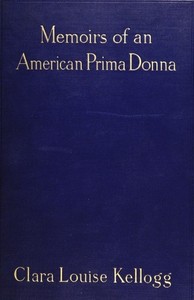
At Folio's default of ten pages a day, you finish Memoirs of an American Prima Donna in about 60 days — roughly 8 minutes of reading each morning.
The opening
the first pages of Memoirs of an American Prima Donna, free
The name of Clara Louise Kellogg is known to the immediate generation chiefly as an echo of the past. Yet only thirty years ago it was written of her, enthusiastically but truthfully, that "no living singer needs a biography less than Miss Clara Louise Kellogg; and nowhere in the world would a biography of her be so superfluous as in America, where her name is a household word and her illustrious career is familiar in all its triumphant details to the whole people."
The past to which she belongs is therefore recent; it is the past of yesterday only, thought of tenderly by our fathers and mothers, spoken of reverently as a poignant phase of their own ephemeral youth, one of their sweet lavender memories. The pity is (although this is itself part of the evanescent charm), that the singer's best creations can live but in the hearts of a people, and the fame of sound is as fugitive as life itself.
A record of such creations is, however, possible and also enduring; while it is also necessary for a just estimate of the development of civilisations. As such, this record of her musical past--presented by Clara Louise Kellogg herself--will have a place in the annals of the evolution of musical art on the North American continent long after every vestige of fluttering personal reminiscence has vanished down the ages. A word of appreciation with regard to the preparation of this record is due to John Jay Whitehead, Jr., whose diligent chronological labours have materially assisted the editor.
Clara Louise Kellogg came from New England stock of English heritage. She was named after Clara Novello. Her father, George Kellogg, was an inventor of various machines and instruments and, at the time of her birth, was principal of Sumter Academy, Sumterville, S. C. Thus the famous singer was acclaimed in later years not only as the Star of the North (the rôle of Catherine in Meyerbeer's opera of that name being one of her achievements) but also as "the lone star of the South in the operatic world." She first sang publicly in New York in 1861 at an evening party given by Mr. Edward Cooper, the brother of Mrs. Abram Hewitt. This was the year of her début as Gilda in Verdi's opera of Rigoletto at the Academy of Music in New York City. When she came before her countrymen as a singer, she was several decades ahead of her musical public, for she was a lyric artist as well as a singer. America was not then producing either singers or lyric artists; and in fact we were, as a nation, but just getting over the notion that America could not produce great voices. We held a very firm contempt for our own facilities, our knowledge, and our taste in musical matters. If we did discover a rough diamond, we had to send it to Italy to find out if it were of the first water and to have it polished and set. Nothing was so absolutely necessary for our self-respect as that some American woman should arise with sufficient American talent and bravery to prove beyond all cavil that the country was able to produce both singers and artists.
For rather more than twenty-five years, from her appearance as Gilda until she quietly withdrew from public life, when it seemed to her that the appropriate moment for so doing had come, Clara Louise Kellogg filled this need and maintained her contention. She was educated in America, and her career, both in America and abroad, was remarkable in its consistent triumphs. When Gounod's Faust was a musical and an operatic innovation, she broke through the Italian traditions of her training and created the rôle of Marguerite according to her own beliefs; and throughout her later characterisations in Italian opera, she sustained a wonderfully poised attitude of independence and of observance with regard to these same traditions. In London, in St. Petersburg, in Vienna, as well as in the length and breadth of the United States, she gained a recognition and an appreciation in opera, oratorio, and concert, second to none: and when, later, she organised an English Opera Company and successfully piloted it on a course of unprecedented popularity, her personal laurels were equally supreme.
Keep going from exactly here — Folio remembers your place and serves the next portion tomorrow.
continue reading Memoirs of an American Prima DonnaAbout this free edition
Memoirs of an American Prima Donna by Clara Louise Kellogg (1842-1916) is free to read in full. Folio serves it in daily portions you can actually finish, tracks your streak and reading position across devices, and reads every page aloud with a built-in narrator. The text comes from Project Gutenberg.
More like Memoirs of an American Prima Donna
The Autobiography of Benjamin Franklin
Benjamin Franklin
Narrative of the Life of Frederick Douglass
Folio
Narrative of the Life of Frederick Douglass
Frederick Douglass
My Bondage and My Freedom
Folio
My Bondage and My Freedom
Frederick Douglass
The Story of My Life
Folio
The Story of My Life
Helen Keller

Up from Slavery
Booker T. Washington
Incidents in the Life of a Slave Girl
Folio
Incidents in the Life of a Slave Girl
Harriet Jacobs
Twelve Years a Slave
Solomon Northup
The Narrative of Sojourner Truth
Folio
The Narrative of Sojourner Truth
Sojourner Truth