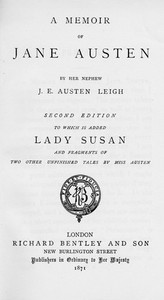
length
51,292 words
a few pages a day
~8 min
finished in
27 days
full read
3h 34m
At Folio's default of ten pages a day, you finish Memoir of Jane Austen in about 27 days — roughly 8 minutes of reading each morning.
The opening
the first pages of Memoir of Jane Austen, free
Chapter VI. Habits of Composition resumed after a long interval--First publication--The interest taken by the Author in the success of her Works
Chapter VII. Seclusion from the literary world--Notice from the Prince Regent--Correspondence with Mr. Clarke--Suggestions to alter her style of writing
Chapter VIII. Slow growth of her fame--Ill success of first attempts at publication--Two Reviews of her works contrasted
Chapter IX. Opinions expressed by eminent persons--Opinions of others of less eminence--Opinion of American readers
Chapter X. Observations on the Novels
Chapter XI. Declining health of Jane Austen--Elasticity of her spirits--Her resignation and humility--Her death
Chapter XII. The cancelled Chapter of 'Persuasion'
Chapter XIII. The last work
Chapter XIV. Postscript
'He knew of no one but himself who was inclined to the work. This is no uncommon motive. A man sees something to be done, knows of no one who will do it but himself, and so is driven to the enterprise.'
HELPS' Life of Columbus, ch. i.
CHAPTER I.
Introductory Remarks--Birth of Jane Austen--Her Family Connections--Their Influence on her Writings.
More than half a century has passed away since I, the youngest of the mourners, {1} attended the funeral of my dear aunt Jane in Winchester Cathedral; and now, in my old age, I am asked whether my memory will serve to rescue from oblivion any events of her life or any traits of her character to satisfy the enquiries of a generation of readers who have been born since she died. Of events her life was singularly barren: few changes and no great crisis ever broke the smooth current of its course. Even her fame may be said to have been posthumous: it did not attain to any vigorous life till she had ceased to exist. Her talents did not introduce her to the notice of other writers, or connect her with the literary world, or in any degree pierce through the obscurity of her domestic retirement. I have therefore scarcely any materials for a detailed life of my aunt; but I have a distinct recollection of her person and character; and perhaps many may take an interest in a delineation, if any such can be drawn, of that prolific mind whence sprung the Dashwoods and Bennets, the Bertrams and Woodhouses, the Thorpes and Musgroves, who have been admitted as familiar guests to the firesides of so many families, and are known there as individually and intimately as if they were living neighbours. Many may care to know whether the moral rectitude, the correct taste, and the warm affections with which she invested her ideal characters, were really existing in the native source whence those ideas flowed, and were actually exhibited by her in the various relations of life. I can indeed bear witness that there was scarcely a charm in her most delightful characters that was not a true reflection of her own sweet temper and loving heart. I was young when we lost her; but the impressions made on the young are deep, and though in the course of fifty years I have forgotten much, I have not forgotten that 'Aunt Jane' was the delight of all her nephews and nieces. We did not think of her as being clever, still less as being famous; but we valued her as one always kind, sympathising, and amusing. To all this I am a living witness, but whether I can sketch out such a faint outline of this excellence as shall be perceptible to others may be reasonably doubted. Aided, however, by a few survivors {3} who knew her, I will not refuse to make the attempt. I am the more inclined to undertake the task from a conviction that, however little I may have to tell, no one else is left who could tell so much of her.
Jane Austen was born on December 16, 1775, at the Parsonage House of Steventon in Hampshire. Her father, the Rev. George Austen, was of a family long established in the neighbourhood of Tenterden and Sevenoaks in Kent. I believe that early in the seventeenth century they were clothiers. Hasted, in his history of Kent, says: 'The clothing business was exercised by persons who possessed most of the landed property in the Weald, insomuch that almost all the ancient families of these parts, now of large estates and genteel rank in life, and some of them ennobled by titles, are sprung from ancestors who have used this great staple manufacture, now almost unknown here.' In his list of these families Hasted places the Austens, and he adds that these clothiers 'were usually called the Gray Coats of Kent; and were a body so numerous and united that at county elections whoever had their vote and interest was almost certain of being elected.' The family still retains a badge of this origin; for their livery is of that peculiar mixture of light blue and white called Kentish gray, which forms the facings of the Kentish militia.
Keep going from exactly here — Folio remembers your place and serves the next portion tomorrow.
continue reading Memoir of Jane AustenAbout this free edition
Memoir of Jane Austen by James Edward Austen-Leigh (1798-1874) is free to read in full. Folio serves it in daily portions you can actually finish, tracks your streak and reading position across devices, and reads every page aloud with a built-in narrator. The text comes from Project Gutenberg.
More like Memoir of Jane Austen
The Autobiography of Benjamin Franklin
Benjamin Franklin
Narrative of the Life of Frederick Douglass
Folio
Narrative of the Life of Frederick Douglass
Frederick Douglass
My Bondage and My Freedom
Folio
My Bondage and My Freedom
Frederick Douglass
The Story of My Life
Folio
The Story of My Life
Helen Keller
Up from Slavery
Booker T. Washington
Incidents in the Life of a Slave Girl
Folio
Incidents in the Life of a Slave Girl
Harriet Jacobs
Twelve Years a Slave
Solomon Northup
The Narrative of Sojourner Truth
Folio
The Narrative of Sojourner Truth
Sojourner Truth