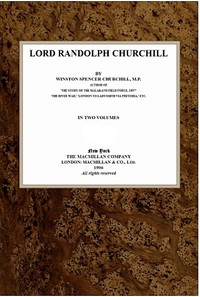
length
297,859 words
a few pages a day
~8 min
finished in
157 days
full read
20h 41m
At Folio's default of ten pages a day, you finish Lord Randolph Churchill in about 157 days — roughly 8 minutes of reading each morning.
The opening
the first pages of Lord Randolph Churchill, free
In the spring of 1893 Lord Randolph Churchill, feeling that he had slender expectations of long life, placed all his papers, private and official, under a trust-deed which consigned them at his death to the charge of two of his most intimate political friends, Viscount Curzon (now Earl Howe) and Mr. Ernest Beckett (now Lord Grimthorpe). As he made a practice of preserving almost every letter he received, the number of documents was sufficient to fill eleven considerable tin boxes. Subject to the conditions prescribed in the trust-deed in regard to matters affecting the India Office or the Foreign Office--which have, of course, been strictly observed--these papers were placed in my hands by my father’s literary executors in July 1902, for the purpose of my writing a full account of his life and work. I am deeply sensible of the confidence implied and of the honour conveyed in that commission, and during the three and a half years which have passed since I accepted it, I have diligently laboured--in spite of some political distractions--to discharge it to the best of my ability.
Sir Michael Hicks-Beach (having consulted with the late Lord Salisbury) and Lord Rosebery have expressed the opinion that the story of Lord Randolph Churchill’s life may now be fully told without impropriety towards individuals or the public. Indeed, it is high time to do so. Lord Randolph’s part in national affairs is not to be measured by long years of office. No great legislation stands in his name upon the statute book. He was a Chancellor of the Exchequer without a Budget, a Leader of the House of Commons but for a single session, a victor without the spoils. No tangible or enduring records--unless it be the Burma province--exist of his labours, and the great and decisive force which he exerted upon the history of the Conservative and Unionist party might be imperfectly realised by a later generation, unless it were explained, asserted, and confirmed by the evidence of those who came in contact or collision with his imperious and vivifying personality.
For a thing so commonly attempted, political biography is difficult. The style and ideas of the writer must throughout be subordinated to the necessity of embracing in the text those documentary proofs upon which the story depends. Letters, memoranda, and extracts from speeches, which inevitably and rightly interrupt the sequence of his narrative, must be pieced together upon some consistent and harmonious plan. It is not by the soft touches of a picture, but in hard mosaic or tessellated pavement, that a man’s life and fortunes must be presented in all their reality and romance. I have thought it my duty, so far as possible, to assemble once and for all the whole body of historical evidence required for the understanding of Lord Randolph Churchill’s career. Scarcely anything of material consequence has been omitted, and such omissions as have been necessary are made for others’ sakes and not his own. Scarcely any statement of importance lacks documentary proof. There is nothing more to tell. Wherever practicable I have endeavoured to employ his own words in the narration; and the public is now in a position to pronounce a complete, if not a final, judgment.
I have been fortunate in the abundance of the materials supplied me. In addition to Lord Randolph Churchill’s tin boxes with their ample stores, there was at hand an invaluable series of scrap-books, containing every conceivable newspaper comment and cartoon, collected by his sister, Lady Wimborne, and covering the whole period of his active political life. But most of all I am indebted to those many friends, irrespective of political party, who either by allowing their letters to be printed, or by reading the proof-sheets, have enabled me to compile what may, without presumption, be called an authoritative account. I accept, of course, in the fullest sense, exclusive responsibility for whatever is written here; but to Sir Michael Hicks-Beach, first of all, my grateful acknowledgments are due, for not only has he with the greatest care and pains thoroughly revised the whole book, but furnished me, besides, with extensive memoranda in respect of those chapters with the events of which he was specially concerned.
Keep going from exactly here — Folio remembers your place and serves the next portion tomorrow.
continue reading Lord Randolph ChurchillAbout this free edition
Lord Randolph Churchill by Winston Churchill (1874-1965) is free to read in full. Folio serves it in daily portions you can actually finish, tracks your streak and reading position across devices, and reads every page aloud with a built-in narrator. The text comes from Project Gutenberg.
More like Lord Randolph Churchill
The Crossing
Folio
The Crossing
Winston Churchill
An essay on the American contribution and the democratic idea
Folio
An essay on the American contribution and the democratic idea
Winston Churchill
London to Ladysmith via Pretoria
Folio
London to Ladysmith via Pretoria
Winston Churchill
The Story of the Malakand Field Force: An Episode of Frontier War
Folio
The Story of the Malakand Field Force: An Episode of Frontier War
Winston Churchill
A Traveller in War-Time
Folio
A Traveller in War-Time
Winston Churchill
The River War: An Account of the Reconquest of the Sudan
Folio
The River War: An Account of the Reconquest of the Sudan
Winston Churchill
Ian Hamilton's March
Winston Churchill
My African Journey
Winston Churchill