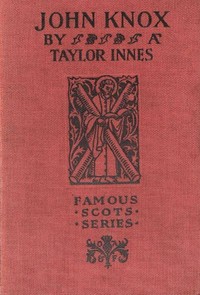
length
49,769 words
a few pages a day
~8 min
finished in
27 days
full read
3h 27m
At Folio's default of ten pages a day, you finish John Knox in about 27 days — roughly 8 minutes of reading each morning.
The opening
the first pages of John Knox, free
The century now closing has redeemed Knox from neglect, and has gathered around his name a mass of biographical material. That material, too, includes much that is of the nature of self-revelation, to be gleaned from familiar letters, as well as from his own history of his time. Yet, after all that has been brought together, Knox remains to many observers a mere hard outline, while to others he is almost an enigma--a blur, bright or black, upon the historic page.
There is one real and great difficulty. For the first forty years of his life we know absolutely nothing of the inner man. Yet at forty most men are already made. And in the case of this man, from about that date onwards we find the character settled and fixed. Henceforward, during the whole later life with its continually changing drama, Knox remains intensely and unchangeably the same. It is the contrast, perhaps the crisis, which is worth studying. The contrast, indeed, is not unprecedented. More than one Knox-like prophet, in the solemn days of early faith, 'was in the desert until the time of his shewing unto Israel'; and not the polished shaft only, but the rough spear-head too, has remained hid in the shadow of a mighty hand until the very day when it was launched. But each such case impels us the more to inquire, What was it after all which really made the man who in his turn made the age?
* * * * *
Knox was born in or near Haddington in 1505. Of his father, William Knox, and his mother, whose maiden name was Sinclair, nothing is known, except that the parents of both belonged to that district of country, and had fought under the standard of the House of Bothwell. We shall never know which of the two contributed the insight or the audacity, the tenacity or the tenderness, the common-sense or the humour, which must all have been part of Knox's natural character before it was moulded from without. His father was of the 'simple,' not of the gentle, sort; possibly a peasant, or frugal cultivator of the soil. But he saved enough to send one of his two sons, John, now in the eighteenth year of his age, and having, no doubt, received his earlier education in the excellent grammar school of Haddington, to the University of Glasgow. Haddington was in the diocese of St Andrews, but a native of Haddington, John Major, was at this time Regent in Glasgow. He had brought from Paris, four years before, a vast academical reputation, and Knox now 'sat as at his feet' during his last year of teaching in Glasgow. In 1523, however, Major was transferred to St Andrews, and there he taught theology for more than a quarter of a century, during the latter half of which time he was Provost or Head of St Salvator's College. Whether Knox at any time followed him there does not appear. Beza, Knox's earliest biographer, thought he did. But Beza's information as to this portion of the life, though apparently derived from Knox's colleague and successor,[1] is so extremely confused as to suggest that the Reformer was equally reticent about it to those nearest him as he has chosen to be to posterity. For nearly twenty years of manhood, indeed, Knox disappears from our view. And when, in 1540, he emerges again in his native district, it is as a notary and a priest. 'Sir John Knox' he was called by others, that being the style by which secular priests were known, unless they had taken not only the bachelor's but also the master's degree at the University.[2] Knox in after years never alluded to his priesthood, though his adversaries did; but so late as 27th March 1543 he describes himself in a notarial deed in his own handwriting as 'John Knox, minister of the sacred altar, of the Diocese of St Andrews, notary by Apostolical authority.' Apostolical means Papal, the notarial authority being transmitted through the St Andrews Archbishop; and Knox at this time does not shrink from dating his notarial act as in such a year 'of the pontificate of our most holy Father and Lord in Christ, the Lord Paul, Pope by the Providence of God.' Only three years later, in 1546, he was carrying a two-handed sword before Wishart, then in danger of arrest and condemnation to the stake at the hands of the same Archbishop Beaton under whom Knox held his orders. And in the following year, 1547, Knox is standing in the Church of St Andrews, and denouncing the Pope (not as an individual, though the Pope of that day was a Borgia, but) as the official head of an Anti-Christian system.
Keep going from exactly here — Folio remembers your place and serves the next portion tomorrow.
continue reading John KnoxAbout this free edition
John Knox by A. Taylor Innes (1833-1912) is free to read in full. Folio serves it in daily portions you can actually finish, tracks your streak and reading position across devices, and reads every page aloud with a built-in narrator. The text comes from Project Gutenberg.
More like John Knox
The Autobiography of Benjamin Franklin
Benjamin Franklin
Narrative of the Life of Frederick Douglass
Folio
Narrative of the Life of Frederick Douglass
Frederick Douglass
My Bondage and My Freedom
Folio
My Bondage and My Freedom
Frederick Douglass
The Story of My Life
Folio
The Story of My Life
Helen Keller
Up from Slavery
Booker T. Washington
Incidents in the Life of a Slave Girl
Folio
Incidents in the Life of a Slave Girl
Harriet Jacobs
Twelve Years a Slave
Solomon Northup
The Narrative of Sojourner Truth
Folio
The Narrative of Sojourner Truth
Sojourner Truth