length
11,347 words
a few pages a day
~8 min
finished in
6 days
full read
47 min
At Folio's default of ten pages a day, you finish Hogarth in about 6 days — roughly 8 minutes of reading each morning.
The opening
the first pages of Hogarth, free
The auction was proceeding leisurely and without excitement. It was an “off day.” I was present because these pictures of the Early British School included a “Conversation Piece” ascribed to Hogarth, and a medley of prints after him, worn impressions, the vigour gone, merely the skeletons of his bustling designs remaining. They fetched trivial prices: they were not the real thing. And there was little demand for the portraits by half-forgotten limners of the period, portraits of dull gentlemen in eighteenth-century costume, examples of wooden Thomas Hudson, famous as the master of Sir Joshua Reynolds, and of such mediocrities as Knapton and Shackleton. Yet they evoked a sort of personal historical interest, recreating, as portrait after portrait passed before our eyes, the level highway of art of those days before Hogarth delivered it from the foreign thraldom.
Tranquilly I contemplated the procession of lifeless portraits, noting with amusement the contrast between the grimy but very real hands of the attendant who supported the canvases upon the easel, and the painted hands in the pictures. The attendant’s body was hidden by the canvas, but his hands appeared on either side of the frame clutching it. I indicated the contrast to my companion, a connoisseur, but he saw no humour in the comparison. He was almost sulky. A decorative Francis Cotes, and a luminous Richard Wilson, that he hoped to acquire for a few pounds, had gone into the fifties. He indignantly refused to make a bid for the “Conversation Piece” ascribed to Hogarth. “What a period! what an outlook!” he cried. “William Kent the arbiter of taste, portraits with the clothes done by drapery men. Conversation Pieces with stupid gentlemen and stupid ladies doing nothing stupidly, and Hogarth flooding the town with his dreadful moralities. Pah!” He shook himself, emitted an exclamation of disgust that made the auctioneer glance quickly in his direction, and then said brusquely, “What do you think of Matisse?”
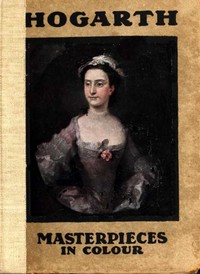
[Illustration: PLATE II.--HOGARTH’S SISTER
(In the National Gallery, London)
This dashing and brilliant portrait probably represents Ann Hogarth, the artist’s younger sister, who died, unmarried, in 1771. Note the vivacious and original way in which Hogarth has handled this sympathetic subject, and the skill with which he has, as it were, “substituted light and colour for paint.”]
I was not going to be drawn into that. I knew that Matisse was le dernier cri, the newest “master,” the idol of the moment among the “advanced,” who had passed beyond the re-discovery of Cézanne and Van Gogh. Hogarth, the painter Hogarth, not the “pictur’d moralities” Hogarth, had also had his period of re-discovery. Perhaps it began that day in the eighties when Whistler was admiring, “almost smelling,” the Canalettos in the National Gallery, while his companion, Mr. Pennington, was seeing for the first time Hogarth’s “Marriage à la Mode” series, “fairly gasping for breath,” to quote his own words.
“Come over here, quickly,” cried Pennington. “What’s the matter?” said Whistler, turning round. “Why! Hogarth! He was a great painter!” “Sh--sh,” said Whistler (pretending he was afraid that some one would overhear), “Sh--sh. Yes! I know it.... But don’t you tell ’em.”
Whistler had known that Hogarth was a great painter for years. His appreciation of the pugnacious little man of genius, with “a sort of knowing jockey look,” to quote Leigh Hunt, dated from his boyhood. “From then until his death,” says Mr. Pennell, “Whistler always believed Hogarth to be the greatest English artist who ever lived, and he seldom lost an opportunity of saying so.”
Well, it is a long time since the eighties, and to-day the fame of Hogarth as a painter is as great as was his fame as a moralist and satirist in the eighteenth century. Indeed I observe that some writers are beginning to resent praise of Hogarth as a painter, considering that the incident is closed, that all are agreed. That is not so. My friend, the connoisseur, who sat by my side at the auction sale, dissents. When he asked me fiercely what I thought of Matisse, I countered with the question--“What do you think of Hogarth?”
His answer was short and to the point. “There are only two of his things that interest me. They’re great. I mean, of course, ‘The Shrimp Girl,’ and ‘The Stay Maker.’ No! I don’t care about his moralities, and satires, and progresses. Single figures and incidental passages are charming, as good as the best episodes in Frith, but as a whole they’re dowdy, and every one of them shouts. I object to shouts and screams in art. Exaggeratedly exact and humorous records of eighteenth-century life and topography they may be, but I don’t want to be reminded of the eighteenth century. Give me the present or the real past, not the past of yesterday. It’s too near, too like us in our Bank Holiday moods, to be pleasant. Whistler called him the greatest English artist, did he? Merely another example of Whistler’s extravagance. Hogarth has his place. Let us keep cool and keep him there.”
Keep going from exactly here — Folio remembers your place and serves the next portion tomorrow.
continue reading HogarthAbout this free edition
Hogarth by C. Lewis Hind (1862-1927) is free to read in full. Folio serves it in daily portions you can actually finish, tracks your streak and reading position across devices, and reads every page aloud with a built-in narrator. The text comes from Project Gutenberg.
More like Hogarth

Constable
C. Lewis Hind
Romney
C. Lewis Hind
Watteau
C. Lewis Hind

The Autobiography of Benjamin Franklin
Benjamin Franklin
Narrative of the Life of Frederick Douglass
Folio
Narrative of the Life of Frederick Douglass
Frederick Douglass
My Bondage and My Freedom
Folio
My Bondage and My Freedom
Frederick Douglass
The Story of My Life
Folio
The Story of My Life
Helen Keller

Up from Slavery
Booker T. Washington