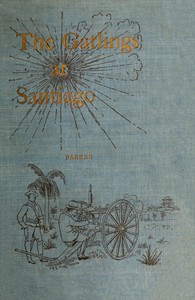
History of the Gatling Gun Detachment, Fifth Army Corps, at Santiago
free to read
length
55,488 words
a few pages a day
~8 min
finished in
30 days
full read
3h 51m
At Folio's default of ten pages a day, you finish History of the Gatling Gun Detachment, Fifth Army Corps, at Santiago in about 30 days — roughly 8 minutes of reading each morning.
The opening
the first pages of History of the Gatling Gun Detachment, Fifth Army Corps, at Santiago, free
The photographic illustrations in this work are due to the courage and kindness of Mr. John N. Weigle, of Gettysburg, Pa. This young man was first sergeant of the Gatling Gun Detachment, and took with him a large supply of material. It was his delight to photograph everything that occurred, and his pleasure to furnish a set of photographs for the use of the author. Mr. Weigle was recommended for a commission in the Regular Army of the United States, for his extreme gallantry in action, and is a magnificent type of the American youth. The thanks of the author are tendered to him for the photographic illustrations so generously supplied.
ILLUSTRATIONS
Lieut. John H. Parker, 13th US Infantry, Late Commanding Gatling Guns at Santiago. Map—Santiago and Surrounding Area. Skirmish Drill at Tampa. Skirmish Drill at Tampa. Field Bakery. Awaiting Turn to Embark. Baiquiri. The “Hornet.” Waiting. Wrecked Locomotives and Machine Shops at Baiquiri. The Landing. Pack Train. Calvary Picket Line. San Juan Hill. Cuban Soldiers as They Were. Wagon Train. Gatling Battery under Artillery Fire at El Poso. Gatling Gun on Firing-Line July 1st. (Taken under fire by Sergeant Weigle). Fort Roosevelt. Sergeant Greene’s Gun at Fort Roosevelt. Skirmish Line in Battle. Fort Roosevelt. A Fighting Cuban, and Where He Fought. Map—Siege Lines at Santiago. Gatling Camp and Bomb-Proofs at Fort Roosevelt. Tree Between Lines Showing Bullet Holes. This Tree Grew on Low Ground. Spanish Block-House. Spanish Fort of Three-Inch Guns. Tentage in Cuba. After the Rain. Native Industry. Charge on San Juan Hill. Gatlings at Baiquiri Just Before Starting For the Front. Cuban Cart used by Gatling Gun Detachment, Priv. J. Shiffer Driving. Tiffany at his Gun in the Trench. Relics of the Battle. 1. Range Table of 16-cm. Gun in Spanish Fort, Silenced by Gatlings July 1, ’98. 2. Rear Sight of same Gun. 3. Fuse picked up by J. Shiffer July 1. 4. Remington Cartridge used by the Spanish Volunteers, the so-called “Explosive” Brass-covered Bullet. 5. Piece of Coral dug up in the Trenches. 6. Spanish Spurs. Cieba Tree, under Which General Toral Surrendered. Undergrowth in Cuba. Cuban Residence. “Reina Mercedes” Sunk by the “Iowa” near Mouth of Harbor of Santiago.
PREFACE.
On the morning of July 1st, the dismounted cavalry, including my regiment, stormed Kettle Hill, driving the Spaniards from their trenches. After taking the crest, I made the men under me turn and begin volley-firing at the San Juan Blockhouse and intrenchments against which Hawkins’ and Kent’s Infantry were advancing. While thus firing, there suddenly smote on our ears a peculiar drumming sound. One or two of the men cried out, “The Spanish machine guns!” but, after listening a moment, I leaped to my feet and called, “It’s the Gatlings, men! It’s our Gatlings!” Immediately the troopers began to cheer lustily, for the sound was most inspiring. Whenever the drumming stopped, it was only to open again a little nearer the front. Our artillery, using black powder, had not been able to stand within range of the Spanish rifles, but it was perfectly evident that the Gatlings were troubled by no such consideration, for they were advancing all the while.
Keep going from exactly here — Folio remembers your place and serves the next portion tomorrow.
continue reading History of the Gatling Gun Detachment, Fifth Army Corps, at SantiagoAbout this free edition
History of the Gatling Gun Detachment, Fifth Army Corps, at Santiago by John H. Parker (1866-1942) is free to read in full. Folio serves it in daily portions you can actually finish, tracks your streak and reading position across devices, and reads every page aloud with a built-in narrator. The text comes from Project Gutenberg.
More like History of the Gatling Gun Detachment, Fifth Army Corps, at Santiago

The Autobiography of Benjamin Franklin
Benjamin Franklin
Narrative of the Life of Frederick Douglass
Folio
Narrative of the Life of Frederick Douglass
Frederick Douglass
My Bondage and My Freedom
Folio
My Bondage and My Freedom
Frederick Douglass
The Story of My Life
Folio
The Story of My Life
Helen Keller

Up from Slavery
Booker T. Washington
Incidents in the Life of a Slave Girl
Folio
Incidents in the Life of a Slave Girl
Harriet Jacobs

Twelve Years a Slave
Solomon Northup
The Narrative of Sojourner Truth
Folio
The Narrative of Sojourner Truth
Sojourner Truth